
Photography is a truly global medium that reaches out across the world and across physical boundaries. It brings us closer to places, people and subjects that we might not ordinarily encounter and enriches our understanding of the world we live in. The rapid spread and enormous reach of photography since the early daguerreotype of the 1840’s to the digital technology of today has ensured that photography is accessible, immediate and global in its nature. Yet is there such a thing as a global image?
The visual or photographic image is something we can all understand and relate to without it being complicated or confused by words. It is certainly a form of global communication that crosses all physical borders and often cultural boundaries, pushing the limits through art and aesthetics in ways that words cannot. Marvin Heiferman in his book ‘Photography Changes Everything’ describes photography as catalytic, a medium that describes and transforms our lives because it compels us not only to look but to act. His book explores the ways in which photography and the photographic image changes us both as photographers and as viewers of the image.
“While we tend to think of photographs as rearview mirrors, the reality is that photography aggressively moves us forward and changes everything.”
– Marvin Heiferman *
*Heiferman, Marvin. 2012. Photography Changes Everything. New York: Aperture, p.8
There is no doubt that the photographic image has a global reach and the potential to make a global impact, yet the question arises around photographic truth and its relative nature. To me this is very important in understanding the meaning of a global image as I believe it defines it. There can be no absolute global image as the photographic image is subjective and open to different interpretations of its intended meaning. Yet this is precisely where the power of the photographic image arises – in its ability to stimulate engagement and response – creating a dynamic relationship and connection between photographer, subject, and viewer that will impact beyond that moment. This is how I interpret the concept of the global image – in its power to communicate on a dynamic global scale in a way that creates a meaningful visual impact and response.
The dynamic nature of photography is central to the global image and must be emphasised. Photography is constantly changing alongside the changes within the photographer, the photographic environment, and the world itself. The rapid changes in technology are also causing tremendous change within the field of photography especially with digital cameras making photography more accessible and affordable. Digitalization has been happening gradually since the mid 1970’s but the real digital explosion has happened with the advent of the smart phone and their increasingly sophisticated camera functions. The Internet and social media have also ensured the widespread reach of the visual and photographic image.
Nowadays everyone can take photos and can do so at any time. With filters and apps for smart phones, as well as online social media sharing apps, the real time sharing of photos has become the norm leading to the rise of what is termed ‘citizen journalism’. This has made photography even more relatable, democratic, accessible and widespread, firmly ensuring its place as part of our global culture. It is a way that we are able to see, document and experience the world by capturing the transient and the everyday in ways that are both artistic and functional. As photography is such a dynamic field and always changing, we need to realise that its impact and effect on us is constantly changing too.
The global image does not exist in isolation and its relevance, meaning, importance and purpose will be defined by the context in which it is created, presented and viewed. The expectations, responses and dialogue that arise as a result of this are what create the ongoing and dynamic impact of photography. It is worth thinking about what needs, questions and perspectives we bring to our work as photographers and also when we view photographs.
In my practice, I try to find beauty in the everyday environment, in the ordinary things, and sometimes in those things that we reject. I often explore the urban environment, cities and suburbs because this is the environment I live in and in which I attempt to find meaning. It is in our shared spaces that I am able to find common ground. I look to the relationship between community and public art, the shared vision that is possible and the collective response to the every changing and often hostile urban environment. Perhaps because I am a migrant, this is a way for me to find my place in my environment in ways that anchor me not just to the physical space I’m in but to the history of a place, and to the shared experiences of everyday life, the shared hopes, visions, fears and concerns.
Where we have come from, where we are now, where we are going to – these are the questions I explore in my photography not only as an individual, but as part of a community, and as a global citizen. These are all aspects that are central to my photography and the global theme of the human being interacting with the modern urban environment and all that this entails. These images are not always comfortable or beautiful in the traditional sense of the word but they are very real. Below are some of my own photographic images that I perceive as relating to the global image.
©Juanita McKenzie
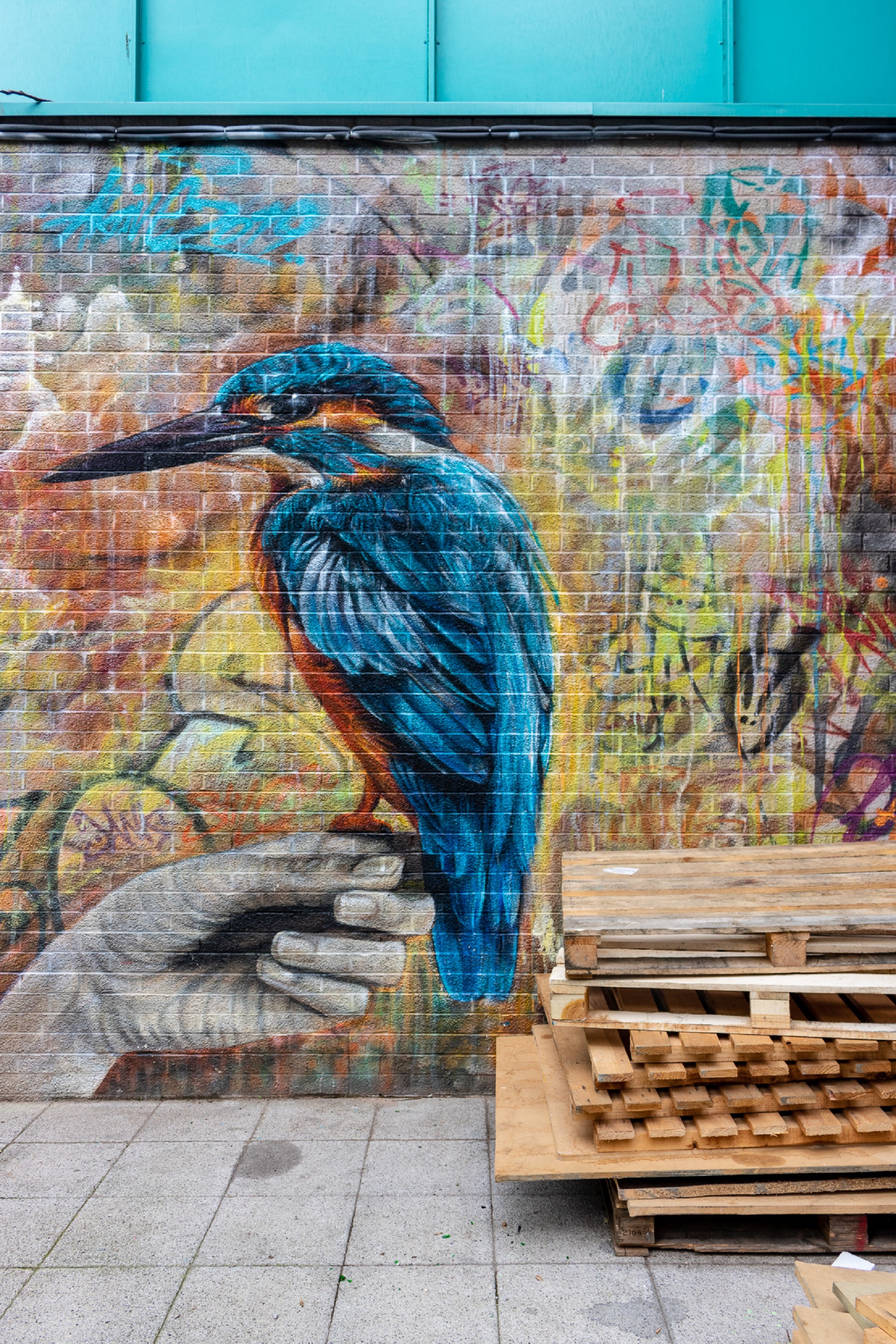
Kingfisher – This is a portion of a large scale artwork on Nelson Street, Bristol, by Nick Harvey (aka Kin-Dose), a Bristol-based street artist, specialising in large scale murals. The stunning realism of this work is simply breathtaking and the colourful Kingfisher stands out in striking contrast to the grey concrete and bricks. Finding this wild and beautiful creature in the context of a city wall speaks to me of our intrinsic longing to connect with nature.

©Juanita McKenzie
Humanity Wins – Neon sign in the window of Amnesty International in Hackney, London. Amnesty International is a global movement of more than 7 million people in over 150 countries and territories who campaign to end abuses of human rights. This is global social activism that campaigns to protect human freedom and dignity.

©Juanita McKenzie
What Do You See? – I noticed this paste up street art, just off Brick Lane. I could not see any identifying tag, however, this looks very much like the work done by street artist, My Dog Sighs. This wasn’t a particularly large artwork and it would have been easy to walk by without seeing it, however, I am used to looking very carefully while walking around this area. The detail in this is incredible and I was particularly drawn to the reflection in the eye, showing what is being seen. There is a tremendous sense of the search to find humanity in a world divided, a poignant and very evocative artwork.
 Journey Through the Lens
That was awesome. Excellent read.
LikeLike
Excellent read. Well done!
LikeLike
Thank you so much, appreciate it!
LikeLike