Visual Storytelling Workshop

As part of my ongoing personal development as a photographer, I attended an online workshop, the Social Documentary Photography Visual Storytelling Workshop. This was hosted by the Royal Photographic Society and presented by professional photographer and teacher, Stewart Wall. More information about his social documentary photography course can be found here.

The course was structured around three components:

  • Part one, imagining the photographic project – conceiving of an idea, making decisions on what the story is you would like to tell, planning out the project
  • Part two, creating the project – taking the images that you have envisioned and included in your plan.
  • Part three, completing the project – post production, sequencing and formats for presenting the finished work

Right from the start I found the course to be engaging and informative and I learned a tremendous amount from it that I will definitely be applying to my studies and FMP, as well as all future personal projects. We explored the work of other artists and how they have approached social documentary photography, how they have created compelling visual narratives and the various formats in which they have shared their final projects.

I was particularly interested in photobooks and zines as this is something I am considering for my Final Major Project. What stood out for me though, was the variety of different ways that a photographic project can be disseminated and shared with an audience – this can range from very simple artifacts such as postcards, to more complex projects such as books or documentary films.

Stewart encouraged us to think creatively about what we would like to document and tell a story about, as well as being creative and unique in the way we choose to present the project. He encouraged experimentation with methods, techniques and ideas that invite creativity and bring the individuality of the photographer to the fore.

We discussed a format and process for planning out a photographic project and deciding on what images to capture and include in a body of work in order to capture the narrative and visual story telling aspect. This process that we were shown really helped me to get an understanding of how to sequence my own photography to create a story or narrative.

As a group, we were given a brief and a task to work on using the techniques and methods we had learned. It was fascinating to see how everyone approached the task and how it was interpreted and expressed in very unique and individual ways.  The feedback session that followed was insightful and allowed us to share ideas and expand on them through group discussion. Below is the short project I created for the workshop:
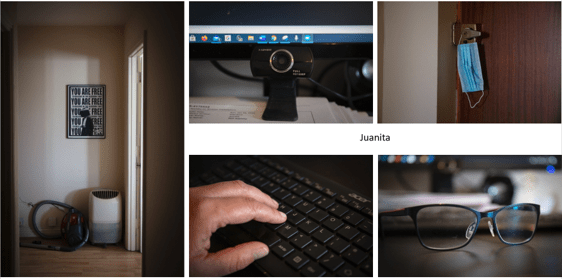
Working from Home 2020
©Juanita McKenzie

I chose to create a simple narrative depicting the reality of working from home as a part of life during the Covid-19 Pandemic. I chose to keep the images dark and shadowy to reflect the sombre mood and a sense of confinement.

I was definitely challenged to think outside the box and produce something different to what I usually do and I had a lot of fun working on the task.  I am reminded that it is always good to have personal projects to work on to allow creativity to flow without any pressure to produce something other than for the love of it.

This was an excellent workshop and it has definitely taught me the value of planning out my projects according to the narrative I wish to express and in line with the way I want to produce and share the project.

F22 Workshop

This week I attended the F22 – Survival Skills for Freelance Creatives Workshop in London as I was fortunate enough to be there at the time. I had seen the workshop advertised by the AOP and thought it would be invaluable for me as somebody who is planning to enter this market, and also felt it matched very well with this term’s coursework. The workshop was presented by Sheryl Garratt, previously the editor of The Face and The Observer magazine, and now a life coach working with freelancers and creative people.

In her workshop, Sheryl discussed the changing photographic market and the difficulties facing freelancers in the industry. She spoke of the constant pace of change and the lack of security in an industry that is in flux, as well as the impact of social media and the way in which ‘content creation’ threatens the photographic industry. This was confirmed by other people attending the workshop who have personally experienced this impact on their photographic careers.

One lady I spoke to was actually attending the workshop because she had previously worked as a freelance photojournalist but was no longer able to earn a living from this work due to the rise in citizen journalism and the use of image submissions from the public. She mentioned that both full-time and freelance jobs in this industry had been significantly reduced across the last decade or more. She was attending the workshop as she is hoping to take a new direction and break into the commercial photography market. It was very informative to hear from other photographers and people in the industry just how they were approaching their freelance work and where they felt the most impact.

Sheryl presented her workshop around ten core foundations that would assist in being successful in growing a business and doing the creative work that we love to do. Based on these principles I identified the following important steps I can take in developing my own freelance path:

  1. Get very clear on my creative vision, my reasons for doing what I do and what I hope to achieve.
  2. Create some great short descriptions of what I do and why I do it. Sheryl advises that we need to find ways of talking about what we do that makes it sound exciting.
  3. Marketing must become part of my daily routine as this is how I will get work.
  4. Do less and focus more on what matters. I would do well to simplify, streamline and focus my work in order to be more productive.
  5. I need to build up an effective working routine that suits my needs and this will increase my productivity.
  6. I should start a savings fund as this is what will give me the creative freedom to explore personal projects and have greater autonomy.
  7. It is essential for me to create a portfolio career, as multiple income streams are the only way to succeed as a freelancer nowadays. I will do some thinking about ways to do this and can also refer to our current coursework for ideas about other careers in the industry.
  8. Networking is extremely important, as is building peer support.
  9. Always invest in what I need to support my continued personal and business growth.
  10. Be realistic and manage my time and energy as this is my most important resource.

The workshop was a great experience as the content was excellent and I learned a number of important tips about how to find clients, how to manage my business and how to maintain a healthy balance between earning a living and doing what I love. It was also invaluable to meet other professionals in the industry, both to learn from them and to network among peers. For further information about Sheryl’s informative and insightful workshops and coaching, please visit her website.

Photography as a profession ©Juanita McKenzie