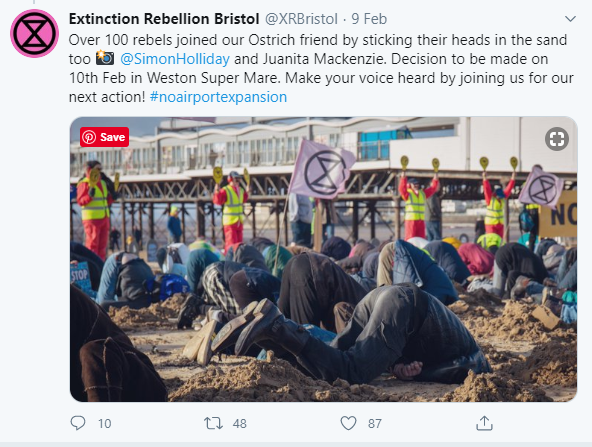
After attending the Extinction Rebellion Protests on 8th May at Weston-super-Mare, I was excited to find out that my image of climate protesters with their heads in the sand was shared by Extinction Rebellion Bristol on their official twitter feed.
Unfortunately, the original tweet had misspelled my name and this was duly shared in both newspapers with incorrect spelling. I also noted that the image which was shared was a very low resolution and the quality was poorer than what I would have provided had I been contacted.
Despite the error, I had a number of people contacting me through my own social media accounts to let me know they had seen the image in the newspapers. I was very pleased to see my image shared like this, however, I have learned a valuable lesson about making sure any image is credited correctly as it has a knock on effect across future publications.
Have you ever thought about how many photographic images you have seen in a single day? We are bombarded by visual stimulus and photographic images seemingly every minute of the day, from images on the internet, social media, newspapers, magazines, to posters and advertising billboards. The photographic image is everywhere I look, so much so that I do not always pay attention or think about the context in which I have seen photographs as they always seem to be in the background, something seen in passing.
One thing I do know is that most of what I see in these images will be partly fictional, edited in some way, enhanced with a filter, retouched to remove imperfections and framed to show the perfect setting or perfect light or perfect pose….and so it goes on. Social media is always guilty of creating ‘fictions’ as people portray the image they would like to express and they highlight their perfect lives and perfect moments. Just like in advertising, this is not the reality for the everyday person but rather a fictitious, constructed and enhanced reality.
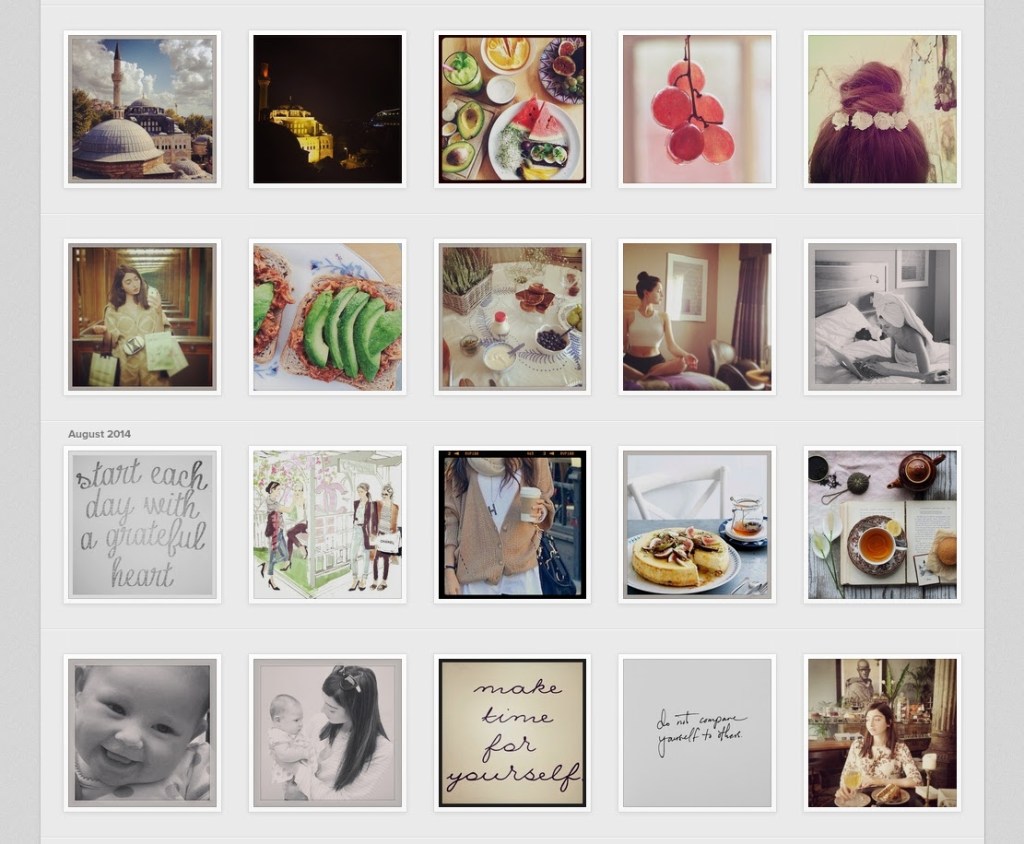
Amalia Ulman is a photographer who used Instagram to create an entire narrative around a fictional identity. In 2014, she used her social media profiles to stage a five-month scripted performance inspired by the extreme makeover culture. This was a project she called ‘Excellences & Perfections’ which explored the rise in social media, personal branding and lifestyle culture in a semi-fictional blend of her real life and online persona. The project can be viewed here: Excellences & Perfections.
This project emphasises how we cannot always discern between what is fact or fiction in the photographic image, or between which images are consciously made rather than taken. Quite often the photographic image is a combination of both and as a photographer, it is important to be able to recognise artifice versus authenticity and to be able to balance these within our own photographic practice.
Cindy Sherman is another well know photographer who constructed her images in a form of staged photography set up in a contrived environment but deliberately constructed to create the appearance of spontaneity. Sherman has always performed as the subject and becomes the characters of her works. She has created many different bodies of work exploring iterations of this idea and has completed many series, working with historical themes of portraiture, circus characters and the grotesque, and using a number of different props and techniques to create these images.
Linda Hutcheon (2003: 117) states that contemporary photography exploits and challenges both the objective and the subjective, the technological and the creative. In my opinion, the contemporary photographic artist will combine both constructed and authentic elements within their work, using both fictional and authentic components within their practice. It is about finding the balance between both aspects and creating an authentic narrative.
As my work is predominantly rooted in the urban landscape and some documentary photography, it is predominantly through the use of framing, editing and conscious use of camera angles that I may use some form of ‘construction’ within my photographic practice and perhaps this is a concept I could explore further by using different photographic media to create my images.
References:
Hutcheon, L. 2003. The Politics of Postmodernism. London: Routledge
This week our module leader, Anna, invited us to create Instagram accounts if we didn’t already have them and to think about a strategy for using them. I have already got an Instagram account and have been active for about 18 months. I have taken very readily to this platform and have found it to be an excellent means of networking, forming community, connecting with an audience and staying in touch with what is going on in terms of trends, events and so forth.
My account has a good following that has been grown completely organically without the use of apps or paid promotions at this point. It was simply a case of sharing content regularly, initially on a daily basis and engaging directly with my audience. This is really about relationship building and I think this is very important and I will always keep this personal connection no matter how big my account may grow.
I now don’t always post daily as it is not necessary to maintain and grow my audience, however, I do post consistently at least 2 – 3 times a week at times and days of the week that have proven to be my best for engagement. I have a good engagement rate as a result and this is important in getting work seen based on the way that algorithms work on Instagram.
I have recently switched to a business profile for my account but have it listed as a personal blog. I chose to make the switch so that I could use the paid promotion feature in the future as my research indicates this does bring results and puts your work in front of the right target audience. It is also an inexpensive way to market.
I am considering changing my profile to make it more professional but I am not sure how this will impact on my current audience as essentially this would be a re-branding exercise. I am still debating wither I should rebrand or open a second account for my professional Instagram presence. Many photographers have more than one account and say this works well for them.
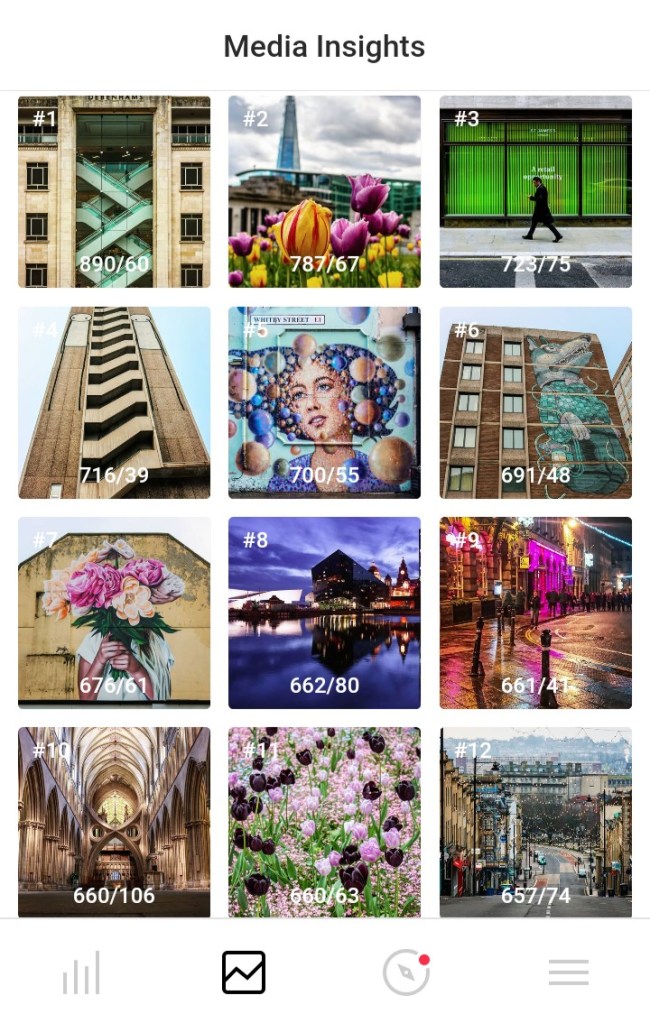
Lastly, I do make use of an app to track who follows and unfollows me as there is an annoying tendency on Instagram for people to follow and unfollow as a way to rapidly increase their following. I use the Instagram business account analytics feature to keep an eye on my engagement and to establish what content is working best. These are essential tools to assist with getting the right content to your audience.
Screenshot of my media insights tool showing likes showing the top posts and the number of likes and comments. These are useful analytics to work with. Instagram: @juanita_mckenzie_
Repeatedly through the course of this term and the previous one, we have at various times reflected on the impact of digital technology and social media on the photographic industry. On one hand, it has made the market very competitive and, some say, oversaturated with inferior quality images, but on the other hand, it has created a tremendous opportunity for photographers and visual artists to showcase their work and connect directly to their audiences and potential markets. Social media offers a very effective way to network online and connect with others on a global level.
Anna, our module leader, said that in her opinion Instagram is one of the most effective online platforms for photographers, providing opportunities that were not their previously. She discussed the importance and value of having an online presence and invited us to submit work to the University Instagram to be published online. This is something I will definitely consider doing in the future as I am already an active Instagram user. We also discussed the importance of having a strategy for Instagram and other social media as these are great marketing tools.
Reflecting on the topic for this week, I looked at where I am currently and where I imagine I would like to be in five years time. I am not yet a commercial photographer, so I do not have a current market, however, I do have a small and growing audience which has largely been gathered via social media, in particular, Instagram. My audience has good engagement with my content and there is a core group of loyal followers who consistently interact with my feed.
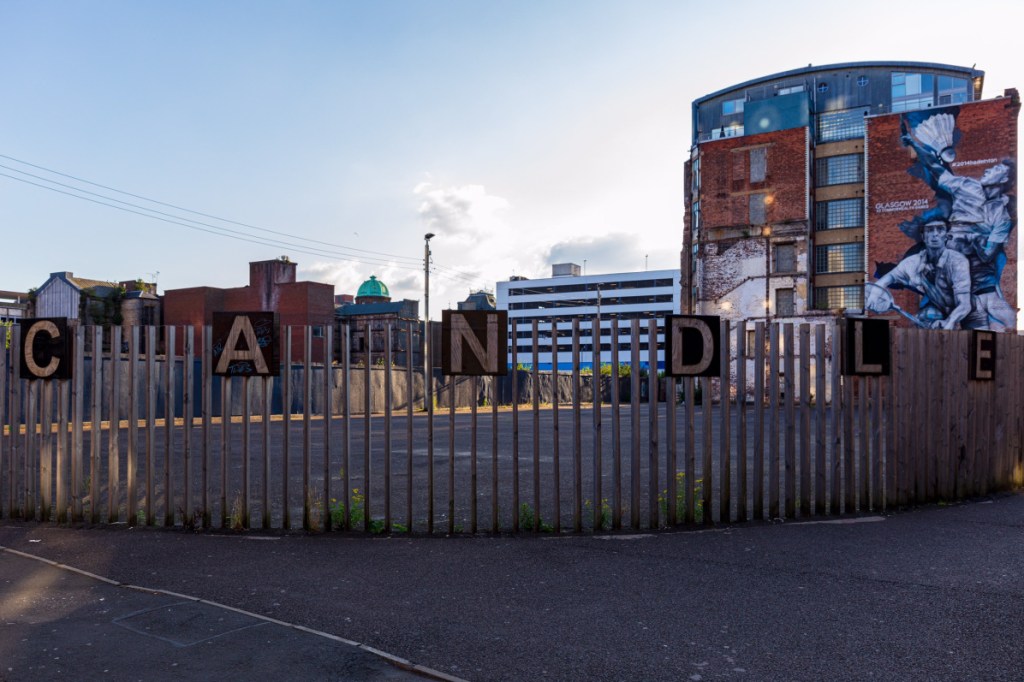
I started out sharing my photography on Instagram with no intention other than challenging myself to share my images and to make the commitment of sharing one image a day. I was stunned by the response and positive feedback I received as I had never considered the prospect of an audience, and was merely posting images for myself. This online platform has proven to be an incredible networking tool, helping me to connect to others and to form genuine relationships. Breaking Glass Magazine, who have recently shared some of my photography, are an example of the real networking, connection and community that I have discovered through Instagram. Below is one of my featured images from their October 2019 Anniversary Edition article which can be viewed here.
I do now look at things like engagement statistics because they are a good measure of whether I am consistently creating quality content for my audience, but also it is a great marketing research tool as it can give good indications of trends, preferences and audience loyalty. However, I do not measure myself by my number of followers and likes, but rather on the quality of real engagement and authentic connection that I can form with others, and by staying true to my own artistic vision.
I imagine that in five years time, my audience would have grown considerably and I would have expanded my presence across other online channels. I would also have begun to market my work and my personal brand through these channels and other areas that are industry relevant and which would place me in the correct market share for my work. Networking is as important online as in person, so this will be central to connecting me to my particular market and over time, my audience and market would begin to see some overlap.
This would be achieved by a strong business plan which incorporates a marketing, communications and social media strategy, alongside creating the quality content and photographic products that my market and audience would engage with. I am very interested in creating photographic books, selling prints and potentially doing freelance work for relevant publications, so my target market is easily defined. I would also consider teaching, running workshops and curating content as supplements to my income in order to be able to freelance and commit to my photography as a full time and commercially viable practice.


 Journey Through the Lens