Due to work demands, I was unable to attend the second group meeting for our Live Brief presentation which is disappointing. However, I did receive feedback from the rest of the group who felt it was a very positive session with some good points made. The webinar was recorded so I was able to watch it later and catch up.
Both tutors, Anna and Jesse, seemed to agree that they liked the concept of having both a video and photographic stills. They also both agree that Instagram is a good channel for our campaign but Jesse cautioned that we do need to be aware of its limitations. For example, he raised concerns about sound saying that many people will flick through Instagram stories without turning on the sound which means that the punchline of the video clip we had created would be completely lost.
To address this, he suggested that we would need to either go with an entirely visual clip or we would need to find a way to encourage viewers to use sound. Anna agreed but felt we should keep the sound and therefore rather encourage them to turn the sound on. Both tutors liked the choice of the video clip and appreciated our take on bringing awareness to the hidden aspects of brain injury.
Both tutors particularly liked the way that we were keeping our campaign ethical and novel at the same time through the combination of workshop (documentary style) and film/stills (editorial/advertising style). However, they felt that we were trying to do far too much in a single campaign, and needed to focus it by doing less. I agree very much with this feedback as I had felt we were going in too many different directions.
Overall, the group is very pleased with the feedback and we are in discussion about our next steps.
Although I am still finding my voice as a photographer, there are clear themes that have become central to my practice and which I will continue to explore and develop through my current and future projects. My area of focus is on life in the cities and suburbs of the UK and on urban photography as a genre. This is a relatively new and sometimes contested genre that has evolved in the last decade but one in which I feel I can locate my current photographic practice.
“In a nutshell, urban photography is more than typical street photography, because it includes everything that can be found within a modern city – architecture, decay, human subjects, various inanimate objects and all that is in between them – any kind of correlations, either figurative or abstract ones. Certain subcategories of socially engaged urban photography tend to be critical rather than simply consumable and they usually have a deeper meaning under the veil of appealing aesthetics. The best way to understand urban photography is to see it as a natural extension of street photography.” (Widewalls, 2016)
Locating myself contextually within this broad area of photography that incorporates so many different styles and contextual references, will allow me to create a visual narrative around urban life and key themes I’ve identified as inherent to modern urban life in the UK. Although I will be working within the scope of the local environment, these themes may touch upon issues that are reflected on a global scale and which are certainly linked to global changes, including issues such as gentrification.
I will focus initially on my local environment, the city of Bristol with a specific interest in the city centre, Stokes Croft and the neighbouring communities. Each of these areas of the city has a very unique and distinct character of its own and is either already experiencing rapid change or is likely to be threatened by it. In my explorations of the urban landscape, my observation has been that there is an architecture of change, a design to it – there is a cycle where places and communities are ‘forgotten’ or neglected and they are allowed to fall into neglect, decay and degeneration, which is then followed by rapid modernisation, ‘urban renewal’ projects and ultimately gentrification with no regard for the impact on the community or its wellbeing.
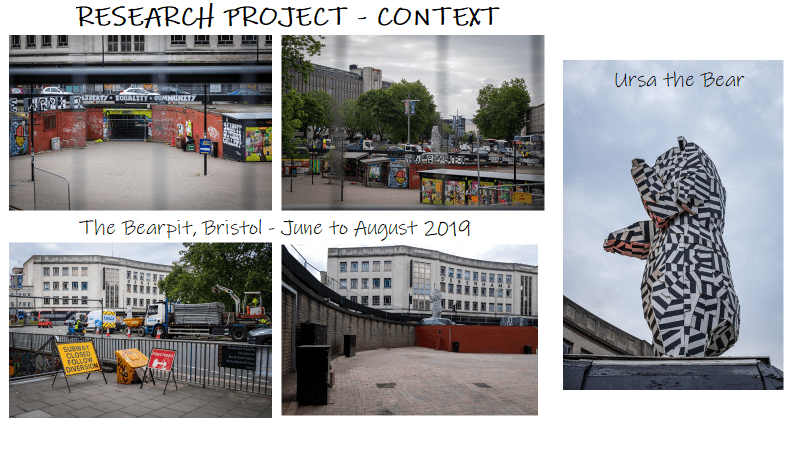
Based on this trend happening throughout UK cities, I see the same happening within Bristol. The unique character of Stokes Croft and the city centre are at risk of being lost to change, modernisation and cultural erasure. At the centre of these areas and inseparable from this issue, is a contentious underpass called The Bearpit which encapsulates the friction and tension building up within the city in the current socio-economic climate of inequality.
What was once a vibrant community project that had transformed a neglected underpass into a space that encouraged street art, freedom of speech with independent billboards and edible gardens, was impacted by austerity and the social issues it causes. In June this year, the local Council ‘locked it down’ after an incident, removing those who inhabited this space and stripping away all that was left in the Bearpit, including the street art. My theory is that this is the beginning of a process of gentrification that will extend from the Bearpit to Stokes Croft and the neighbouring areas. My project will involve documenting this process.
Snapshot of the project from previous term, showing the ‘lockdown’ of the Bearpit, stripping of the space, and Ursa the Bear, the last inhabitant of the Bearpit.
The nature of the Bearpit as an underpass, makes it an interstitial space that exists in a type of ‘no man’s land’ between places, yet at the same time it is the vital link connecting them. This embodies the concept of non-space, a neologism termed by the French anthropologist, Marc Augé and which refers to anthropological spaces of transience that do not hold enough significance to be viewed as places. Nonplace photography is an important component to my own photographic practice as these are so often the forgotten spaces of post-capitalist inequality, existing on the vague borders between neglected and decaying areas and the shiny structures of modern urbanisation.
I have observed that non-places and areas of urban degeneration tend to be areas that attract street art and graffiti, another aspect of the urban landscape to which I am repeatedly drawn and which offers an alternative form of social commentary about these spaces. Perhaps it is the illegal nature of street art that relegates it to the anonymity of non-spaces yet I propose that this in turn has transformed it into a unique subculture that has found a place within non-place. This is a concept I will also continue to explore within my local environment and other cities I may visit.
Left: Street Artist, Ben Eine’s work Last Days of Shoreditch refers to the rapid gentrification happening in this area. The images depict the brutal effects of these changes. Right: Street artists painting around the demolition site and making a statement about the changes to Shoreditch. Well known street artist, Stik, depicts this poignantly in his artwork: Past, Present and Future.
After the review with our tutors, we met to discuss the feedback and reach a decision on the concept of our campaign. We reached agreement around creating a video which would illustrate the hidden aspects of brain injury by using the concept of not always being able to see everything that is actually there. As a group, we took on board the feedback received from our tutor, Jesse, about making short video clips rather than one longer video. There were a number of ideas put forward and Oliver, who came up with the initial concept and has experience with creating video/film, will be working on creating the first video clip. Bloo also has film/video experience and has agreed to create storyboards to illustrate the other ideas for short clips.
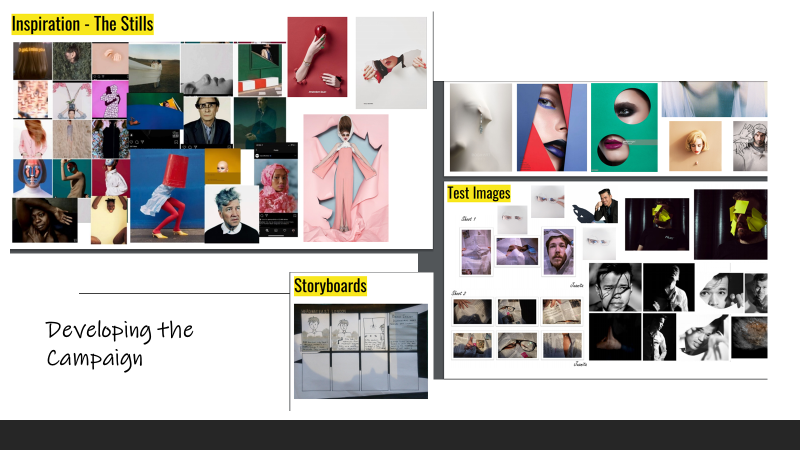
I expanded on the mood board concept that was introduced by Oliver previously and looked for images that represented the editorial look and feel that had interested our tutors and which also inspired us prior to the group meeting. We discussed this and came up with an artistic direction to try for the stills that we would use in the campaign – the approach would be to create images that showed our subjects ‘breaking through’ and emerging from paper or fabric to represent the experience of brain injury impacting on personal identity. In the group discussion one of the team members suggested doing a workshop with the members of Headway in order to create the photographic stills and possibly we could incorporate some of their artwork.
We each then created sample images for photographic stills which returned mixed results for various reasons. I was not happy with my image quality as I had to rush it to deliver on time while juggling work demands. I took quick ‘snapshots’ to illustrate my concept which was a person emerging through paper – I used newspaper because it was a resource I had, however, my vision was for our subjects, the members of Headway East London, to ‘emerge’ through paper covered in artwork they had created specifically for our project, in line with the workshop idea that we had discussed. I chose to repeat the concept with a second series of images which were actually self-portraits, something I have not done before as I am rather camera shy.
The other members produced images in their own unique styles, with Bloo cleverly emerging through white paper with reading glasses incorporated into the image, Oliver doing self-portraits with Stik-it notes on his face and our project leader, Raeann creating beautiful images working with a model. There was some stunning work produced but I felt we lost focus by working individually in this way as we have such varied styles and genres of photography. The ideas we have come up with as a result of this process are very creative and I still feel that we are working well together as a group, especially considering the challenges of working remotely from each other and juggling the demands of life, jobs and our coursework over and above this.
The one concern I have and which I raised with the group, is that I cannot see the link between our video concept and the photographic stills we are creating. This leaves me feeling there is a lack of coherence in the design of this pitch and it actually feels like we are almost creating two entirely different campaigns. We will continue this week to create more content for the presentation to put forward to the tutors next week and will start compiling a folder of the work that will be put into a presentation. I will not be able to attend the next group meeting due to work demands so this is rather disappointing but I will contribute as much as I can prior to the meeting and will rely on the group to update me on the feedback.
As part of the module, Sustainable Prospects, students have been given an opportunity to participate in a live brief. There were mixed feelings among the students, with many raising concerns about the workload for this term. Working on the live brief is voluntary so not all students have chosen to participate. I am also concerned about the workload and keeping up with everything during this term, however, I am very excited about the opportunity to participate in a live brief and have chosen to take part.
We had different briefs to choose from and these were for Oxfam, Headway East London and City ID who each presented a video for us about their respective campaigns. Although City ID was probably the most logical brief for me to choose, it was Headway East London that really drew me and I put this forward as my first choice to work on. I based my choice on the brief that I most wanted to work on and give me time to, the one that I connected to the most. Headway East London’s video was great and I really felt that I would be proud to work with this organisation and I absolutely support the great work that they are doing.
I was delighted to find out that this was the campaign I was allocated to with three of my fellow students – Bloo, Raeann and Oliver. We have set up a WhatsApp group and have planned our first meeting as a group to do some initial brainstorming and discuss our next steps. It was a great way to start as everybody in the group seems very enthusiastic about this project and eager to pitch in and do the work. We will need to deliver the live brief for a pitch within 9 weeks and I look forward to working on this as a team.
Visit the website to find out more about this local charity and the amazing work they do.



 Journey Through the Lens