Rethinking Photographers

There are many opinions about photographers (some positive, some negative) and they’re not always accurate. The perception of photographers and what they do is heavily influenced by the media and other mainstream ways in which photography is portrayed, for example in news, film and advertising. These are often based on stereotypes, particularly those around gender stereotyping. Sometimes photography is portrayed as being an exciting, adventurous and highly paid profession with an accompanying lifestyle, or it can be portrayed as a ruthless, voyeuristic and dishonest profession.

This excellent video created by Mishka Henner and David Oates looks at the way photographers have been portrayed in film by creating a clever montage. Their introduction to the video is very apt:

“Voyeur, hunter and investigator are just a few of the roles that have characterized the photographer when depicted in modern cinema. In Photographers, hundreds of scenes involving this now ubiquitous character are remixed and re-sequenced to expose the clichés, tropes and accidental truisms associated with the medium. As the sole subject of the film, the photographer is turned from observer to observed.”

Advertising for cameras has always portrayed the camera equipment as being the key to successful photography, however, now more than ever with such rapidly changing digital technologies, there is a constant emphasis on the value of the equipment in creating professional images. The aim is to encourage purchasing and upgrading to new equipment and to do so means creating a hype around the value of the camera, rather than the value of the photographer. This puts tremendous pressure on photographers to keep up with the newest and latest equipment in order to compete with what is out there and also diminishes the value and skill of the photographer.

Smart phone technology has gone hand in hand with the rapid rise in social media use and has created a digital culture of image sharing and content creation. The capabilities of smart phone cameras have been developed to the point that many people no longer use cameras and indeed that’s the way the technology is marketed. There is a tendency for the technology to be marketed in such a way that it implies anybody with a good camera or smartphone can be a good photographer. This has resulted in our day to day lives becoming saturated with average images that can completely obscure real photography and visual arts.

I have chosen to work with digital technology and use a DSLR camera because of the image quality and the immediacy, however, there is a part of me that wants to explore analogue as an artistic medium and return to the older technology for the enjoyment of the process and the distinct style of analogue images. There is a growing trend towards retro cameras with new Polaroid type cameras and other retro styles becoming very popular. Personally, I would prefer the original technologies rather than new versions created to look old as it lacks authenticity.

I have readily embraced social media as a means to showcase photography and have enjoyed the experience so far. I have learned that there is a lot more required than good photography in order to succeed on social media, so this can be challenging initially when starting out. There are many large accounts on social media that are about content creation and I have repeatedly seen that the most successful ones are those that have strong personal branding.

I believe these days it is essential for photographers to have an online presence as this is where the audience is located, and also where the photographer’s work can be found by potential clients. The caution is that it is a highly competitive and saturated market, so it is essential to plan content and share high quality, memorable images that will not only stand out from the rest, but will also showcase the photographer’s personal style.

It is a constantly changing visual world with rapid advancements in digital camera and smart phone technology and the subsequent rise of social media. Photographers could easily become lost amid the constant visual noise so they need to always be creating, adapting and competing in this digital arena. The perceptions are quite often that photographers are not highly skilled and people are not always willing to pay for photographic services or products when they believe they can do just as well themselves.

It really is essential that photographers rethink where they are positioning themselves in the market, what they are offering and how they can adapt to the changing terrain of visual art and technology. It is also vital that photographers think about their personal branding, what visual language they are using and how they are being perceived.
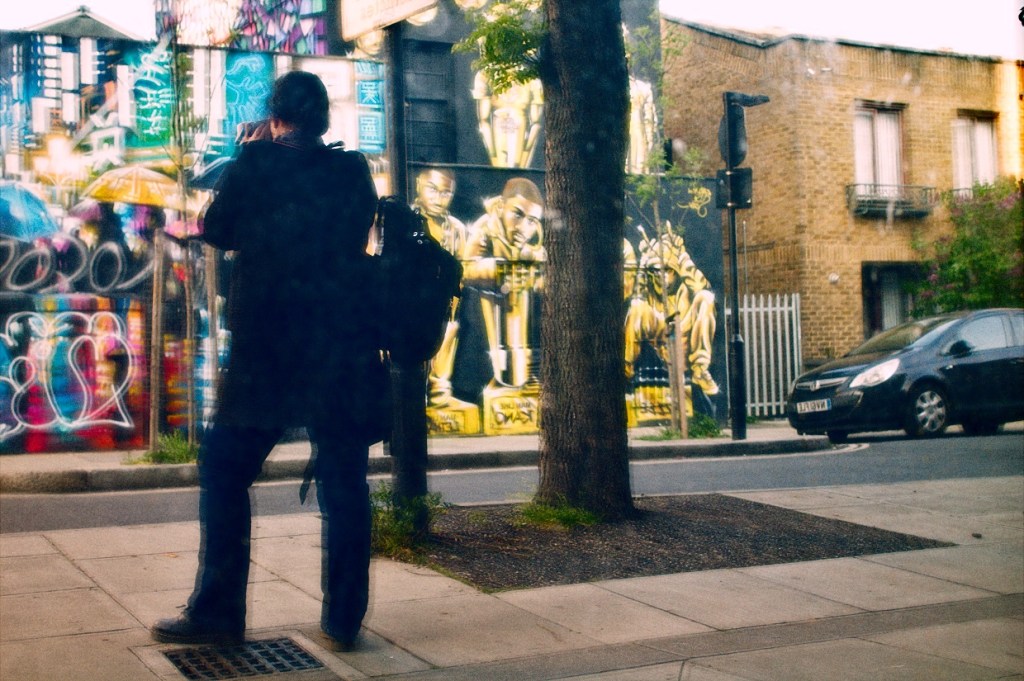
Artistic shot of me photographing street art in the rain. Photo by K.Magro

Journal Reflection – Positions and Practice,Week 2

Having explored the concept this week of photography as an interdisciplinary field, I’ve spent some time reflecting on whether my current photographic practice is interdisciplinary and how I could expand further on this.

I am already focusing on aspects of documentary photography which may have its roots in early interests in journalism and film. Social and cultural commentary are present in my work already and this draws upon earlier studies in psychology. Within my current practice I explore urban art as an integral part of the urban landscape and the social commentary it provides.

I would like to expand my practice by learning more about Fine Art photography and how this can be combined with street and documentary photography to create something more contemporary. I would like to explore surrealism, Bauhaus and expressionism as art movements that could inform, develop and deepen my photographic practice.

My interest in the urban landscape is closely linked to the architecture of places as well as the historical, cultural and geographical elements within these landscapes. Studies and research across all these areas would be extremely useful for contextual research and project development.

László Moholy-Nagy, Bauhaus balconies in Dessau, 1927.
© László Moholy-Nagy 

An Unruly Discipline

Photography as a discipline has changed rather rapidly throughout it’s history and even more so since the advent of digital technology. It has been influenced by a number of different disciplines, such as art, film, and literature. It has also had a strong relationship with technology and, since the early inception of the Camera Obscura to the DSLR and smart phone technologies of today, it has been influenced by the available technologies. As there are so many different photographic tools available, there is a tremendous variance in method, technique, processing and product within the discipline of photography.

Photography has also been used in a number of different ways, making it difficult to define it as a discipline. It has been used by the arts, news, military, science, forensics, research and documentary fields, all with very different purposes and processes. Photography has also been used to create technologies like x-rays and infra-red, that have been used in the fields of medicine or military technology. More recently infra-red has been used artistically by photographers to create stunning, almost otherworldly images that are the result of a the crossover between science and art.

Edward Thompson.The City. Studies in pollution #1, North Circular (2014)
© Edward Thompson

Photography also cannot be separated from the arts, such as fine art, stills, cinema and architecture. Not only has it drawn inspiration from these arts, but it has also influenced them, illustrating the interrelationship between these fields. Anthropology, archaeology and the social sciences have also worked with photography resulting in a relationship between photography and cultural, historical and geographical influences.

As a field photography is an unruly discipline as it refuses to be limited or confined by the boundaries and prescriptions of a single discipline. It is by its very nature an interdisciplinary field that is constantly evolving and dynamically responding to the changing world we live in.

References: https://www.designboom.com https://edwardthompson.co.uk

Submissions – Cranes

Cranes at Prince’s Wharf, Bristol – February 2019, taken with Sony Xperia ©Juanita McKenzie

In late June 2019, fellow students doing their MA studies in Photography at Falmouth University were tasked to produce a zine, compiled of images from interested participants. The theme they chose was industrial cranes with images shot using a smartphone. I knew I had some eligible images and submitted these in support of their project. The final zine has been compiled and has some stunning images of various cranes. It is well worth a look and can be viewed here: crane-machine.

Thinking Away From Photography

The coursework this week set a task of finding a piece of work that was not a photograph but which linked in some way to our own practice or research interests. I actually found this to be quite a difficult task, not because of thinking away from photography, but rather because of the amount it revealed.  I realised that there are a number of influences in my photography and in my life, some of which go quite far back.  These influences range across music, films, art, documentaries and many different genres but through exploring these in the context of this discussion, I realised there is a common thread. 

From Blake to Banksy….poetry to graffiti….what is the connection?  For me it began a long time ago with William Blake’s ‘Songs of Innocence and Experience’, a collection of poems that show two very different states of the human experience and reflect upon the inequality inherent in the industrial society of that time.  Banksy on the other hand, is one of the most controversial and well known street artists of our times. His work is often political and satirical, critical of authority, inequality and the human suffering that results. This is the theme that I have found in common across the many different artists or genres that influence my own practice or research interests.

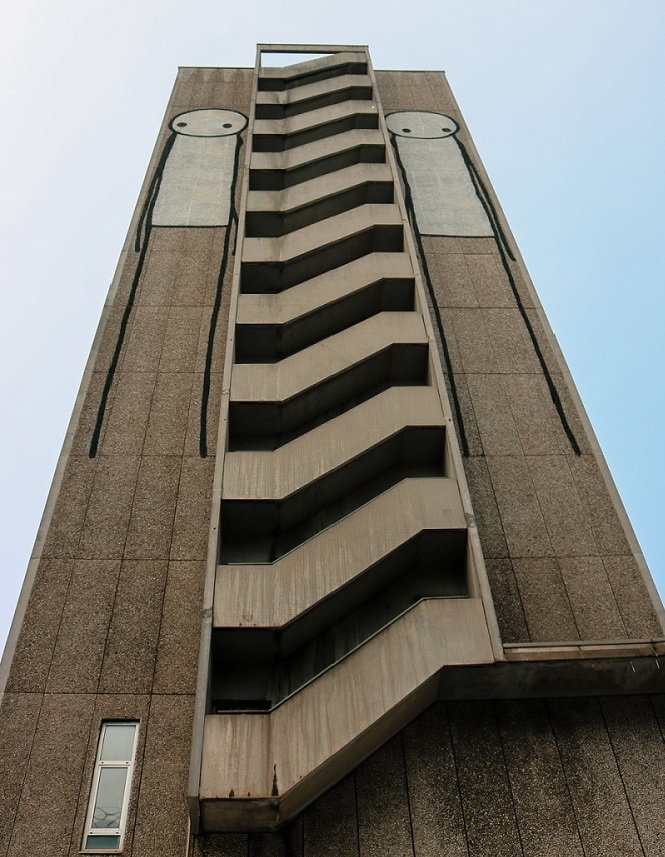
Looking at my current work, street art is one of my research projects and one of my favourite street artists is British street artist, Stik. His work has definitely inspired me to photograph the streets, the street art that appears there, the people that live in these areas, the urban environment and the relationship people have with it, as well as to capture the character of places before they are gone.  In a way I feel that photography is a means of documenting the rapid changes happening in our cities and communities, but also preserving something of them before they are gone. 

Large scale mural by Stik - Nelson Street, Bristol  ©Juanita McKenzie
Large scale mural by Stik – Nelson Street, Bristol
©Juanita McKenzie

Stik uses simple stick figures to convey meaning through simplicity – the subtle bend in an arm, or position of the dot for an eye, can convey so much expression and emotion.  He makes use of colour, line and environment to create artworks that represent the community and reflect the vulnerability of the human being while also giving hope.  His artwork has not only inspired me but has also been a source of tremendous comfort and joy to me at various times in the past few years. (This is discussed in my oral presentation which can be found here).

I feel a connection to Stik’s artwork because in my own practice, I also try to capture similar themes in my photography – the vulnerability of people in the harsh environment of the city, the inequality and contrasts that are so much a part of urban life (really a microcosm of the global inequality), but also the tremendous courage, community and spirit that arises from this. 

I hope to capture the vulnerability but also the fragile beauty in the cities, the dialogue between the opposites, the dance between old and new, the tension and friction, and the constant process of metamorphosis. 

The clip below is by Stik and discusses some aspects of his work and community: 

Visit Stik’s website for further information about his work: http://stik.org/