As I completed the assignments for this module after a difficult term and amidst the changes happening in the world around me, it heightened my awareness of the amount of change that has happened and the enormity of it’s impact. My project began as an exploration of change and impermanence and this has indeed been the outcome. Sadly, I feel it is time to pause this particular project and consider whether I am able to progress it into the Final Major Project or whether I will need to rethink this.
My work in progress portfolio is a continuation of the portfolio’s submitted across the past terms and reflects the change across a period of time. The work in progress can be viewed here.
As part of our coursework we are being encouraged to explore Strategies of Freedom – the photographer’s relationship to the apparatus. This was a very interesting exploration as it challenged me to think beyond the camera and it’s prescribed way of working, to think of creative strategies to expand beyond its boundaries.
I regularly challenge myself in my own practice by making myself to work with a different lens to my usual preferred ones as it means I have to think and consider the way I am approaching my photography. I like to work with prime lenses so that I have to move around to find my composition and frame it the way I envisage it creatively.
I would like to explore different formats and have considered polaroid as an option, along with experimenting with 35 mm expired film to achieve interesting and unexpected effects. I have not considered any of these for my current project as they didn’t seem like suitable choices for what I was hoping to achieve, however, these could be an excellent fit for other landscape photography projects that I have in mind.
I feel that I have lost my creativity with my project and perhaps this has been due to feeling uneasy with the project itself and questioning whether this is the correct one for me to pursue. I also feel that I have limited myself in terms of technique and approach to my subject matter. This is something I will need to consider prior to my Final Major Project as I will need to find ways to stimulate ideas and create art.
In the meantime, I have found it helpful to work on other projects purely for the fun of it and to create a visual journal for myself as a way to experiment with my photography and approach it in a less serious way.
Prior to the start of this module, we were invited to participate in a voluntary challenge inspired by the work of Ed Ruscha. The aim of the task was to produce a series of images as a small book, inspired by one of Ed Ruscha’s.
In responding to this challenge, I chose to work with an interpretation of Ruscha’s book: Some Los Angeles Apartments, 1965. I decided to choose a similar subject but one which would be related to a current theme: the impact of Covid-19 reflected in the local pubs that were closed as a result of lockdown measures. I planned a route to walk and took all the photographs on the same day of a selection of closed up pub buildings.
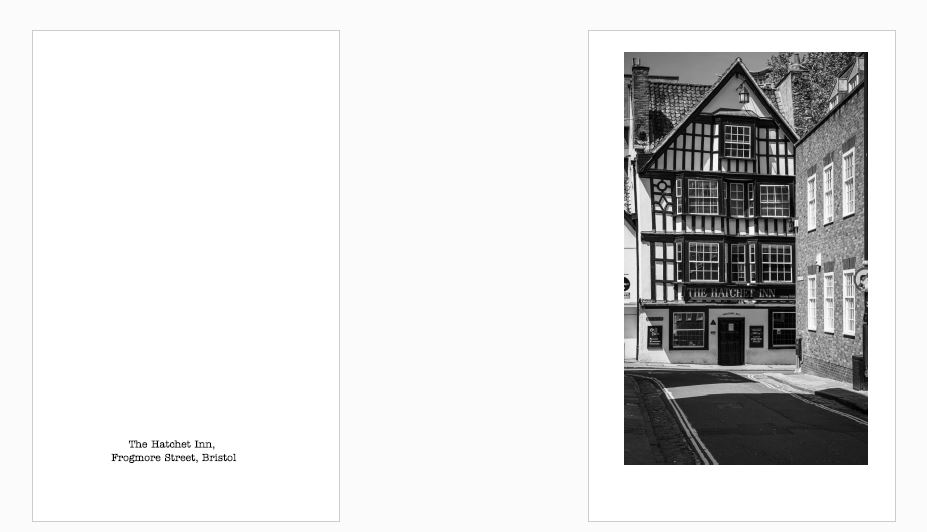
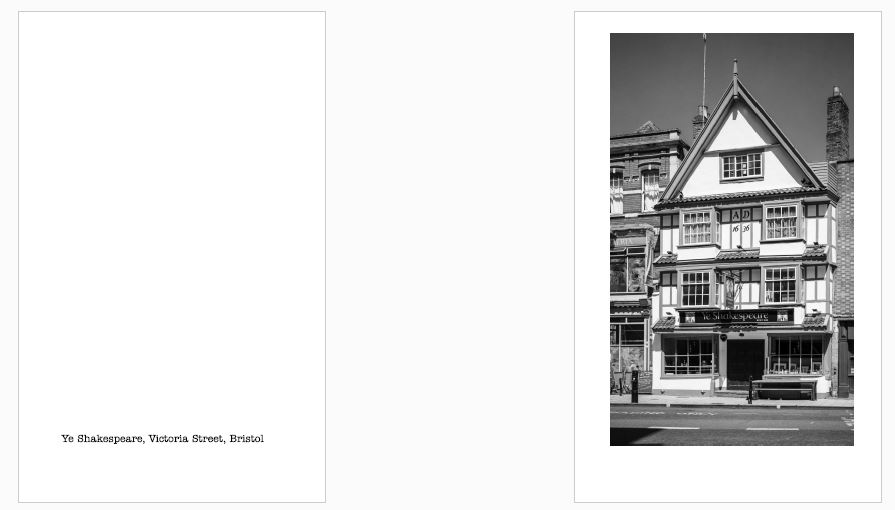
I chose to produce my images in black and white and to format their layout in a very similar style to that used by Ruscha in this particular book. Staying with this style, I used very little description and simply provided a caption in a plain font that stated the pub name and location. I titled the book in the same style font and layout as Ruscha’s and titled my book project: Some Bristol Pubs in Lockdown
I have been fascinated with the work of Ed Ruscha for some time and was also fortunate to view his exhibition at the Tate Modern earlier this year (see previous post), so this challenge was one I really looked forward to doing as I have found a lot of inspiration in his work. In approaching the challenge I opted to print a book that would look very similar and would draw upon Ruscha’s use of typography, layout and simple captions. I usually work in full colour but opted to work with black and white images not only to stretch my creative abilities but to create something similar in feel to those created by Ruscha. Below are some samples from the book that I printed.
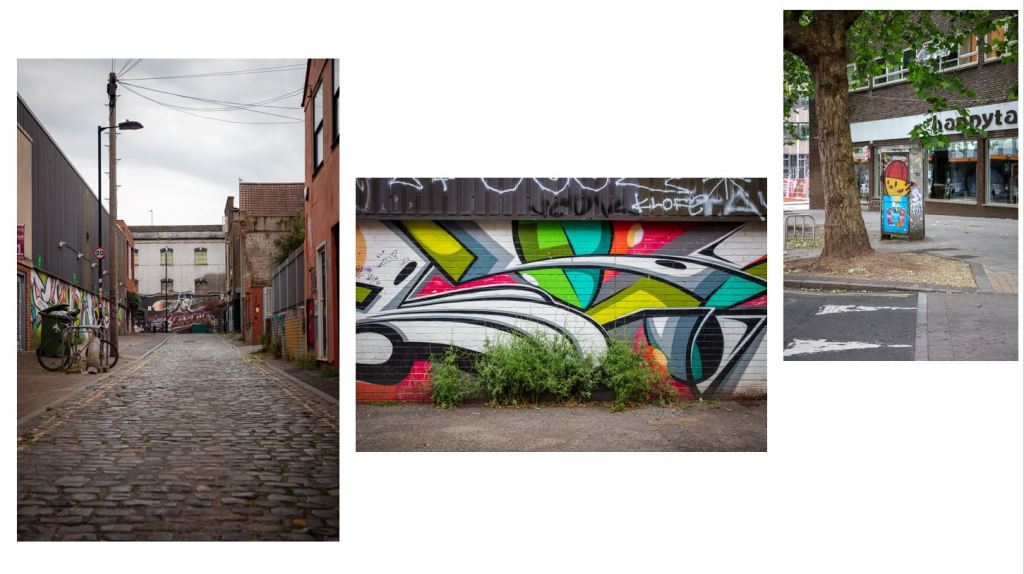
My research project based on The Bearpit and Stokes Croft was extremely challenging in these past months due to illness and then followed by the circumstances of Covid-19 Lockdown. The work in progress portfolio can be viewed here.
The context in which we both create and consume photography is constantly changing and transforming, opening up new possibilities and directions.
Price, 1994, states that the use of the photograph determines it’s meaning. In other words, the context in which we view the image determines its meaning. This is illustrated very well in the Benneton Advert which formed part of their controversial 1992 ad campaign which used an image by journalism student, Therese Frare, originally published in November 1990 LIFE Magazine. The original black and white image was of gay activist and AIDS victim, David Kirby, as he lay on his death bed. Two years later this image was recolourised by artist Ann Rhoney and used by Benetton in its campaign.
Different groups had different reactions to this image, however, it received a lot of heavy criticism and backlash as it was perceived as spreading fear and profiting from the suffering of others. Yet David Kirby’s own parents had consented to the use of this image, as did the photographer, who believed this was a powerful message to raise awareness. Benetton themselves stated that this was the first public campaign to address AIDS and was intended to show solidarity. It is obvious there were different perceptions surrounding the way the image was portrayed.
Benetton often used pseudocumentary style images in their advertising campaigns and many of their adverts have been highly controversial, drawing different responses from different groups of people. Their campaigns often need to be looked at on a deeper level to understand the meaning. I don’t personally find their images offensive, instead I view them as provocative and challenging, inviting the viewer to connect with the concept and engage with it.
Reaction could thus be considered a success as it has evoked emotion and engagement. More thoughtful analysis of their adverts, however, would lead to a response rather than a reaction. Their campaigns certainly illustrate how meaning can be interpreted by the viewer and also by the context in which the image is placed. These images were likely to have been judged much more harshly when viewed as advertising and seen in the context of magazines, than if they were seen in the context of documentary photography or art. More of their historic campaigns can be viewed on their website: Benetton Group.
In looking at my own photographic practice and the context in which it is created and potentially received, I relate very strongly to this quote by Barthes, as it is closely aligned to my own relationship with photography and what I attempt to convey in my photographic practice:
“The photograph is a message. Considered overall this message is formed by a source of emission, a channel of transmission, and a point of reception.” (Barthes, 1977, p.15).
My own practice is located predominantly within documentary style and urban landscape photography, both of which could be consumed through the format of printed photographic images, either as part of a collection, exhibition or individual prints, or within the printed format of a photographic book. No doubt there are other contexts to consider but these are what I feel are most suited to my particular practice.
In considering how my photographic practice may be received and interpreted by viewers, I believe that the context is very relevant and relates to the audience or consumer of the work. An example of context is apparent in the feedback I received for last term’s Work in Progress. The tutors felt it was repetitive in places, and needed more depth and experimentation.
I had shown this work to others prior to submitting the assignment and received different responses from them. What I noticed was that people who lived in Bristol and weren’t photographers all felt a sense of sorrow within the images and knew exactly what the series of images was about. This led to them relating to the images and expressing their own feelings about the space being depicted and the events surrounding the images.
I also showed these images to people who were photographers but didn’t know the story behind the images. Most of them picked up on the narrative by spotting the clues in the images – things such as the changing seasons, the colour yellow and the link to the yellow lines, the strong sense of desolation and loss, and of course the missing bear.
What is very apparent is that there were three different perceptions and sets of responses to the same images based on the context in which they were viewed: critically as part of the MA Photography assignment, emotionally by people who lived in the area and related to the story, and technically by other photographers. This is something I will always need to consider when creating photographic projects and when making decisions about the context in which they will be consumed and who the audience is intended to be.
Resources:
Barthes, Roland (1977). ‘The Photographic Message’ in Image Music Text. London: Fontana.




 Journey Through the Lens