Research Methods

The project I have proposed to work on is centred around the idea of impermanence and how this is expressed in the context of the urban environment.  I intend to explore the relationships between people, place and psyche through the concept of nonplace, impermanence and the architectural language of change.  I will mostly be exploring this within my local environment but also within any other cities or suburban landscapes that I may have the opportunity to explore.  The project will progress in stages across the different course modules and I am open to the idea that it could even change as I progress.

As part of my project I will be referring to a number of different sources to provide the contextual research that will underpin my work.  Some of this will be achieved through reading a variety of different books, articles and periodicals, as well as doing online research around the genre of urban photography, the techniques used, projects around similar themes,  and the work of photographers that inspire me or from whom I can learn. 

Robert Frank is one of a number of photographers whose work inspires me and is relevant to my current project.  He was an immigrant to America and set out on a two-year road trip to photograph the real America from the viewpoint of an outsider.  This resulted in his 1958 book called The Americans.  For Robert Frank, his work itself was the research, depicting a raw and honest documentary of America at that time. 
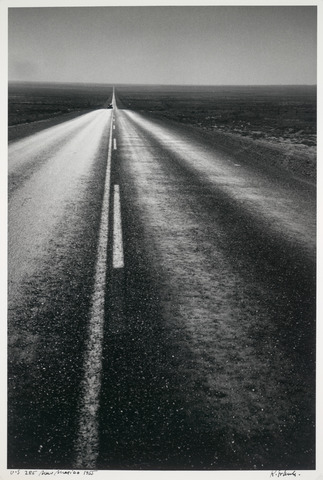

Robert Frank, U.S. 285, New Mexico, 1955. Photograph © Robert Frank, from The Americans

Lewis Bush is another photographer whose work is of great interest to me as he explores issues of gentrification, capitalism, urban change and the political context of urban landscapes.  His book, Metropole, is about the changing face of London in the context of global capitalism and how this drives modern property developments, gentrification and displacement of people.  Lewis Bush does a vast amount of research during his various projects and brings together knowledge and research in the fields of economics, politics, journalism, technology, art and history. 

Lewis Bush, Untitled, 2015 © Lewis Bush, from Metropole

I will be referring to the work of French anthropologist, Marc Augé, around the concept of non-place and will do further research on any other artists working with this concept, as well as any relevant sources within the fields of sociology and anthropology. The concept of psychogeography is another area for potential research that may bring a different aspect to my project.

Lastly, I plan to incorporate literature into my background research, and hope to find time to read some of the works by authors or poets, such as William Blake, who write about city life and the contrasts, paradoxes and changes inherent to it, as well as referring to other written or visual works that explore our relationship with the landscapes we explore, inhabit or interact with in some way.   

Another important aspect to my research will be the practical context of physically exploring the urban landscape to gain knowledge of it, as well as attempting to engage with people in these landscapes and communities.  This supports a practice-based approach to my research, as well as supporting a constructivist research methodology. 

These are perhaps ambitious plans for my research as time is always a constraint, however, I don’t see the research as being limited to only this semester of the course, but rather an ongoing process that will continue to inform, develop and evolve my project.

Power and Responsibility

Just as photography can have a positive social and political impact, so too there is equal potential for it to be used in negative ways.  Issues around power, responsibility and ethics are extremely important areas for photographers to consider. 

 “Photographs really are experience captured, and the camera is the ideal arm of consciousness in its acquisitive mood. To photograph is to appropriate the thing photographed. It means putting oneself into a certain relation to the world that feels like knowledge — and, therefore, like power.” – Susan Sontag, On Photography, 1977, pg 3-4

Both commercial and documentary photography are fields that are frequently criticised for the objectification of the subject and the misuse of the way in which the subject is portrayed and, indeed, the sense of ownership that is attributed to both the image and the subject by the photographer or by the commercial institutions that gather and commission images. However, these are issues that are not solely confined to these specific fields and need to be considered in all areas of photography. 

As photographers we need to consider very carefully why we are choosing to take a photograph of a particular subject and why we choose to take it at a particular moment in time.  The moment of decision and the selection of a particular moment in time to capture, is in itself an act of power.  The concept of the decisive moment was first proposed by Henri Cartier-Bresson in 1952 and has since been largely misunderstood by photographers and photojournalists as being a technique to be employed in the pursuit of the perfect image rather than a reference to the sensitivity that is required by the photographer in deciding when to take an image. 

His work, widely published in magazines and in a series of superb books, only rarely reported newsworthy events. It provided, rather, a broad description of a place, its people and culture, and the texture of its everyday life. And it helped create the image of the photojournalist as an alert and sympathetic, but also knowing and detached, observer — an image that dovetailed neatly with the notion of the “decisive moment” and in the process limited its meaning. Under the rubric of photojournalism, the decisive moment is not only a pictorial climax that yields a satisfying photograph but also a narrative climax that reveals a truth about the subject.” – Peter Galassi, Henri Cartier-Bresson: The Early Work, Peter Galassi, pg 9

We also always need to remember that without context an image can be misused or misrepresented, therefore, as photographers we need to consider very carefully how an image can be interpreted, or misrepresented outside of the original context and meaning.  We have to take responsibility for how the subject is portrayed and how the image could be used, manipulated or interpreted. 

An example of this is photojournalist Jeff Mitchell’s image of refugees crossing from Croatia to Slovenia in October 2015 which was used controversially by the UK Independent Party during the 2016 referendum campaign to leave the European Union. This is discussed in greater detail in an interview published in The Guardian newspaper which can be viewed here.


Refugees cross from Croatia into Slovenia in October 2015 (c) Jeff Mitchell/Getty Images https://goo.gl/gtrmU6

This is not to enter into political discussion or to debate this particular incident, nor is it a criticism of Jeff Mitchell who I do not believe anticipated such a use of his image. Rather, this is to emphasise that as photographers we have to consider very carefully where we sell our work and just how much ownership of it we are prepared to give away. We always have a moral and ethical responsibility that is implicit in our work which means we need to be aware of the nature of any contracts we enter into, whilst also being aware of the power of the image and the way it could be used.

References: Galassi, P. (1987). Henri Cartier-Bresson: The Early Work. New York: The Museum of Modern Art. Sontag, S. (1977). On Photography. London: Penguin Books The Guardian: https://www.theguardian.com/artanddesign/2016/jun/22/jeff-mitchells-best-shot-the-column-of-marching-refugees-used-in-ukips-brexit-campaign

Rethinking Photographers

There are many opinions about photographers (some positive, some negative) and they’re not always accurate. The perception of photographers and what they do is heavily influenced by the media and other mainstream ways in which photography is portrayed, for example in news, film and advertising. These are often based on stereotypes, particularly those around gender stereotyping. Sometimes photography is portrayed as being an exciting, adventurous and highly paid profession with an accompanying lifestyle, or it can be portrayed as a ruthless, voyeuristic and dishonest profession.

This excellent video created by Mishka Henner and David Oates looks at the way photographers have been portrayed in film by creating a clever montage. Their introduction to the video is very apt:

“Voyeur, hunter and investigator are just a few of the roles that have characterized the photographer when depicted in modern cinema. In Photographers, hundreds of scenes involving this now ubiquitous character are remixed and re-sequenced to expose the clichés, tropes and accidental truisms associated with the medium. As the sole subject of the film, the photographer is turned from observer to observed.”

Advertising for cameras has always portrayed the camera equipment as being the key to successful photography, however, now more than ever with such rapidly changing digital technologies, there is a constant emphasis on the value of the equipment in creating professional images. The aim is to encourage purchasing and upgrading to new equipment and to do so means creating a hype around the value of the camera, rather than the value of the photographer. This puts tremendous pressure on photographers to keep up with the newest and latest equipment in order to compete with what is out there and also diminishes the value and skill of the photographer.

Smart phone technology has gone hand in hand with the rapid rise in social media use and has created a digital culture of image sharing and content creation. The capabilities of smart phone cameras have been developed to the point that many people no longer use cameras and indeed that’s the way the technology is marketed. There is a tendency for the technology to be marketed in such a way that it implies anybody with a good camera or smartphone can be a good photographer. This has resulted in our day to day lives becoming saturated with average images that can completely obscure real photography and visual arts.

I have chosen to work with digital technology and use a DSLR camera because of the image quality and the immediacy, however, there is a part of me that wants to explore analogue as an artistic medium and return to the older technology for the enjoyment of the process and the distinct style of analogue images. There is a growing trend towards retro cameras with new Polaroid type cameras and other retro styles becoming very popular. Personally, I would prefer the original technologies rather than new versions created to look old as it lacks authenticity.

I have readily embraced social media as a means to showcase photography and have enjoyed the experience so far. I have learned that there is a lot more required than good photography in order to succeed on social media, so this can be challenging initially when starting out. There are many large accounts on social media that are about content creation and I have repeatedly seen that the most successful ones are those that have strong personal branding.

I believe these days it is essential for photographers to have an online presence as this is where the audience is located, and also where the photographer’s work can be found by potential clients. The caution is that it is a highly competitive and saturated market, so it is essential to plan content and share high quality, memorable images that will not only stand out from the rest, but will also showcase the photographer’s personal style.

It is a constantly changing visual world with rapid advancements in digital camera and smart phone technology and the subsequent rise of social media. Photographers could easily become lost amid the constant visual noise so they need to always be creating, adapting and competing in this digital arena. The perceptions are quite often that photographers are not highly skilled and people are not always willing to pay for photographic services or products when they believe they can do just as well themselves.

It really is essential that photographers rethink where they are positioning themselves in the market, what they are offering and how they can adapt to the changing terrain of visual art and technology. It is also vital that photographers think about their personal branding, what visual language they are using and how they are being perceived.

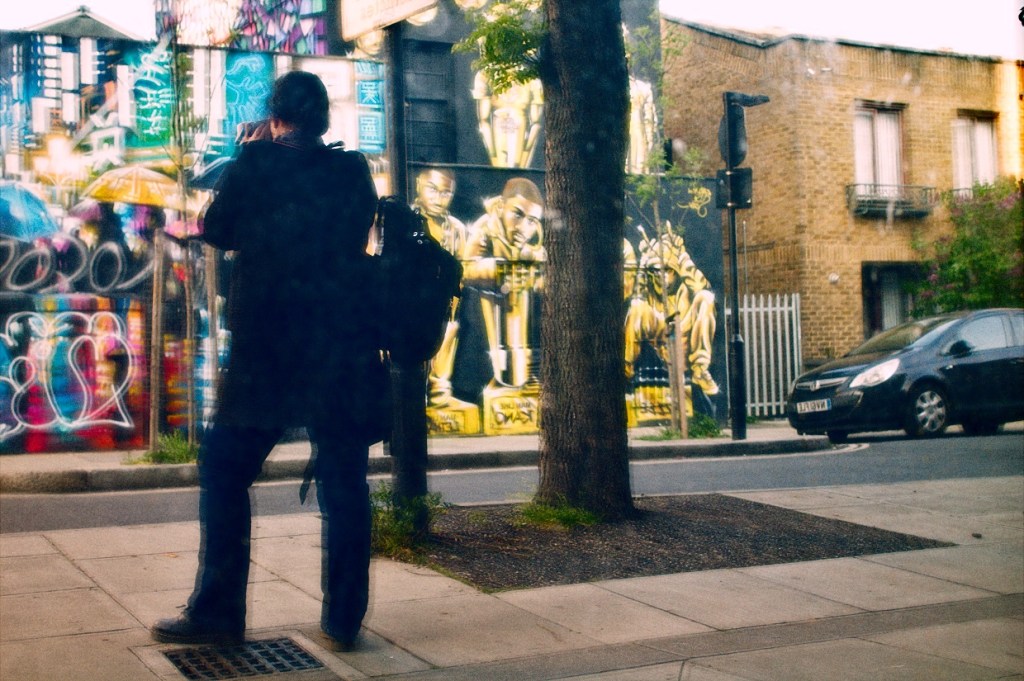
Artistic shot of me photographing street art in the rain. Photo by K.Magro