Live Brief – Brainstorming

Live Brief – Week 2

This week, we held our first meeting as a group.  As we are located in different parts of the UK and in the world, we will be using a webinar format to hold our meetings which we agreed will need to be on a weekly basis.  Our aim for the first meeting was to start with some initial brainstorming and agreeing on our next steps as a group. 

We began by discussing what we had observed in the brief and identified these key points:

  • Headway East London are looking for an online campaign
  • The campaign is to be utilised during Brain Injury Awareness Week in May 2020
  • The aim of the campaign is to raise awareness about brain injury
  • Important areas are the hidden aspects of brain injury, the fact that it is unique for each individual, and the impact it has on identity.

As a group we were clear that we wanted to keep our campaign positive and focus on the strong sense of community and encouragement that we observed about Headway East London during the brief and by looking at their website.  We discussed some of the activities and projects that members of Headway are involved in, art exhibitions, writing projects, music groups, cooking and food events, gardening and youth projects.  These all reflect the tremendous sense of community and empowerment that is integral to Headway East London, while also showing the diversity of its members. 

We came up with a number of different ideas during the brainstorming session, including the idea of creating a video alongside photographs to create a striking online campaign.  We discussed the potential of a video done on location, interviews with members, incorporating their artwork and music into videos and photographs, and even including family members.  It was it agreed that we needed to contact the organisation first to discuss whether it was possible to have members participate in our campaign and for us to work on location. 

It was a full session and very productive with great ideas coming forward.  We rounded off with clear action points for each one of us for the week ahead – these included me doing research on their use of social media, while other team members were to research past campaigns, what other similar organisations have done, potential audiences and various other planning tasks.  I am pleased with the outcome of our first meeting and look forward to seeing what we come up with.  

Artwork done by members of Headway East London. Source: http://headwayeastlondon.org/about/who-are-headway-east-london/

Journal Reflection -Sustainable Prospects Week 2

This week we looked at business basics and writing up business plans. We also touched briefly on copyright law. The practical aspects of working within the photographic industry were discussed alongside the various careers within the photography industry, as well as discussion around what it means to be a professional photographer in the industry today.

Scott Grant (2014) in his book identifies three types of professional photographer:

  • High end professional photographer – high end professional clients across many genres, high financial reward.
  • General professional photographer – clients across many genres from a less prestigious client base, lower financial reward, photographers tend to be from an art or academic background, aspire to becoming a high end professional photographer.
  • Domestic professional photographer – work in commercial photography for weddings, events, portraits and is not commissioned, usually self taught, regionally based and rely on constantly finding new clients.

I am not yet earning significant income from photography so I do not consider myself to be a professional photographer at this point, although I would like this to be a future prospect. I would aspire to freelance work as a general professional photographer and have an interest in social-documentary photography, architecture and cityscape photography, and the creation of photography books. Although, there are many other careers to be considered in the photographic industry, I am primarily interested in the photography itself. The challenge will be to succeed in a highly competitive industry in a digital age.

Photographing the Photographer – Image credit © K.Magro

Reference: Grant, Scott, Professional Photography: The New Global Landscape Explained (2014), CRC Press, p. 5

Whose Image is it Anyway?

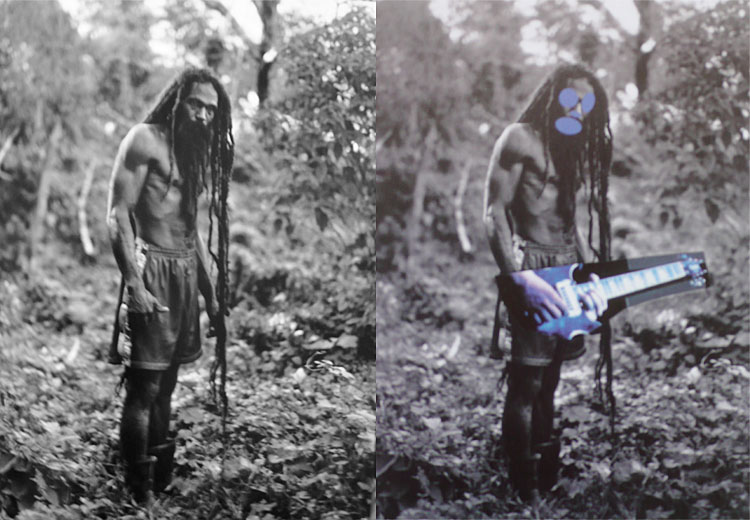
Image on left: original photography by Patrick Cariou / Image on right: artwork by Richard Prince (Boucher, 2019)

This week our coursework looked at copyright and referred to the well documented copyright case of Cariou vs. Prince.  French photographer Patrick Cariou opened a case against Richard Prince and his gallery, Gagosian, for copyright infringement. Prince, a well known appropriation artist had incorporated some of Cariou’s images from his book, Yes, Rasta, published in 2000, into his series of paintings and collages called Canal Zone, exhibited in 2008 at New York’s Gagosian Gallery .

 The outcome of this landmark case in 2009 initially found in favour of Cariou, but then on appeal in 2013, found that Prince, the defendant, was free of any copyright infringement and this decision was based on the principle of ‘Fair Use’.  Both the Warhol Foundation and the Robert Rauschenberg Foundation had filed briefs in the appeal case siding with Prince. “Their argument: the intellectual content and aesthetic meaning of works of art are not always visible to the naked eye without art-historical context. Their brief suggested that art historians, curators and other experts should have a say in the case”. (Boucher, 2019)

The principle of fair use, stipulates that the secondary use of an image must transform the original by using it in a different way or for a different purpose in order to create a new meaning, or message. “Whether or not art is transformative depends on how it may “reasonably be perceived” and not on the artist’s intentions. Even though Prince expressly stated he did not “have a message,” the court still found that most observers would see Prince’s “Canal Zone” as having a radically different purpose and aesthetic than Cariou’s “Yes Rasta” and that this was enough to make the work transformative”. Artist Rights. (2019)

This raises the question of what is considered ethical as there are a number of factors to be considered in this case, such as the financial impact – Prince made a significant amount of money with his series of ‘Canal Zone’, while Cariou as the original artist did not make much through the sales of his book. It raises the question of whether the appropriation of the images may have had a negative impact on the marketing of the original work.

Another important factor to consider is the length of time taken by the original artist to create the body of work. In Cariou’s case it took 6 years to create this body of work during which time he lived and worked alongside the Rastafarians in Jamaica building up the trust necessary to allow him to photograph them. Lastly, and most importantly, in the context of the Cariou vs. Prince case, I believe the question must be asked whether the subjects of the artwork were treated ethically and how they may have felt about the appropriation and subsequent use of the images.

In conclusion, this case highlights the fact that although the use of copyrighting indicates ownership of material, it doesn’t necessarily protect work from being utilised or re-purposed.  If copyrighted work is used without permission, there would be legal grounds to open a court case to defend the work based on the copyright laws of a particular country.  This would largely depend on whether or not one could afford such a case and then, should such a case goes to court, Fair Use would be applied in countries such as the USA and UK. 

References:

Boucher, B. (2019). Landmark Copyright Lawsuit Cariou v. Prince is Settled. [online] ARTnews.com. Available at: https://www.artnews.com/art-in-america/features/landmark-copyright-lawsuit-cariou-v-prince-is-settled-59702/ [Accessed 3 Dec. 2019].

Artist Rights. (2019). Cariou v. Prince — Artist Rights. [online] Available at: http://www.artistrights.info/cariou-v-prince [Accessed 3 Dec. 2019].

Live Brief – Introduction

As part of the module, Sustainable Prospects, students have been given an opportunity to participate in a live brief.  There were mixed feelings among the students, with many raising concerns about the workload for this term.  Working on the live brief is voluntary so not all students have chosen to participate.  I am also concerned about the workload and keeping up with everything during this term, however, I am very excited about the opportunity to participate in a live brief and have chosen to take part.

We had different briefs to choose from and these were for Oxfam, Headway East London and City ID who each presented a video for us about their respective campaigns.  Although City ID was probably the most logical brief for me to choose, it was Headway East London that really drew me and I put this forward as my first choice to work on.  I based my choice on the brief that I most wanted to work on and give me time to, the one that I connected to the most.  Headway East London’s video was great and I really felt that I would be proud to work with this organisation and I absolutely support the great work that they are doing. 

I was delighted to find out that this was the campaign I was allocated to with three of my fellow students – Bloo, Raeann and Oliver.  We have set up a WhatsApp group and have planned our first meeting as a group to do some initial brainstorming and discuss our next steps.  It was a great way to start as everybody in the group seems very enthusiastic about this project and eager to pitch in and do the work.  We will need to deliver the live brief for a pitch within 9 weeks and I look forward to working on this as a team.

Visit the website to find out more about this local charity and the amazing work they do.

Journal Reflection -Sustainable Prospects Week 1

The first week of this module has been incredibly exciting with the introduction of the live briefs and the opportunity to participate in these.  We have been allocated our groups for the live brief project and I am pleased to have been allocated to my first choice, even though this is likely to take me out of my comfort zones as a photographer. Read more about the live brief here.

Already the importance of research in this context has been emphasised as it is essential to understand the client and the brief in order to create an effective project pitch.  Preliminary research for the live brief projects has involved looking at the client, the visual language they are using, where their campaigns are appearing and how they are being presented.

I have undertaken a lot of online research this week around the live brief, focusing on how the client is utilising social media channels, where they are focusing their campaigns and how they are presenting themselves visually.  This has led me to consider my own visual language and how I am portraying myself and my work online.  I anticipate that I will be making some changes in the near future as I consider the importance of personal branding.

I have looked into various definitions of research methodologies and initially struggled to apply this to my artistic and photographic practices as it seemed rather theoretical. It was immensely helpful to look at how other photographers approach their research and to discover a number of varied yet equally relevant ways to approach this. 

In the past I have used research methods in my formal studies, however, as these were not art studies, it was predominantly through books, periodicals, text books and online sources.  These are equally relevant to my current photography project, along with practice-based research and constructivist methodologies. 

This includes physical exploration of the urban landscape, engaging with people in these landscapes and communities, placing myself within the context of the project, and exploring relevant techniques.  I was pleased to gain a real sense of context for my research and feel this will help to focus my work and photographic practice.

Inspiration © Juanita McKenzie