Visual Storytelling Workshop

As part of my ongoing personal development as a photographer, I attended an online workshop, the Social Documentary Photography Visual Storytelling Workshop. This was hosted by the Royal Photographic Society and presented by professional photographer and teacher, Stewart Wall. More information about his social documentary photography course can be found here.

The course was structured around three components:

  • Part one, imagining the photographic project – conceiving of an idea, making decisions on what the story is you would like to tell, planning out the project
  • Part two, creating the project – taking the images that you have envisioned and included in your plan.
  • Part three, completing the project – post production, sequencing and formats for presenting the finished work

Right from the start I found the course to be engaging and informative and I learned a tremendous amount from it that I will definitely be applying to my studies and FMP, as well as all future personal projects. We explored the work of other artists and how they have approached social documentary photography, how they have created compelling visual narratives and the various formats in which they have shared their final projects.

I was particularly interested in photobooks and zines as this is something I am considering for my Final Major Project. What stood out for me though, was the variety of different ways that a photographic project can be disseminated and shared with an audience – this can range from very simple artifacts such as postcards, to more complex projects such as books or documentary films.

Stewart encouraged us to think creatively about what we would like to document and tell a story about, as well as being creative and unique in the way we choose to present the project. He encouraged experimentation with methods, techniques and ideas that invite creativity and bring the individuality of the photographer to the fore.

We discussed a format and process for planning out a photographic project and deciding on what images to capture and include in a body of work in order to capture the narrative and visual story telling aspect. This process that we were shown really helped me to get an understanding of how to sequence my own photography to create a story or narrative.

As a group, we were given a brief and a task to work on using the techniques and methods we had learned. It was fascinating to see how everyone approached the task and how it was interpreted and expressed in very unique and individual ways.  The feedback session that followed was insightful and allowed us to share ideas and expand on them through group discussion. Below is the short project I created for the workshop:
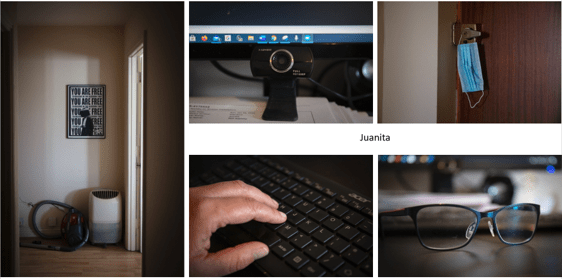
Working from Home 2020
©Juanita McKenzie

I chose to create a simple narrative depicting the reality of working from home as a part of life during the Covid-19 Pandemic. I chose to keep the images dark and shadowy to reflect the sombre mood and a sense of confinement.

I was definitely challenged to think outside the box and produce something different to what I usually do and I had a lot of fun working on the task.  I am reminded that it is always good to have personal projects to work on to allow creativity to flow without any pressure to produce something other than for the love of it.

This was an excellent workshop and it has definitely taught me the value of planning out my projects according to the narrative I wish to express and in line with the way I want to produce and share the project.

Strategies of mediation

This week we explored what was described as strategies of mediation – using and re-using existing images. This process refers to appropriation, referencing or remixing an image. In an earlier module we had explored the well documented copyright case of Cariou vs. Prince. French photographer Patrick Cariou opened a case against Richard Prince and his gallery, Gagosian, for copyright infringement. Prince, a well known appropriation artist had incorporated some of Cariou’s images from his book, Yes, Rasta, published in 2000, into his series of paintings and collages called Canal Zone, exhibited in 2008 at New York’s Gagosian Gallery. See post here.

Another well known case is that of artist Joy Garnet and photographer Susan Meiselas in the case that came to be known as ‘Joywar’. Garnet, a New York artist, creates paintings based on found photographs gathered from the mass media. In this particular case, she based her work on an uncredited image found on the web that was in fact a piece of a 1979 photograph by Susan Meiselas. This became a copyright case which raises important questions around issues of appropriation and context.

Molotov Man © Susan Meiselas 1979
Molotov, from the series Riots, © Joy Garnett 2004
Banksy’s graffiti mural ‘The Flower Thrower’, which was painted on a Jerusalem wall in 2005 (Alamy Stock Photo) Source: The Independent

Looking at the three images above, the question arises as to when an image is replicated even when using a different medium, how closely it resembles the original work could potentially infringe upon copyright. The final image by Banksy bears some resemblance to the original Molotov Man but does it in fact derive from this original image. Interestingly, Banksy recently lost a trademark case against a greeting card company that used his iconic image without consent.

From my own perspective as a photographer, I would not like my artwork to be appropriated, referenced or remixed my images as this could change the context of the image and thus dramatically change the meaning and intent of my original artwork. Furthermore, there is the ethical consideration of profiting from another artist’s work without consent. I have already experienced this on social media where one of my images was used to create a composite image that I did not agree to. It was resolved by engaging with the individual concerned and asking for my work to be credited.

I have subsequently attended a number of very good online workshops presented by Creative Wick Hackney during the Covid-19 lockdowns, one of which addressesd issues of copyright and how to protect our work as artists.

References:

Repeat Photography

William Henry Fox Talbot is well known for creating the first negative image of the Oriel window at Lacock Abbey in Wiltshire. What is less widely known is that Talbot actually created a further five such negatives across a period of time using the same basic composition of the window, thus creating a process of repeat photography.

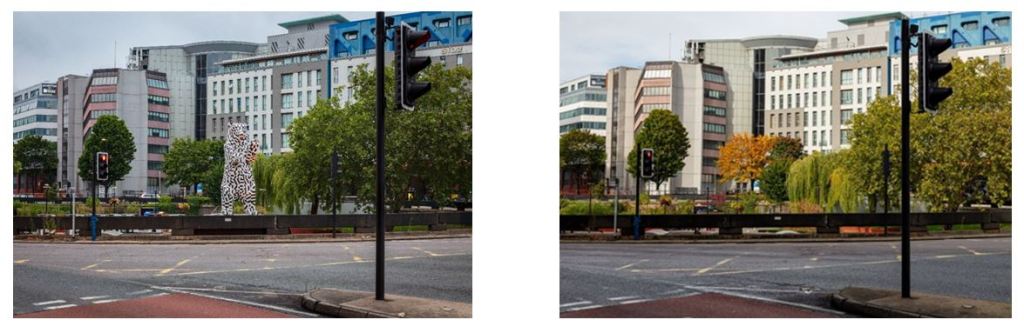
I have already applied this method to my ongoing project of the Bearpit, having taken photographs every month since last year, from the same vantage point – a bus stop across the road simply because of the clear shot I have from there which also incorporated Ursa the Bear back then.  The angle I originally photographed from was specifically to include Ursa the Bear as I rightly predicted she would be removed.  This choice has dictated any further repeat photography as it shows the most dramatic change of the bear having been removed. 

I do however also employ repeat photography from within the Bearpit itself, always photographing the same subway entrances from the same direction and vantage points.  The reason I have been doing this is to try to show changes across a period of time as one of the central themes within my project has been about impermanence and change.  By documenting places in this way and sharing the details of location, it is possible that these images could become archival over time.

I think repeat photography is an excellent idea for long term projects and is very useful for landscape photographers whether it is the natural landsape or an urban one. Throughout my own images and process of repeat photography, the changes are there for me to see but they are often quite subtle and perhaps not obvious across a the series of photos.  However, I do believe this is a very good method for documenting change across time.  In this case it may be that the changes are qualitative. 

The images below are not necessarily aesthetically pleasing, however, they clearly show the change over time. The first image shows Ursa the Bear still standing while the second one clearly shows her absence. The passage of time is clearly marked by the change in light and the seasonal colours of the trees in the background – summer to autumn of 2019.

Repeat Photography – The Bearpit, Bristol 2019
© Juanita McKenzie, 2020

Ed Ruscha Challenge

Prior to the start of this module, we were invited to participate in a voluntary challenge inspired by the work of Ed Ruscha. The aim of the task was to produce a series of images as a small book, inspired by one of Ed Ruscha’s. 

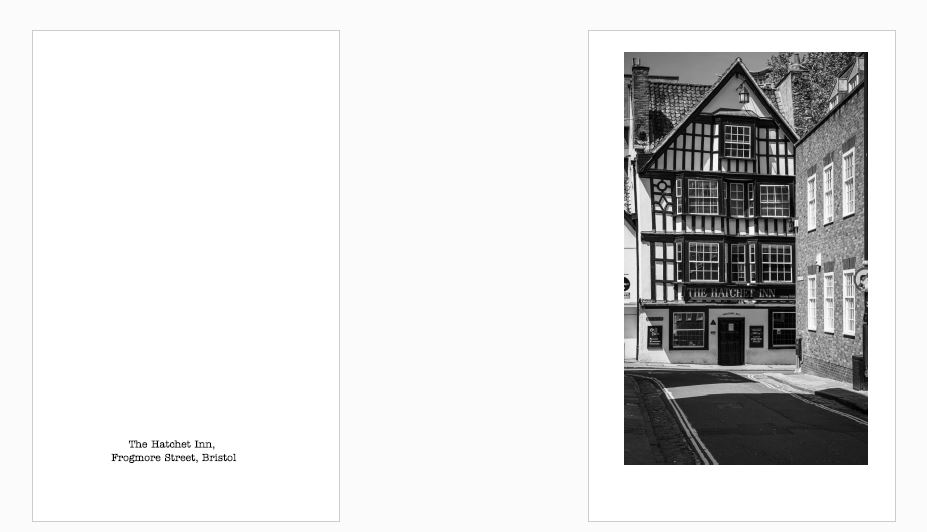
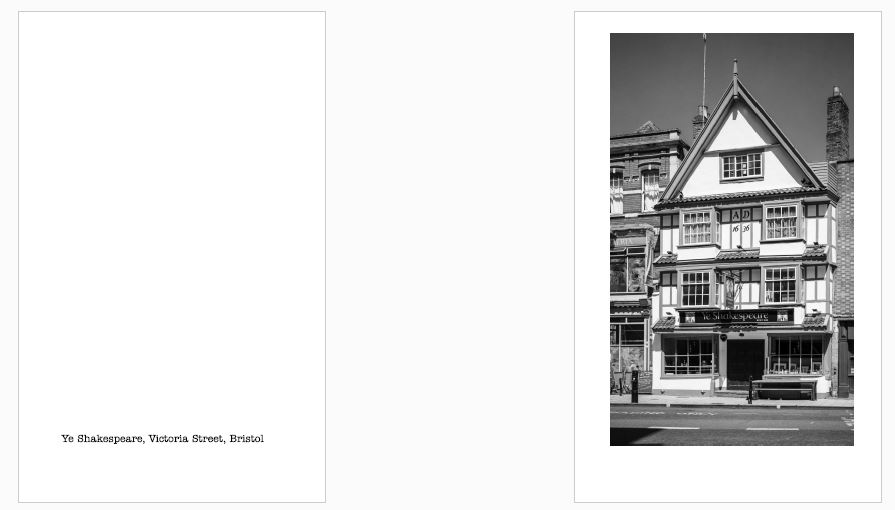
In responding to this challenge, I chose to work with an interpretation of Ruscha’s book: Some Los Angeles Apartments, 1965. I decided to choose a similar subject but one which would be related to a current theme: the impact of Covid-19 reflected in the local pubs that were closed as a result of lockdown measures. I planned a route to walk and took all the photographs on the same day of a selection of closed up pub buildings.

I chose to produce my images in black and white and to format their layout in a very similar style to that used by Ruscha in this particular book. Staying with this style, I used very little description and simply provided a caption in a plain font that stated the pub name and location. I titled the book in the same style font and layout as Ruscha’s and titled my book project: Some Bristol Pubs in Lockdown

I have been fascinated with the work of Ed Ruscha for some time and was also fortunate to view his exhibition at the Tate Modern earlier this year (see previous post), so this challenge was one I really looked forward to doing as I have found a lot of inspiration in his work. In approaching the challenge I opted to print a book that would look very similar and would draw upon Ruscha’s use of typography, layout and simple captions. I usually work in full colour but opted to work with black and white images not only to stretch my creative abilities but to create something similar in feel to those created by Ruscha. Below are some samples from the book that I printed.


Some Bristol Pubs in Lockdown, 2020 © Juanita McKenzie