Journal Reflection – Positions and Practice,Week 5

During coursework this week, we explored issues of power and responsibility as photographers. I am very clear on my own morals, ethics and responsibilities as a photographer, however, I found it difficult to come to terms with power. This is a concept I was initially very uncomfortable with as I had never considered myself as powerful in my role as a photographer or as having power over others in this capacity. 

Upon reflection I came to understand through Henri Cartier-Bresson’s concept of the decisive moment, that the moment of decision, choosing when to take a photograph, was actually an act of power. This led me to consider how as photographers we should reflect upon why we choose a particular subject to portray, or a particular moment in time to capture, and what we will include in the frame. Conversely, what we exclude or leave out – the photographs never taken – are equally significant. What is present or absent in an image is a conscious decision made by the photographer that will not only create meaning but will speak of the photographer’s relationship to the subject matter.

Our tutor, Jesse Alexander, emphasised that it is vital for us as photographers to understand the relationship between subject, image, viewer and photographer, and that it is our moral and ethical responsibility to make that relationship as fair as we believe is reasonably possible. In discussions on the forum, we looked at how photographs can be misused, and debated our responsibility as photographers in this context. It made me extremely aware of the need to be careful about who I am willing to work with and just how much ownership of my work I am prepared to give away.

I think its also extremely important to be aware of the kind of contracts involved and define both who the contract serves and protects.  We always have a moral and ethical responsibility that is implicit in our work as photographers by virtue of the relationship that exists between the photographer, the subject and the viewer. For me this triangular ‘model’ is a good starting point from which to make ethical judgments about my own photographic practice or that of another, and to enable me to assess the balance of power in each situation. We need to always be aware of the power of an image and therefore be discerning and sensitive in the way we work.

In peer debates privacy and dignity were raised as being important to ethical photography, and this is very pertinent to me as somebody with an interest in both street and social documentary photography. I had in fact been considering working on a project around social issues in the urban environment, in particular homelessness.  I am acutely aware of the vulnerabilities in these circumstances and how essential it is to protect what little privacy and dignity such people have. 

The conflict for me is between feeling I have a responsibility to tell the story while constantly questioning myself around the moral aspects of photographing such vulnerable subjects. I believe it is essential to be sensitive towards the subject, to be very clear on personal integrity, and to work collaboratively where possible.  I particularly feel that collaborative work is not only ethical but also empowering for all involved and is particularly important in portraiture, photojournalism and social documentary photography.

I am currently focusing on urban architecture and some street photography, so in this context it’s very important for me to understand the law,  particularly in respect of private buildings and photographing people.  My first responsibility is always to make sure I know the law and to work within those boundaries while also maintaining my rights as a photographer. The second very important aspect for me is to consider the subjects that I am photographing and to make sure that I am photographing with sensitivity, respect and compassion. 
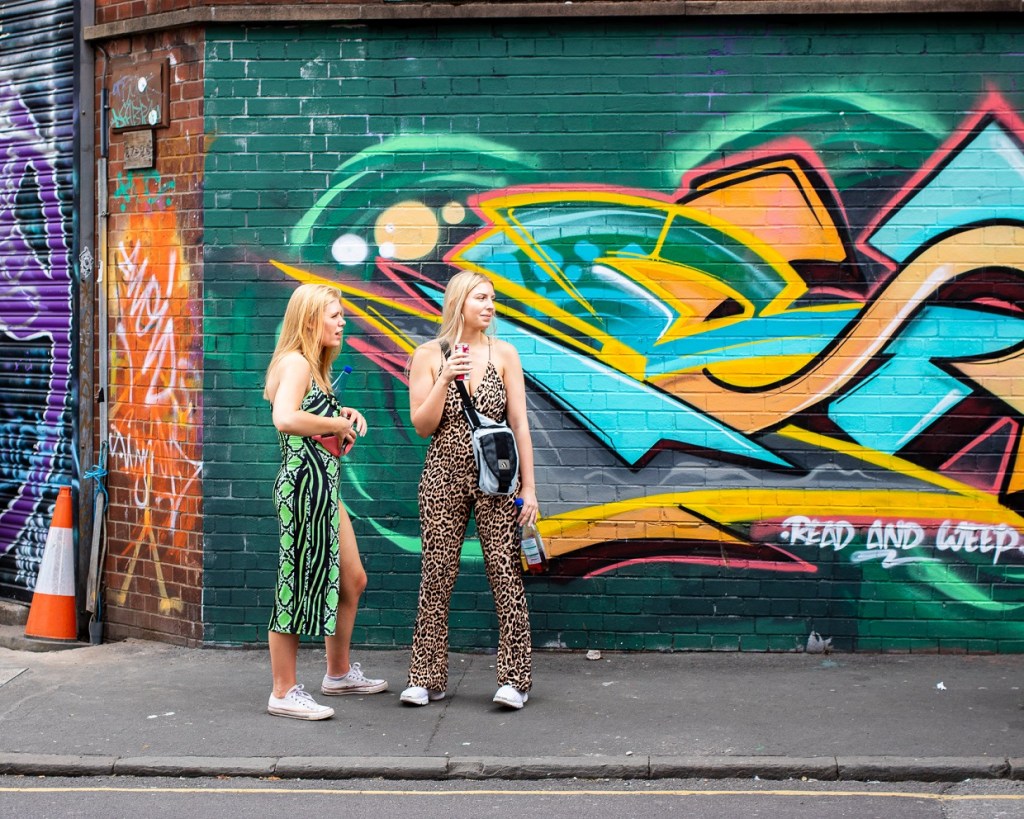
Colour Co-ordination – Street Photography, Bristol ©Juanita McKenzie

Journal Reflection – Positions and Practice,Week 4

This week our coursework was focused on creative collaboration and learning how this could support and develop our photographic practice. The task was set to work in creative partnership with one or two of our peers to create and deliver a micro-project by the end of the week.

To find our creative partners, we were tasked to post something in our forum discussions, text or image, that we felt a connection to and which represented something about ourselves and our work. We then looked at the contributions shared by our peers to find a post that resonated with our own and from this established our groups.

I chose to post the following quote as it is how I approach much of my urban photography:

“To me, photography is an art of observation. It’s about finding something interesting in an ordinary place… I’ve found it has little to do with the things you see and everything to do with the way you see them.” – Elliot Erwitt

This immediately connected me with my peer, Dean, who posted these song lyrics: ” Life is just a bowl of All-Bran. You wake up every morning and it’s there. So live as only you can. It’s all about enjoy it ’cause ever since you saw it , there ain’t no one can take it away.” – lyrics from Happy Days Toytown by the Small Faces.

We both felt an immediate connection around finding beauty in the ordinary things and this became the foundation from which we structured our project. We had been given complete freedom to choose a theme, the content and creative direction of the project with the only specifications being that we needed to create a small body of work in it’s own right which was formed in collaboration and which could be presented in a digital format.

Dean and I had a conversation on the phone about the project and very quickly came up with a simple project idea and process. We agreed to take a walk in our respective cities with the parameters being the same day of the week, the same time and duration, and it had to be in a local context. The aim would be to look for the beauty in the ordinary along the path of the walk and this would generate a body of images we could then collate.

We both ended up wandering much further than we anticipated and went off the intended routes but the result was rather interesting. When we looked at our images side by side, we began to notice similarities in the forms, the themes, the subject and mood despite being in very different cities.

Harmony ©Juanita McKenzie
Image from the project. Full project slides can be viewed here.

I had a good eye for pairing up images so that each page of our presentation has a side by side image by each photographer. Dean was brilliant at designing and compiling the presentation. We chose the images together, agreed on the layout and edit of the final compilation and created the text together. The entire process felt incredibly easy and fluid because we made such a great creative match based on the shared vision in our work.

When we presented it at our webinar, we both spoke about our images and why we took them, also looking at why we paired them the way we did. I felt that it was a balanced dialogue between us and the creative vision was easily articulated to our peers and tutor. We got very positive feedback at the webinar and also when we shared it in our discussion forum.

Looking at the work produced by our peers, it was very exciting and inspiring to see how others had approached this micro-project and the way they had chosen to present it. I was also amazed at the way in which certain themes repeatedly came through in each of the projects, for example environmental issues, the celebration of day to day life, finding meaning within the ordinary, and home or sense of place.

This was an incredibly valuable experience as I mostly work on my own and did not realise how working collaboratively can actually take the creative process into new directions and out of the usual comfort zones. It was a great activity and I learned so much from my peers and from working in creative partnership!

Nature finds a way ©Juanita McKenzie
Image from the project. Full project slides can be viewed here.

Journal Reflection – Positions and Practice,Week 2

Having explored the concept this week of photography as an interdisciplinary field, I’ve spent some time reflecting on whether my current photographic practice is interdisciplinary and how I could expand further on this.

I am already focusing on aspects of documentary photography which may have its roots in early interests in journalism and film. Social and cultural commentary are present in my work already and this draws upon earlier studies in psychology. Within my current practice I explore urban art as an integral part of the urban landscape and the social commentary it provides.

I would like to expand my practice by learning more about Fine Art photography and how this can be combined with street and documentary photography to create something more contemporary. I would like to explore surrealism, Bauhaus and expressionism as art movements that could inform, develop and deepen my photographic practice.

My interest in the urban landscape is closely linked to the architecture of places as well as the historical, cultural and geographical elements within these landscapes. Studies and research across all these areas would be extremely useful for contextual research and project development.

László Moholy-Nagy, Bauhaus balconies in Dessau, 1927.
© László Moholy-Nagy