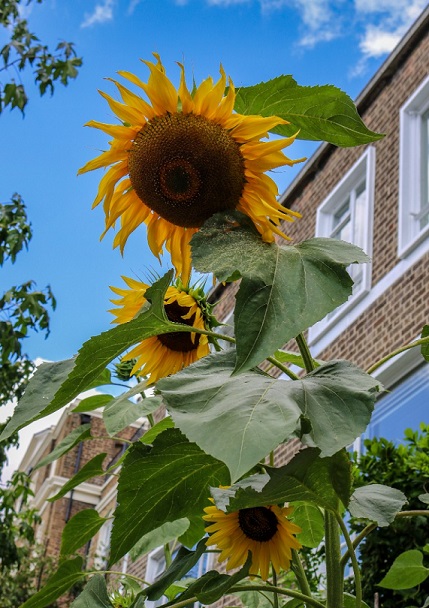
In October, I entered the RPS Monthly Photo Competition. The theme was Snapshot and I interpreted this as being an image that would create a sense of immediacy and closeness that would allow the viewer to feel present when viewing the image.
I selected an image taken during the summer when I got lost walking in London and which unexpectedly led me to discover beautiful sunflowers in the middle of the city. This is a flower that brings me fond memories of my childhood, growing up near Johannesburg, in South Africa where it was a common sight to see them growing in the fields.
The image is taken looking up at the tall sunflowers to emphasise their height and replicate my memories and perspectives of seeing these flowers as a child, but in contrast they are set against the backdrop of the city environments that are my adult world. I always enjoy photographing interesting juxtapositions in the world around me.
The competition closed at the end of October and I was delighted to discover I had been shortlisted. The shortlisted images can be viewed here.
Due to work demands, I was unable to attend the second group meeting for our Live Brief presentation which is disappointing. However, I did receive feedback from the rest of the group who felt it was a very positive session with some good points made. The webinar was recorded so I was able to watch it later and catch up.
Both tutors, Anna and Jesse, seemed to agree that they liked the concept of having both a video and photographic stills. They also both agree that Instagram is a good channel for our campaign but Jesse cautioned that we do need to be aware of its limitations. For example, he raised concerns about sound saying that many people will flick through Instagram stories without turning on the sound which means that the punchline of the video clip we had created would be completely lost.
To address this, he suggested that we would need to either go with an entirely visual clip or we would need to find a way to encourage viewers to use sound. Anna agreed but felt we should keep the sound and therefore rather encourage them to turn the sound on. Both tutors liked the choice of the video clip and appreciated our take on bringing awareness to the hidden aspects of brain injury.
Both tutors particularly liked the way that we were keeping our campaign ethical and novel at the same time through the combination of workshop (documentary style) and film/stills (editorial/advertising style). However, they felt that we were trying to do far too much in a single campaign, and needed to focus it by doing less. I agree very much with this feedback as I had felt we were going in too many different directions.
Overall, the group is very pleased with the feedback and we are in discussion about our next steps.
After the review with our tutors, we met to discuss the feedback and reach a decision on the concept of our campaign. We reached agreement around creating a video which would illustrate the hidden aspects of brain injury by using the concept of not always being able to see everything that is actually there. As a group, we took on board the feedback received from our tutor, Jesse, about making short video clips rather than one longer video. There were a number of ideas put forward and Oliver, who came up with the initial concept and has experience with creating video/film, will be working on creating the first video clip. Bloo also has film/video experience and has agreed to create storyboards to illustrate the other ideas for short clips.
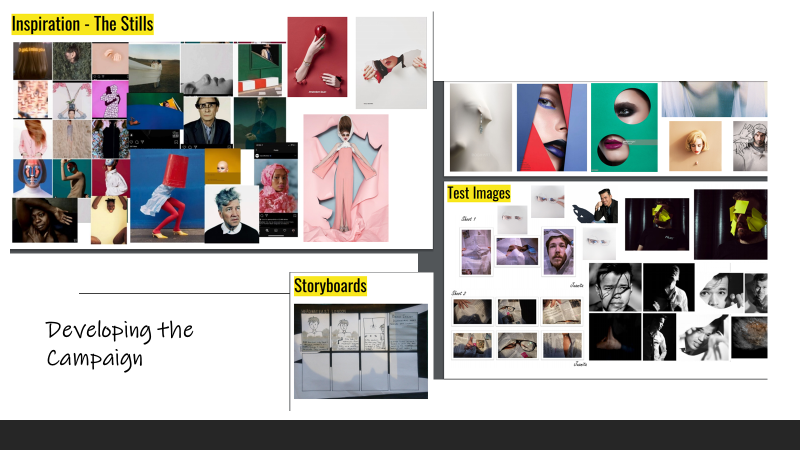
I expanded on the mood board concept that was introduced by Oliver previously and looked for images that represented the editorial look and feel that had interested our tutors and which also inspired us prior to the group meeting. We discussed this and came up with an artistic direction to try for the stills that we would use in the campaign – the approach would be to create images that showed our subjects ‘breaking through’ and emerging from paper or fabric to represent the experience of brain injury impacting on personal identity. In the group discussion one of the team members suggested doing a workshop with the members of Headway in order to create the photographic stills and possibly we could incorporate some of their artwork.
We each then created sample images for photographic stills which returned mixed results for various reasons. I was not happy with my image quality as I had to rush it to deliver on time while juggling work demands. I took quick ‘snapshots’ to illustrate my concept which was a person emerging through paper – I used newspaper because it was a resource I had, however, my vision was for our subjects, the members of Headway East London, to ‘emerge’ through paper covered in artwork they had created specifically for our project, in line with the workshop idea that we had discussed. I chose to repeat the concept with a second series of images which were actually self-portraits, something I have not done before as I am rather camera shy.
The other members produced images in their own unique styles, with Bloo cleverly emerging through white paper with reading glasses incorporated into the image, Oliver doing self-portraits with Stik-it notes on his face and our project leader, Raeann creating beautiful images working with a model. There was some stunning work produced but I felt we lost focus by working individually in this way as we have such varied styles and genres of photography. The ideas we have come up with as a result of this process are very creative and I still feel that we are working well together as a group, especially considering the challenges of working remotely from each other and juggling the demands of life, jobs and our coursework over and above this.
The one concern I have and which I raised with the group, is that I cannot see the link between our video concept and the photographic stills we are creating. This leaves me feeling there is a lack of coherence in the design of this pitch and it actually feels like we are almost creating two entirely different campaigns. We will continue this week to create more content for the presentation to put forward to the tutors next week and will start compiling a folder of the work that will be put into a presentation. I will not be able to attend the next group meeting due to work demands so this is rather disappointing but I will contribute as much as I can prior to the meeting and will rely on the group to update me on the feedback.
As part of our work on the live briefs, we had a scheduled meeting with our tutors, Jesse and Anna, and were tasked to be ready with a short presentation to put forward our initial ideas for the campaign. We met earlier in the week to prepare for this and one of the members of our group, Oliver, created a mood board as a visual stimulus to help focus how we would like our campaign to look and to help us agree on a coherent style across the group. We all have very different styles of photography and work in different genres, so it is going to be a challenge to bring this together into a consistent visual narrative.
Oliver’s Mood Board
The mood board was a great idea and triggered a lot of discussion on the main visual themes we wanted to incorporate into the campaign. This was incorporated into our presentation to the tutors, as well as main points from the research we had done so far. Our research had led us to identifying Instagram as the focus for our campaign pitch as it is the online channel that we felt would most fit with our concepts and could incorporate clever use of video within the Instagram Stories function, as well as IGTV. The tutors seemed to agree with us and liked the concept of video, but suggested that instead of long videos we look at creating short clips. They both seemed to like the editorial look and feel to our mood board and felt that this was a different approach to apply to this type of campaign.
The tutor feedback was very positive and definitely helped us to arrive at a focus and direction for the way we want to design the campaign. We also took the opportunity this week to establish a list of each group member’s key skills so that we could look at allocating roles for the duration of our work on the live brief. We selected one of our team to be the Project Manager and take responsibility for planning our timeline as there are only 6 more weeks left before we need to be ready to pitch. It will be essential to plan effectively so we can deliver on time.
This week, we held our first meeting as a group. As we are located in different parts of the UK and in the world, we will be using a webinar format to hold our meetings which we agreed will need to be on a weekly basis. Our aim for the first meeting was to start with some initial brainstorming and agreeing on our next steps as a group.
We began by discussing what we had observed in the brief and identified these key points:
Headway East London are looking for an online campaign
The campaign is to be utilised during Brain Injury Awareness Week in May 2020
The aim of the campaign is to raise awareness about brain injury
Important areas are the hidden aspects of brain injury, the fact that it is unique for each individual, and the impact it has on identity.
As a group we were clear that we wanted to keep our campaign positive and focus on the strong sense of community and encouragement that we observed about Headway East London during the brief and by looking at their website. We discussed some of the activities and projects that members of Headway are involved in, art exhibitions, writing projects, music groups, cooking and food events, gardening and youth projects. These all reflect the tremendous sense of community and empowerment that is integral to Headway East London, while also showing the diversity of its members.
We came up with a number of different ideas during the brainstorming session, including the idea of creating a video alongside photographs to create a striking online campaign. We discussed the potential of a video done on location, interviews with members, incorporating their artwork and music into videos and photographs, and even including family members. It was it agreed that we needed to contact the organisation first to discuss whether it was possible to have members participate in our campaign and for us to work on location.
It was a full session and very productive with great ideas coming forward. We rounded off with clear action points for each one of us for the week ahead – these included me doing research on their use of social media, while other team members were to research past campaigns, what other similar organisations have done, potential audiences and various other planning tasks. I am pleased with the outcome of our first meeting and look forward to seeing what we come up with.


 Journey Through the Lens