The Miniclick Photo Talks – Laia Abril

This was a fascinating talk that I attended with a fellow student on the MA Course. It was a Miniclick Photo Talk with Laia Abril, a photographer and multi-disciplinary artist who works across a number of different mediums and platforms. Her work relates to femininity but addresses the uneasy stories and realities around subjects such as gender equality. She has produced a number of books around these subjects, including A History of Misogyny: Chapter One: On Abortion (2018), which looks at abortion controls and how this appears across many different cultures, as well as showing the repercussions of these controls. Abril is currently working on A History Of Misogyny, Chapter 2: On Rape Culture.

This is not my usual choice of photography or artist, however I was quickly captivated by Abril’s own review of her work, which showed her to be a deeply insightful, sensitive and courageous human being. She spoke of how she considered her subjects and the potential danger they could be placed in through working with her. She was always aware of this every step of the way and was very protective of the woman who agreed to be her subjects. She also admitted that the danger and threat was also a potential for her as the photographer who could easily become a target around such emotional issues and readily acknowledged that she sometimes feels scared. I was very impressed with her strong sense of ethics and courage.

Abril approached these books by visualising complex situations and emotions, things that cannot be photographed. She then attempts to articulate and represent these visually. She supports her work by doing an immense amount of research and this stems from her journalism background. She said that reading and text research was central to her projects and that this is valuable when as a photographer you are located geographically far away from your subjects. Abril said that her process was one of accumulating information and then finding her position in it.

Her goal, she says, is usually a book and her aim is to make sure the viewer enjoys it from start to finish, so this can be difficult when presenting uncomfortable issues such as abortion. This has meant she has had to become very creative in how she designs a book or presents an exhibition. Abril focuses on how she groups images together, integrates text into the artwork, uses clever inserts and includes interesting representational images. She makes use of small, simple images because she believes it is more powerful for people to make the connections themselves.

Abril is always incredibly sensitive towards the women who are her subjects and says that it is through building a connection that they will talk to her, when they feel comfortable and safe. She cautions that it is important to be aware of how a subject experiences working with a photographer as we do not know the impact we have on them emotionally and psychologically. As photographers we must always consider how we portray our subjects, but also how we interact with them and what the impact on them will be.

Although, this is not my particular style of photography, I learned a tremendous amount from this discussion and would be apply to apply this in the future if I begin to work with subjects as part of social documentary projects.
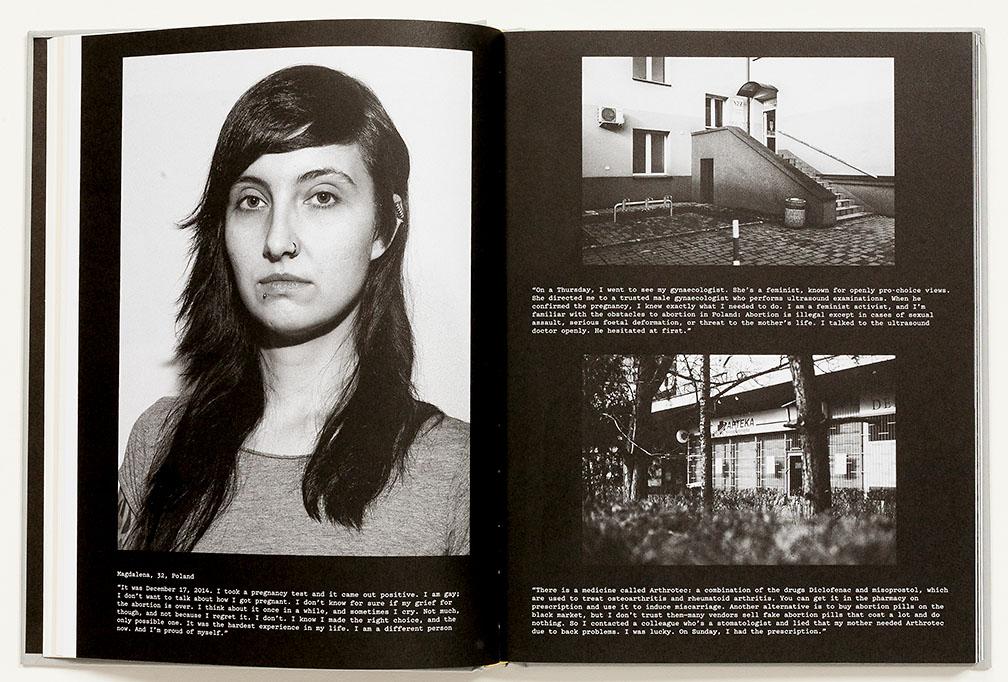
On Abortion, 2018 ©Laia Abril

F22 Workshop

This week I attended the F22 – Survival Skills for Freelance Creatives Workshop in London as I was fortunate enough to be there at the time. I had seen the workshop advertised by the AOP and thought it would be invaluable for me as somebody who is planning to enter this market, and also felt it matched very well with this term’s coursework. The workshop was presented by Sheryl Garratt, previously the editor of The Face and The Observer magazine, and now a life coach working with freelancers and creative people.

In her workshop, Sheryl discussed the changing photographic market and the difficulties facing freelancers in the industry. She spoke of the constant pace of change and the lack of security in an industry that is in flux, as well as the impact of social media and the way in which ‘content creation’ threatens the photographic industry. This was confirmed by other people attending the workshop who have personally experienced this impact on their photographic careers.

One lady I spoke to was actually attending the workshop because she had previously worked as a freelance photojournalist but was no longer able to earn a living from this work due to the rise in citizen journalism and the use of image submissions from the public. She mentioned that both full-time and freelance jobs in this industry had been significantly reduced across the last decade or more. She was attending the workshop as she is hoping to take a new direction and break into the commercial photography market. It was very informative to hear from other photographers and people in the industry just how they were approaching their freelance work and where they felt the most impact.

Sheryl presented her workshop around ten core foundations that would assist in being successful in growing a business and doing the creative work that we love to do. Based on these principles I identified the following important steps I can take in developing my own freelance path:

  1. Get very clear on my creative vision, my reasons for doing what I do and what I hope to achieve.
  2. Create some great short descriptions of what I do and why I do it. Sheryl advises that we need to find ways of talking about what we do that makes it sound exciting.
  3. Marketing must become part of my daily routine as this is how I will get work.
  4. Do less and focus more on what matters. I would do well to simplify, streamline and focus my work in order to be more productive.
  5. I need to build up an effective working routine that suits my needs and this will increase my productivity.
  6. I should start a savings fund as this is what will give me the creative freedom to explore personal projects and have greater autonomy.
  7. It is essential for me to create a portfolio career, as multiple income streams are the only way to succeed as a freelancer nowadays. I will do some thinking about ways to do this and can also refer to our current coursework for ideas about other careers in the industry.
  8. Networking is extremely important, as is building peer support.
  9. Always invest in what I need to support my continued personal and business growth.
  10. Be realistic and manage my time and energy as this is my most important resource.

The workshop was a great experience as the content was excellent and I learned a number of important tips about how to find clients, how to manage my business and how to maintain a healthy balance between earning a living and doing what I love. It was also invaluable to meet other professionals in the industry, both to learn from them and to network among peers. For further information about Sheryl’s informative and insightful workshops and coaching, please visit her website.

Photography as a profession ©Juanita McKenzie

Contextual Research – Viviane Sassen

In the previous webinars discussing photography markets, I came across the work of Viviane Sassen. She is a Dutch photographer who is extremely successful in both fine art and fashion photography. Although her genre of photography seems completely unrelated to my own practice in urban photography, there was something about her work that really stood out to me and made an impact.

I was particularly drawn to her 2014 series, Umbra, in which she makes strong use of shadow, contrasts, colour, shadow and lines. When I came across the video below and heard Viviane Sassen describe how and where she discovered her photographic voice, I began to understand that I had been unconsciously drawn to the light and colours familiar to a landscape I had known most of my live, the African landscape, having grown up in South Africa. Viviane Sassen describes that it was only upon spending time in Africa that she connected to her creative voice and it is there that she learned about working with light and shadow, bright colours and sharp contrasts.

Her sensitivity to her subjects while in Africa is so clearly expressed and she acknowledges an awareness of the imbalance in power between her as the photographer and her subjects. Sassen approaches her subjects by gaining their understanding of her intention and that the photography is about concepts that are far larger and more abstract than themselves. She approached these images from a symbolic perspective and this resulted in a powerful series of portraits that made a tremendous impact on me because she has succeeded in capturing the essence of her subjects, somehow merging the present moment, with the cultural and historic inheritance of people and place.

“One of the best ways to appreciate Sassen’s work is through her photobooks. Flamboya merges documentary and fine art to find a new way of looking at Africa, one that is neither exoticising nor straightforward reportage. Parasomnia is a more dreamlike exploration of Africa that draws on those childhood memories and vivid dreams.” (O’Hagan, 2013) Sassen herself encourages photographers and artists to experiment and push the boundaries on creativity, working intuitively to create the magic . I feel truly inspired by her approach to photography and will refer to her work often as I experiment with the use of light, shadow, colour, contrast and line in my own work.

Viviane Sassen talks about her photographic process and how she discovered her creative voice.

Reference: O’Hagan, S. (2013). Fashion photographer Viviane Sassen: a different take. [online] the Guardian. Available at: https://www.theguardian.com/fashion/2013/oct/12/fashion-photographer-viviane-sassen [Accessed 8 Dec. 2019].

Research Methods

The project I have proposed to work on is centred around the idea of impermanence and how this is expressed in the context of the urban environment.  I intend to explore the relationships between people, place and psyche through the concept of nonplace, impermanence and the architectural language of change.  I will mostly be exploring this within my local environment but also within any other cities or suburban landscapes that I may have the opportunity to explore.  The project will progress in stages across the different course modules and I am open to the idea that it could even change as I progress.

As part of my project I will be referring to a number of different sources to provide the contextual research that will underpin my work.  Some of this will be achieved through reading a variety of different books, articles and periodicals, as well as doing online research around the genre of urban photography, the techniques used, projects around similar themes,  and the work of photographers that inspire me or from whom I can learn. 

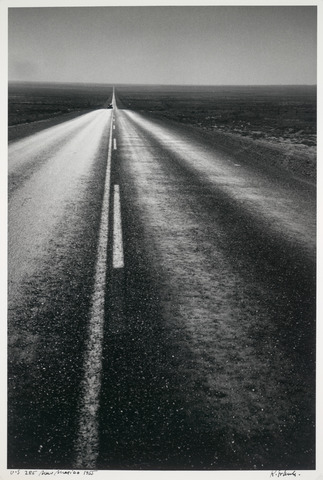
Robert Frank is one of a number of photographers whose work inspires me and is relevant to my current project.  He was an immigrant to America and set out on a two-year road trip to photograph the real America from the viewpoint of an outsider.  This resulted in his 1958 book called The Americans.  For Robert Frank, his work itself was the research, depicting a raw and honest documentary of America at that time. 


Robert Frank, U.S. 285, New Mexico, 1955. Photograph © Robert Frank, from The Americans

Lewis Bush is another photographer whose work is of great interest to me as he explores issues of gentrification, capitalism, urban change and the political context of urban landscapes.  His book, Metropole, is about the changing face of London in the context of global capitalism and how this drives modern property developments, gentrification and displacement of people.  Lewis Bush does a vast amount of research during his various projects and brings together knowledge and research in the fields of economics, politics, journalism, technology, art and history. 

Lewis Bush, Untitled, 2015 © Lewis Bush, from Metropole

I will be referring to the work of French anthropologist, Marc Augé, around the concept of non-place and will do further research on any other artists working with this concept, as well as any relevant sources within the fields of sociology and anthropology. The concept of psychogeography is another area for potential research that may bring a different aspect to my project.

Lastly, I plan to incorporate literature into my background research, and hope to find time to read some of the works by authors or poets, such as William Blake, who write about city life and the contrasts, paradoxes and changes inherent to it, as well as referring to other written or visual works that explore our relationship with the landscapes we explore, inhabit or interact with in some way.   

Another important aspect to my research will be the practical context of physically exploring the urban landscape to gain knowledge of it, as well as attempting to engage with people in these landscapes and communities.  This supports a practice-based approach to my research, as well as supporting a constructivist research methodology. 

These are perhaps ambitious plans for my research as time is always a constraint, however, I don’t see the research as being limited to only this semester of the course, but rather an ongoing process that will continue to inform, develop and evolve my project.

Thinking Away From Photography

The coursework this week set a task of finding a piece of work that was not a photograph but which linked in some way to our own practice or research interests. I actually found this to be quite a difficult task, not because of thinking away from photography, but rather because of the amount it revealed.  I realised that there are a number of influences in my photography and in my life, some of which go quite far back.  These influences range across music, films, art, documentaries and many different genres but through exploring these in the context of this discussion, I realised there is a common thread. 

From Blake to Banksy….poetry to graffiti….what is the connection?  For me it began a long time ago with William Blake’s ‘Songs of Innocence and Experience’, a collection of poems that show two very different states of the human experience and reflect upon the inequality inherent in the industrial society of that time.  Banksy on the other hand, is one of the most controversial and well known street artists of our times. His work is often political and satirical, critical of authority, inequality and the human suffering that results. This is the theme that I have found in common across the many different artists or genres that influence my own practice or research interests.

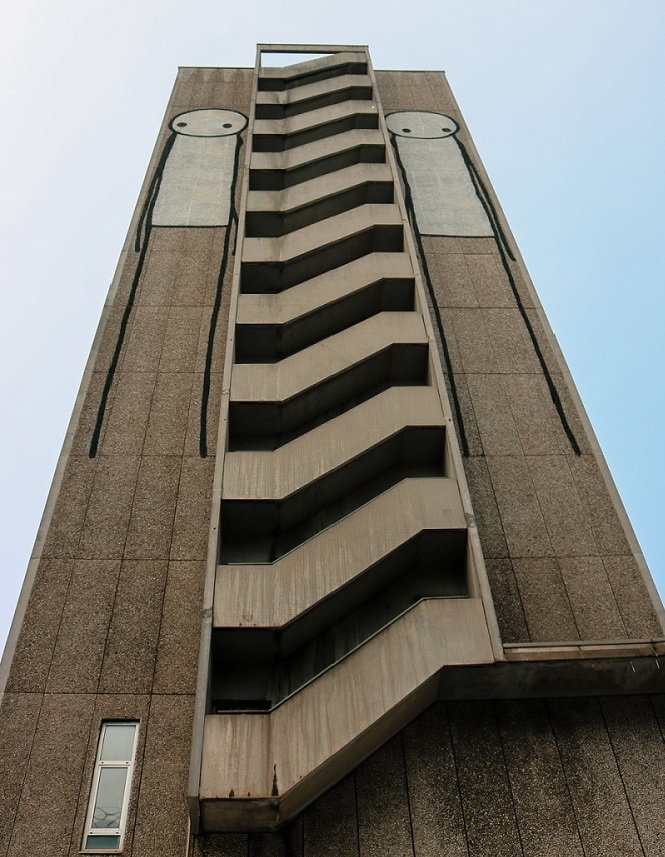
Looking at my current work, street art is one of my research projects and one of my favourite street artists is British street artist, Stik. His work has definitely inspired me to photograph the streets, the street art that appears there, the people that live in these areas, the urban environment and the relationship people have with it, as well as to capture the character of places before they are gone.  In a way I feel that photography is a means of documenting the rapid changes happening in our cities and communities, but also preserving something of them before they are gone. 

Large scale mural by Stik - Nelson Street, Bristol  ©Juanita McKenzie
Large scale mural by Stik – Nelson Street, Bristol
©Juanita McKenzie

Stik uses simple stick figures to convey meaning through simplicity – the subtle bend in an arm, or position of the dot for an eye, can convey so much expression and emotion.  He makes use of colour, line and environment to create artworks that represent the community and reflect the vulnerability of the human being while also giving hope.  His artwork has not only inspired me but has also been a source of tremendous comfort and joy to me at various times in the past few years. (This is discussed in my oral presentation which can be found here).

I feel a connection to Stik’s artwork because in my own practice, I also try to capture similar themes in my photography – the vulnerability of people in the harsh environment of the city, the inequality and contrasts that are so much a part of urban life (really a microcosm of the global inequality), but also the tremendous courage, community and spirit that arises from this. 

I hope to capture the vulnerability but also the fragile beauty in the cities, the dialogue between the opposites, the dance between old and new, the tension and friction, and the constant process of metamorphosis. 

The clip below is by Stik and discusses some aspects of his work and community: 

Visit Stik’s website for further information about his work: http://stik.org/