The project I have proposed to work on is centred around the idea of impermanence and how this is expressed in the context of the urban environment. I intend to explore the relationships between people, place and psyche through the concept of nonplace, impermanence and the architectural language of change. I will mostly be exploring this within my local environment but also within any other cities or suburban landscapes that I may have the opportunity to explore. The project will progress in stages across the different course modules and I am open to the idea that it could even change as I progress.
As part of my project I will be referring to a number of different sources to provide the contextual research that will underpin my work. Some of this will be achieved through reading a variety of different books, articles and periodicals, as well as doing online research around the genre of urban photography, the techniques used, projects around similar themes, and the work of photographers that inspire me or from whom I can learn.
Robert Frank is one of a number of photographers whose work inspires me and is relevant to my current project. He was an immigrant to America and set out on a two-year road trip to photograph the real America from the viewpoint of an outsider. This resulted in his 1958 book called The Americans. For Robert Frank, his work itself was the research, depicting a raw and honest documentary of America at that time.
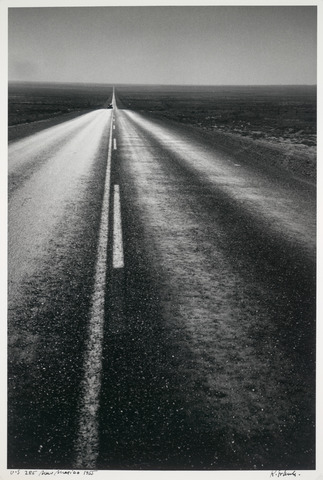
Robert Frank, U.S. 285, New Mexico, 1955. Photograph © Robert Frank, from The Americans
Lewis Bush is another photographer whose work is of great interest to me as he explores issues of gentrification, capitalism, urban change and the political context of urban landscapes. His book, Metropole, is about the changing face of London in the context of global capitalism and how this drives modern property developments, gentrification and displacement of people. Lewis Bush does a vast amount of research during his various projects and brings together knowledge and research in the fields of economics, politics, journalism, technology, art and history.

I will be referring to the work of French anthropologist, Marc Augé, around the concept of non-place and will do further research on any other artists working with this concept, as well as any relevant sources within the fields of sociology and anthropology. The concept of psychogeography is another area for potential research that may bring a different aspect to my project.
Lastly, I plan to incorporate literature into my background research, and hope to find time to read some of the works by authors or poets, such as William Blake, who write about city life and the contrasts, paradoxes and changes inherent to it, as well as referring to other written or visual works that explore our relationship with the landscapes we explore, inhabit or interact with in some way.
Another important aspect to my research will be the practical context of physically exploring the urban landscape to gain knowledge of it, as well as attempting to engage with people in these landscapes and communities. This supports a practice-based approach to my research, as well as supporting a constructivist research methodology.
These are perhaps ambitious plans for my research as time is always a constraint, however, I don’t see the research as being limited to only this semester of the course, but rather an ongoing process that will continue to inform, develop and evolve my project.
 Journey Through the Lens