As part of my ongoing personal development as a photographer, I attended an online workshop, the Social Documentary Photography Visual Storytelling Workshop. This was hosted by the Royal Photographic Society and presented by professional photographer and teacher, Stewart Wall. More information about his social documentary photography course can be found here.
The course was structured around three components:
Part one, imagining the photographic project – conceiving of an idea, making decisions on what the story is you would like to tell, planning out the project
Part two, creating the project – taking the images that you have envisioned and included in your plan.
Part three, completing the project – post production, sequencing and formats for presenting the finished work
Right from the start I found the course to be engaging and informative and I learned a tremendous amount from it that I will definitely be applying to my studies and FMP, as well as all future personal projects. We explored the work of other artists and how they have approached social documentary photography, how they have created compelling visual narratives and the various formats in which they have shared their final projects.
I was particularly interested in photobooks and zines as this is something I am considering for my Final Major Project. What stood out for me though, was the variety of different ways that a photographic project can be disseminated and shared with an audience – this can range from very simple artifacts such as postcards, to more complex projects such as books or documentary films.
Stewart encouraged us to think creatively about what we would like to document and tell a story about, as well as being creative and unique in the way we choose to present the project. He encouraged experimentation with methods, techniques and ideas that invite creativity and bring the individuality of the photographer to the fore.
We discussed a format and process for planning out a photographic project and deciding on what images to capture and include in a body of work in order to capture the narrative and visual story telling aspect. This process that we were shown really helped me to get an understanding of how to sequence my own photography to create a story or narrative.
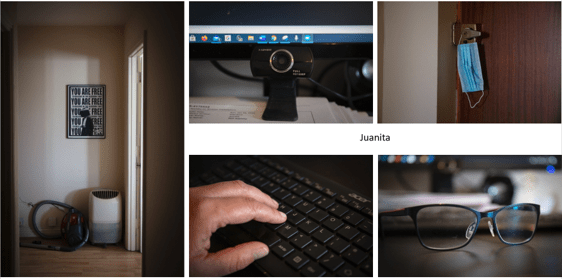
As a group, we were given a brief and a task to work on using the techniques and methods we had learned. It was fascinating to see how everyone approached the task and how it was interpreted and expressed in very unique and individual ways. The feedback session that followed was insightful and allowed us to share ideas and expand on them through group discussion. Below is the short project I created for the workshop:
I chose to create a simple narrative depicting the reality of working from home as a part of life during the Covid-19 Pandemic. I chose to keep the images dark and shadowy to reflect the sombre mood and a sense of confinement.
I was definitely challenged to think outside the box and produce something different to what I usually do and I had a lot of fun working on the task. I am reminded that it is always good to have personal projects to work on to allow creativity to flow without any pressure to produce something other than for the love of it.
This was an excellent workshop and it has definitely taught me the value of planning out my projects according to the narrative I wish to express and in line with the way I want to produce and share the project.
In this module, the focus was on strategies of sharing – the challenges of working with others and the different ways of working collaboratively. This is an important topic for me as I consider the way in which my project is progressing and whether it will become the social documentary I had always intended or whether I shall approach this from the perspective of conceptual and landscape documentary approaches.
I have looked to the work of a number of artists that have worked with various communities and individuals in different ways that have involved participation, collaboration or co-operation. I was particularly interested in Zed Nelson’s documentary film, The Street, depicting life in Hoxton Street in East London over a period of 4 years. Nelson is primarily a photographer but decided to create this documentary film and the result was a powerful, authentic and deeply moving record of a community impacted by change.
Nelson interviews members of the community and builds up rapport in ways that shows a deepening of the relationship through the course of the film and the greater sense of trust and sharing that it conveys. The interviews are revealing and at times surprising, getting to the heart of issues within the community and the impact on individual lives. The interviews are powerful and give voice to the community.
The Street, Zed Nelson – Trailer
The work Nelson has done in creating The Street, is deeply inspiring to me as it touches so closely on key themes I am working with in my own project. The idea of creating a documentary film is something I feel is a creative direction that could transform the project I am working on and take it to a different level. It will require a tremendous amount of collaboration with the communities involved and of course, it means learning new techniques in order to create a film. I am contemplating this as a creative possibility but realise that this would mean a far longer term project than the scope of the MA Photography.
Whether I choose to produce a documentary film or a photobook, as was my early intention, I know that collaborative work and participation from the community will be essential in order to represent a community that has been underrepresented and distinctly lacks a voice. Their views would be far more personal and accurate than my own view as the observer and photographer, and it is also essential to incorporate many different views, opinions and perspectives within a documentary work.
My intention in the previous term had been to begin meeting up with people from the community and exploring the possibilities of collaborative work. I had identified key community organisations that would have been a logical and natural starting point for this collaboration in order to facilitate building relationships within the community itself. The sudden and expected Covid-19 Pandemic and the resulting lockdowns prevented me from pursuing this at the time and even now I am feeling limited by the rules and regulations around social interactions.
From my perspective there is a tremendous sense of confusion around rules and social distancing, as well as a measure of anxiety, fear and mistrust that I perceive in society at the moment and this does not seem like an appropriate or suitable time to try to begin building relationships in a community I am not part of. It is a dilemma for me as I am unsure how to move this project forwards now and what direction to take.
In January 2020, I visited the Tate Modern to explore the Ed Ruscha collection on display in their Artist Rooms. As an avid fan of Ruscha’s work I was eager to see this display encompassing a selection of his works spanning across his entire career and including his photographic books, photographic series and some of his iconic paintings.
Text has always been an integral part of Ruscha’s work with his clever use of typography and seemingly random use of isolated words and phrases. This was the first time that I have seen his paintings, all of which incorporated interesting textures and words or phrases superimposed on landscapes or sometimes on plain backgrounds.
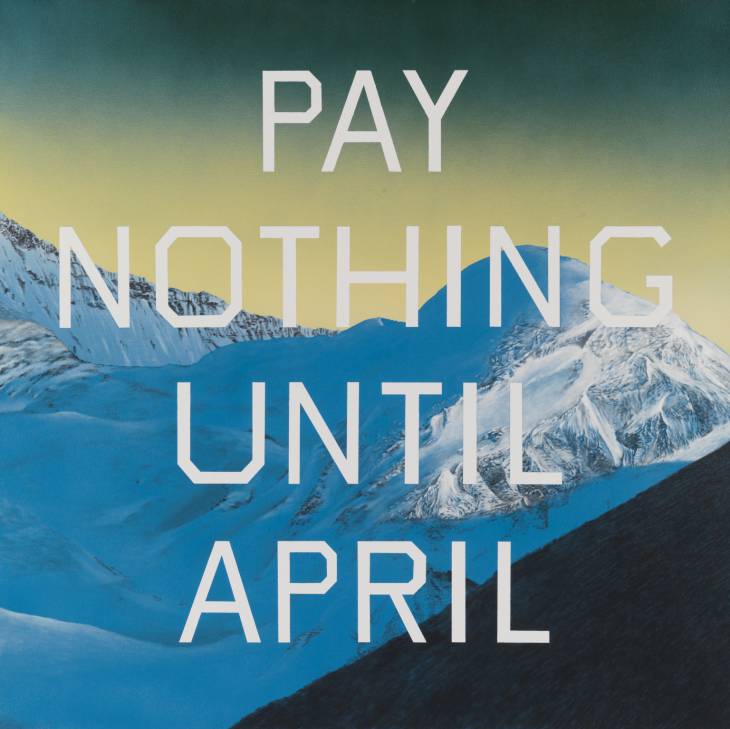
Ruscha’s early career was as a graphic artist and it is clear that he draws upon these techniques to create his art, cleverly working with different styles, fonts and layouts both on canvas and within is photographic books. Ruscha’s background in graphic art also influences his use of language and text as he frequently draws upon the language of advertising and adverts. This is quite obvious in works such as the one below:
Pay Nothing Until April 2003 Edward Ruscha born 1937 ARTIST ROOMS Acquired jointly with the National Galleries of Scotland through The d’Offay Donation with assistance from the National Heritage Memorial Fund and the Art Fund 2008 http://www.tate.org.uk/art/work/AR00047
The same language of advertising also appears in his photographic books with titles such as Some Los Angeles Apartments (1965) and Real Estate Opportunities (1970). Furthermore, this is a language that appears in Ruscha’s images and artwork not only as words, but also as a visual language through objects, signs and various other symbols.
Ruscha was fascinated by sign painters and he was inspired by the colourful billboard signs he saw all around him in Los Angeles. In a fascinating interview with Tate Modern’s Director, Frances Morris, he also refers to speeches made by people such as Mohammed Ali and authors such as Gertrude Stein, people who had a colourful and descriptive way with words. Ruscha describes these as being early influences that were part of his environment and his history and which later became incorporated into his work.
Ruscha is a talented conceptual artist and seeing his paintings gave me a greater understanding of his photographic works as it emphasised how he approaches his subject matter as a conceptual artist influenced by his earlier career as a graphic artist in the advertising industry. He incorporates text into his paintings in ways that are often out of context or at odds with the image in order to emphasise stereotypes and cultural conditioning. In his photographic books and series, this influences his choice of subject matter, the clever use of repetition of a theme or concept, his unusual book titles, and the use of very minimal words in his books, as well as the layout of his images.
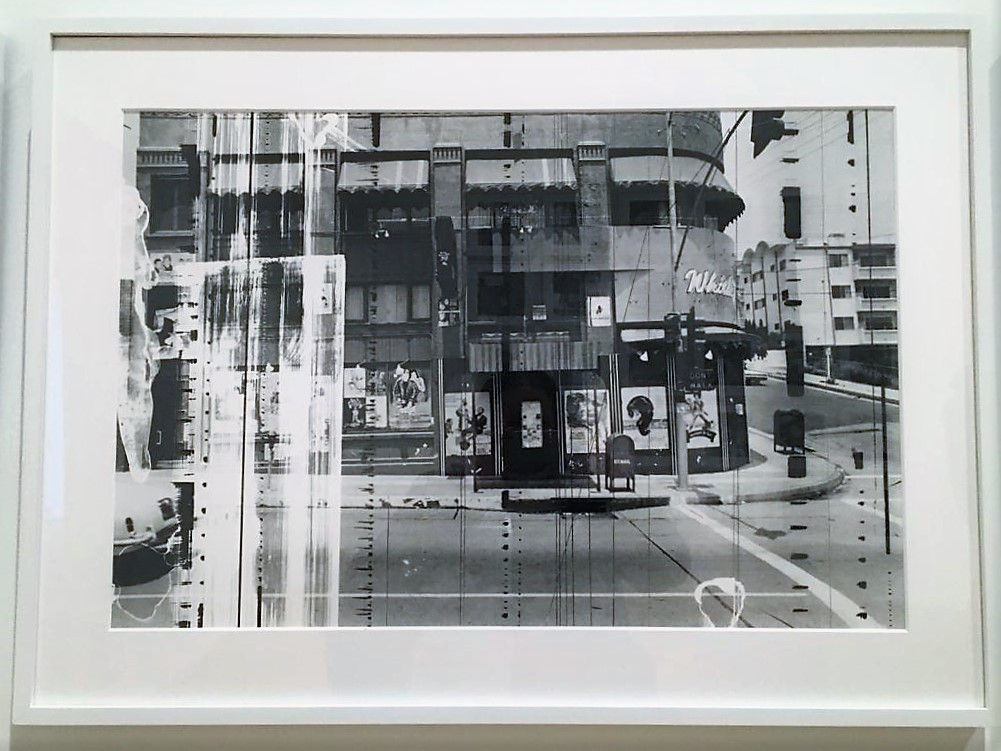
His use of everyday words and phrases combined with images of the banal have create Ruscha’s iconic conceptual artworks. The image below is inspired by British writer J.G. Ballard whom Ruscha greatly admired. The text is taken from Ballard’s 1975 novel, High-Rise, a dystopian novel that revolves around a modern residential tower block and the process of social breakdown which occurs in this setting. The text appears at odds with the tranquil landscape it is superimposed upon, creating a contrast between two very different landscapes and states of being. Interestingly, J G Ballard, once said of Ed Ruscha: “The coolest gaze in American art.” (Ed Ruscha: ‘There’s room for saying things in bright shiny colours’, 2020)
Ruscha finds inspiration in his everyday environment and in the banal, transforming it into art and offering a form of commentary on American life and politics, stereotypes, consumerism and mass media imagery. He draws upon the topography, architecture, and mundane objects of his environment, in particular his home town Los Angeles and Hollywood and attempts to record what he sees. He draws consistently upon the urban landscape, as well as the typical cultural brands, icons, signs and language that form part of the ‘American Dream, for example cinema, the automobile culture, billboards.
For me there is a fascination with Ruscha’s focus on the icons of the ‘American Dream’ as there is something alluring about the concept of the American automobile culture and the classic road trip that is perhaps resonant with my own childhood experiences and landscapes growing up in South Africa. The similarity is in the wide open roads and constantly changing landscapes, the isolated petrol stations along the way, as well a the fascinating signposts, local icons and well known brands. The large American cities and icons were always present in the films of my teenage years and the Hollywood influence feels always familiar as a result. Ruscha’s interest in the urban landscape and it’s banal details, inspire much of my current photographic practice as I now find meaning in the urban landscape in which I find myself and which forms the narrative of my daily life.
At the start of a new term and new module, I begin with a short reflection on the feedback and assessment for the previous term. Overall, I was disappointed in the grades I received as these showed a considerable drop since the first term. The feedback itself was relevant and helpful, certainly aspects that I will take on board and integrate into my future practice, particularly the suggestions to experiment with different photographic techniques and methodologies, as well as different ways of presenting a portfolio.
What concerned me the most was that I didn’t necessarily feel that my artistic vision was communicated clearly enough, or that it was fully understood, and I have been left with many questions on whether my choice of project is suitable or if my technique is good enough. I have spent the holidays feeling tremendous self-doubt and questioning my abilities as an artist. I’ve had to remind myself of my reasons for choosing to study and for selecting the particular project that I have, in order to return to the original integrity of my artistic choices and vision. This is what I now hope to be able to articulate and express clearly as I go forward this term.
“Photographs bear witness to a human choice being exercised in a given situation. A photograph is a result of the photographer’s decision that it is worth recording that this particular event or this particular object has been seen.” – John Berger (1972)
Not only do we make human choices in our photography, but we also have human responses to our subjects, whatever these may be. The dilemma or conflict that I have encountered in my own practice is the suggestion that I should choose between two paths or contexts, namely that of documentary or art – choosing whether my work will be subjective or attempt to be objective, whether it will be narrative or emotive, or both? Whether it will be a challenging and outward focused body of work, or a sentimental and self-focused body of work? My impulse is to attempt to find a synergy between the two, some kind of balance between apparent opposites and contradictions and this is what I attempt to achieve through the human choices I make as a photographer.
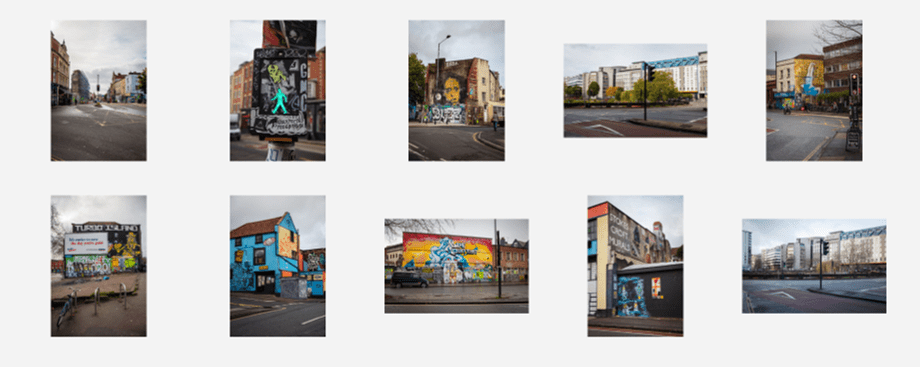
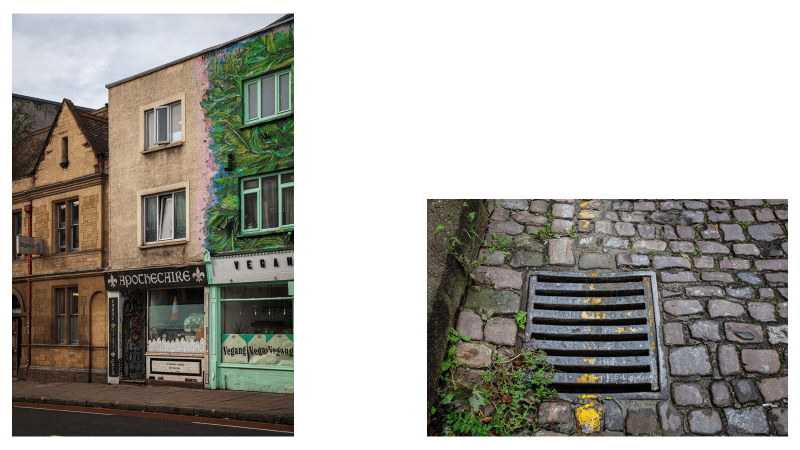
The intention of my work is to document what I believe are the last days of the areas in my city known as Stokes Croft and The Bearpit. Originally Stokes Croft referred to a section of road by this name, however, over time it has come to refer to an area surrounding this road which has a distinct cultural and community identity. This is particularly seen in the diversity of people, artistic enterprises and graffiti art which appears throughout the area, including artwork by the well-known Bristol graffiti artist, Banksy. I do not wish to romanticise the area or make it appear more glamorous than the reality of what it is, so I acknowledge and hope to portray that this area is not without its problems – it has historically been neglected by local authorities, leading to social issues and urban decay. However, the community itself has transformed the area into a colourful space of diversity, tolerance and freedom of expression, something I value and believe is important in our city.
It is my belief that it is only a matter of time before development will completely erode the character of this area, the slow creep of gentrification has already begun and just in the time since I started the MA, the Bearpit was locked down and stripped, the graffiti washed from the walls and Ursa the Bear, a much loved art installation in The Bearpit, was also taken down. This is the moment that I feel the heart of the city was wounded and the slow creep of gentrification had become visible. I do not purport to change this or to prevent it or to challenge it through my photography, as this has already been done by various groups and campaigns – the slow creep of gentrification has been eating away at the heart of this area for years already, so my intention as an artist and photographer is to preserve what I can through photographically documenting the area across time and before the cultural identity of the place is gone forever. At the same time my own feelings of loss and sorrow are what I also hope to convey within the images, as I believe this will explain and express my human choices.
My practice at this time might be considered as anti-establishment and anti-intentional which is even more pertinent because of the area my current project is documenting – the spirit of anarchic rebellion has always been the spirit of this place. I am not neutral in my feelings towards the area and the way in which it has been impacted by decisions made by a faceless officialdom and authority, yet I may not overtly express a political stance due to my personal circumstances and the nature of my employment. This is one of my limitations and also my challenge, to be able to express through image that which I cannot through verbal statement, to make clear my stance and feelings, and communicate that I am not neutral in the choice of what I photograph, of what I include in the frame and where I am located inside this narrative.
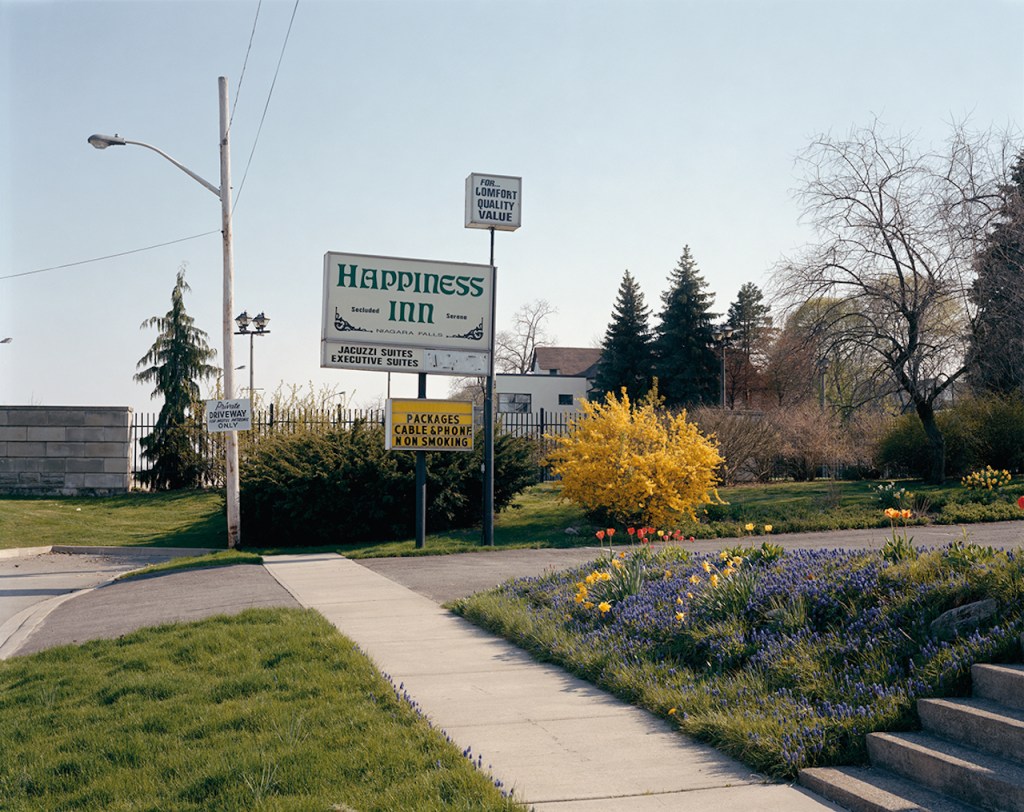
In many ways, academia and the arts, is also a form of establishment, and this could also be translated as conformism to contextual traditions and styles. Again this is one of the challenges for me, as I struggle to balance this desire to learn and inform my photographic choices without becoming mired in conformity or colouring this project with the perspectives of establishment. I aim for a raw, honest authenticity in my work – with no artifice or sense of construction to a scene, but rather a more spontaneous on the ground feeling to the images. I want the viewer to see the scene as it is, unapologetically flawed, imperfect and rough. I feel that I am most resonant with the tradition of the snapshot aesthetic, a technique that was made prominent in Stephen Shore’s American Surfaces. Inspired by Stephen Shore’s work, I aim to capture the mundane, the everyday reality in a way that begins drawing the viewer in as if they are part of the scene, really there, participating in the image and not just viewing it.
I want the images to be relate-able, to connect with the people who know this area, understand it’s character and recognise the places in my images, making this aimed to some extent at a niche market. Yet I believe that there are many communities that are similar and undergoing the slow creep of gentrification, which means that it will be recognisable to others from other cities, to other people who are experiencing this same sense of loss of community and place. The impulse to document places and their socio-cultural contexts in a way that creates this broader narrative is inspired by those photographers who have embodied the concept of the ‘American road trip’ into their work, in particular Stephen Shore, Alec Soth, Edward Ruscha. All three artists have incorporated travelling, or journeying, into their practice, be it through road trips or walking, be it across a country or simply in their own cities in a the so-called ‘on the road’ style of photography that I find tremendously authentic and honest.
“I fell in love with the process of taking pictures, with wandering around finding things. To me it feels like a kind of performance. The picture is a document of that performance” – Alec Soth (Magnum Photos, 2020).
These artists show a natural curiosity for the world they live in, an awareness of the beauty of the mundane and every day places and people, that tell the real story of a time and place. They are also all willing to undertake long term and large-scale projects in order to tell a compelling story of the reality of place and people. These are all aspects that influence my work and provide the context from which my work is informed despite being located in an entirely different part of the world and working in a far smaller scale. As I do most of my photographic exploration through walking, I also relate to the older French tradition of the flaneur, the urban wanderer and artist, as described by the French poet Charles, Baudelaire and embodied by photographers such as Eugène Atget andBrassaï. I also feel affinity to aspects of the related tradition of psychogeography, a concept defined by French philosopher and Marxist, Guy Debord, which brings in the psychological aspects to a place and adds a sense of the mysterious to my explorations of the urban areas in which I wander.
The act of walking is, in fact, integral to my photographic practice and my experience or sense of the places I explore, as it is this powerful and intentional act of walking which helps me to the understand and know the subtle nuances and details of a place, which is what I hope to share through my images. There is no artifice or gloss to the images or to this project as a whole, as this is what gives it authenticity – the gritty, real and tangible feel to the image – and it is authenticity that elicits a response. I believe this has been both my success and my failure simultaneously – it has been achieved but perhaps not understood without knowing the wider context of my artistic vision and the direction I am taking, something I have struggled to define and articulate. Perhaps this is related to the sense I experience daily of being ‘silenced’ by rules, regulations, systems of hierarchy and power.
Going forward, I aim to express more freely and clearly what I truly feel as I believe there is opportunity to express my subjective feelings within a framework of documentary narrative. I view the image,the photograph, as a form of communication – a way to start a conversation, engage with an issue or an audience, to tell a story and invite participation in this story. This impulse must naturally push me towards exploring street portraiture even though I am uncomfortable in this style. Conceptually, this is the next step to explore along with further immersion into the snapshot aesthetic, and possibly even exploring black and white photography as an artistic choice. I am considering exploring different techniques by using 35 mm film photography as a means to experiment initially and potentially including Polaroid to bring something a little different to the project as I move further into the process.
An important concept that I must emphasise and which is always central to my practice, no matter what context, technique or aesthetic I apply, I don’t want to decide for the viewer what they will feel or think when looking at the scenes I capture. I want them to experience it for themselves and to only become aware of my subjective feelings as the artist once they have already begun to follow the narrative as the viewer – this I hope to achieve through the small links and clues provided within the images, within their sequencing and layout, and potentially by the inclusion of text. This will hopefully invite the viewer to engage with the image and the narrative, allowing the viewer to become immersed into their own experience of the scene and only then becoming aware of my presence and feelings as a participant within the narrative, a character within the scene, in relationship with it or to it. There should be no fixed script, but rather a fluid and unique response to the experience as this is when narrative becomes dialogue; when viewing becomes experiencing. This is my aim and artistic vision – my human choice.
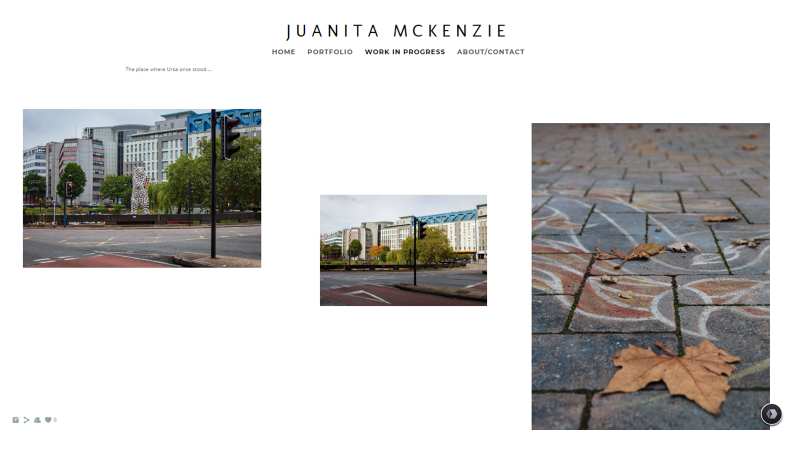
I have made it through a term that was quite tough for me but do feel a tremendous sense of achievement after submitting the assignments for the term. I am particularly pleased with the website I have set up to showcase my portfolio work and current projects. My Work in Progress has been submitted as part of the assignments for this term and can be viewed here: Work in Progress.
This is my oral presentation to accompany the work in progress for the term.





 Journey Through the Lens