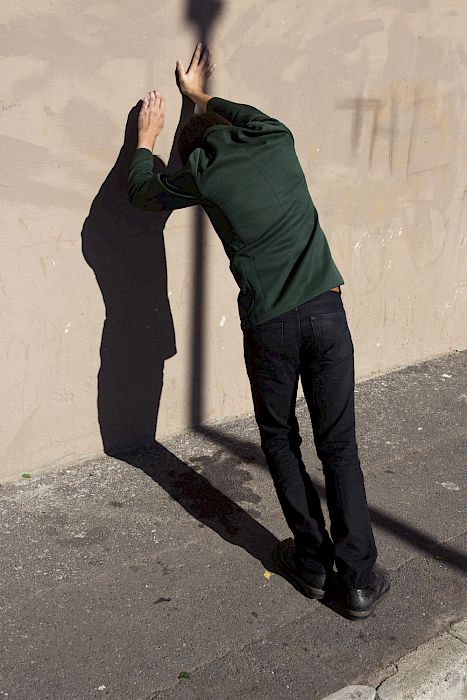
Contextual Research – Viviane Sassen

In the previous webinars discussing photography markets, I came across the work of Viviane Sassen. She is a Dutch photographer who is extremely successful in both fine art and fashion photography. Although her genre of photography seems completely unrelated to my own practice in urban photography, there was something about her work that really stood out to me and made an impact.

I was particularly drawn to her 2014 series, Umbra, in which she makes strong use of shadow, contrasts, colour, shadow and lines. When I came across the video below and heard Viviane Sassen describe how and where she discovered her photographic voice, I began to understand that I had been unconsciously drawn to the light and colours familiar to a landscape I had known most of my live, the African landscape, having grown up in South Africa. Viviane Sassen describes that it was only upon spending time in Africa that she connected to her creative voice and it is there that she learned about working with light and shadow, bright colours and sharp contrasts.

Her sensitivity to her subjects while in Africa is so clearly expressed and she acknowledges an awareness of the imbalance in power between her as the photographer and her subjects. Sassen approaches her subjects by gaining their understanding of her intention and that the photography is about concepts that are far larger and more abstract than themselves. She approached these images from a symbolic perspective and this resulted in a powerful series of portraits that made a tremendous impact on me because she has succeeded in capturing the essence of her subjects, somehow merging the present moment, with the cultural and historic inheritance of people and place.

“One of the best ways to appreciate Sassen’s work is through her photobooks. Flamboya merges documentary and fine art to find a new way of looking at Africa, one that is neither exoticising nor straightforward reportage. Parasomnia is a more dreamlike exploration of Africa that draws on those childhood memories and vivid dreams.” (O’Hagan, 2013) Sassen herself encourages photographers and artists to experiment and push the boundaries on creativity, working intuitively to create the magic . I feel truly inspired by her approach to photography and will refer to her work often as I experiment with the use of light, shadow, colour, contrast and line in my own work.

Viviane Sassen talks about her photographic process and how she discovered her creative voice.

Reference: O’Hagan, S. (2013). Fashion photographer Viviane Sassen: a different take. [online] the Guardian. Available at: https://www.theguardian.com/fashion/2013/oct/12/fashion-photographer-viviane-sassen [Accessed 8 Dec. 2019].
Submissions – Snapshot

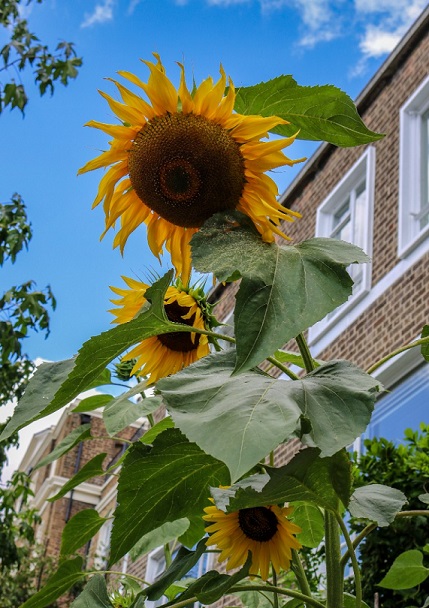
In October, I entered the RPS Monthly Photo Competition. The theme was Snapshot and I interpreted this as being an image that would create a sense of immediacy and closeness that would allow the viewer to feel present when viewing the image.

I selected an image taken during the summer when I got lost walking in London and which unexpectedly led me to discover beautiful sunflowers in the middle of the city. This is a flower that brings me fond memories of my childhood, growing up near Johannesburg, in South Africa where it was a common sight to see them growing in the fields.

The image is taken looking up at the tall sunflowers to emphasise their height and replicate my memories and perspectives of seeing these flowers as a child, but in contrast they are set against the backdrop of the city environments that are my adult world. I always enjoy photographing interesting juxtapositions in the world around me.

The competition closed at the end of October and I was delighted to discover I had been shortlisted. The shortlisted images can be viewed here.

London Sunflower © Juanita McKenzie

Live Brief – Second Group Meeting

Due to work demands, I was unable to attend the second group meeting for our Live Brief presentation which is disappointing. However, I did receive feedback from the rest of the group who felt it was a very positive session with some good points made. The webinar was recorded so I was able to watch it later and catch up.

Both tutors, Anna and Jesse, seemed to agree that they liked the concept of having both a video and photographic stills.  They also both agree that Instagram is a good channel for our campaign but Jesse cautioned that we do need to be aware of its limitations.  For example, he raised concerns about sound saying that many people will flick through Instagram stories without turning on the sound which means that the punchline of the video clip we had created would be completely lost. 

To address this, he suggested that we would need to either go with an entirely visual clip or we would need to find a way to encourage viewers to use sound.  Anna agreed but felt we should keep the sound and therefore rather encourage them to turn the sound on.   Both tutors liked the choice of the video clip and appreciated our take on bringing awareness to the hidden aspects of brain injury. 

Both tutors particularly liked the way that we were keeping our campaign ethical and novel at the same time through the combination of workshop (documentary style) and film/stills (editorial/advertising style). However, they felt that we were trying to do far too much in a single campaign, and needed to focus it by doing less. I agree very much with this feedback as I had felt we were going in too many different directions.

Overall, the group is very pleased with the feedback and we are in discussion about our next steps.

Journal Reflection -Sustainable Prospects Week 5

Individual Tutorial

This week I had my first individual tutorial with my tutor, Laura. I have not been able to attend many webinars so I do feel as though I have not been able to benefit fully from her experience and guidance through the weeks so far. Laura has, however, been brilliant in getting to know me and developing an understanding of my photographic practice and current work.

Laura observed that although I don’t believe I have yet found my creative voice, that I have already developed my own style which is consistent across the images I have presented to her. We talked about how I am grouping and sequencing my images and exploring ways to create a narrative through clever use of sequence. I mentioned that I think this project may lend itself to becoming a photography book and Laura has suggested I think about how I would incorporate some text and to research ways of doing a creative layout for a book.

Through questioning, Laura extracted that I spend a lot of time walking and exploring my environment to discover the things I photograph. She quickly identified that this is a core part of my photographic practice and she has suggested I do some reading on the subject of walking and try to reach a deeper insight around why this is so important to me and how this shapes my photographic practice. She has recommended a book that I have now added to my list of reading for contextual research.

I felt the tutorial was very encouraging and supportive, and I particularly liked that Laura asked a lot of questions which led me to some important insights about my practice. She is definitely getting me to explore a different layer of meaning within my current project and this is leading me to explore why I do what I do, why I have chosen this particular project and what it really means to me.

Fallen ©Juanita McKenzie

Who Buys Photography?

The coursework is now focused on an in-depth exploration of the market for selling photography, with a focus on identifying who the potential buyers are, understanding how to sell photography and how to price work for different markets. We explored practical aspects of pricing, writing estimates, production and invoices, as well as terms and conditions.

Our module leader, Anna, presented two live workshops to discuss the various markets and how to break into them. The discussions were intensive and sparked a number of questions, so Anna has agreed to follow up with further workshops on this subject.

We initially discussed the differences between editorial and advertising markets, summing up that the main difference are in the process, result and target audience. Advertising usually has a very specific brief and is about promoting a brand or product, whereas editorial photography is more open to a pitch and is about telling a story or illustrating something. Fashion photography falls into the category of editorial photography and is an example of visual story telling with no text involved. We also looked at how there is some crossover with fine art and fashion photography.

We further discussed the usage of images and discussed licencing as opposed commissions. The conclusion I came to was that licensing is by far the quickest and easiest option for commercial work. Being able to calculate the costs of licensing is an important part of calculating rates for work and a great resource to refer to is the AOP website which has guidance around this and on writing up terms and conditions, all of which are essential as a professional in the industry.

The fine art photography market is predominantly based in Paris and New York and centered around some of the important galleries, and annual fairs and exhibitions, such as the Paris Photo Fair. It is a very difficult market to break into and only a limited number of artists are successful in selling in the fine art industry.

A photographer who has been very successful in establishing a career in both the fashion and fine art world, is Dutch photographer Viviane Sassen. She has done a number of installations, exhibitions and books, and has received numerous rewards. She has developed a distinct visual language and strong personal brand which is one of the reasons she has been so successful. She is an artist whose work I was not familiar with previously but who I will research further as I believe there is a lot I can learn from her photographic practice and apply to my particular genre of photography.

Heine #01 from UMBRA, 2013 ©Viviane Sassen
Heine #02 from UMBRA, 2013 ©Viviane Sassen