Week 12 – Wrapping it up

I have made it through a term that was quite tough for me but do feel a tremendous sense of achievement after submitting the assignments for the term. I am particularly pleased with the website I have set up to showcase my portfolio work and current projects. My Work in Progress has been submitted as part of the assignments for this term and can be viewed here: Work in Progress.

This is my oral presentation to accompany the work in progress for the term.

Journal Reflection -Sustainable Prospects Week 11

Coursework this week looked at the importance of marketing and ways in which to do so. We were tasked to think about a marketing plan for ourselves for the next 10 weeks and to break it down into a series of steps. As I am very time pressured at the moment, I am aware that I will need to make this plan something simple, realistic and achievable.

  1. Create a site for my online portfolio and a gallery. This can be part of my final assignments and where I can present my work in progress.
  2. My website is only partially done so get this up and running during my time off for the holidays.
  3. Review my Instagram account and either re-brand or open a second account ideally to coincide with the first week of the New Year.
  4. Consider whether I want other social media platforms at this stage, such as Facebook and Twitter and set up the accounts if I decide to implement them.
  5. Plan a schedule for sharing content on social media – looking at content, best times and events/holidays.
  6. Design and print business cards to match online logo.
  7. Run a paid promotion on Instagram.
  8. Do some planned surveys via Instagram as a means of market research to understand what content my audience wants.
  9. Develop a professional portfolio.
  10. Write some blurbs about what I do and which can be used within pitches or at networking events.
Planning for the future ©Juanita McKenzie

Journal Reflection -Sustainable Prospects Week 10

This week our module leader, Anna, invited us to create Instagram accounts if we didn’t already have them and to think about a strategy for using them. I have already got an Instagram account and have been active for about 18 months. I have taken very readily to this platform and have found it to be an excellent means of networking, forming community, connecting with an audience and staying in touch with what is going on in terms of trends, events and so forth.

My account has a good following that has been grown completely organically without the use of apps or paid promotions at this point. It was simply a case of sharing content regularly, initially on a daily basis and engaging directly with my audience. This is really about relationship building and I think this is very important and I will always keep this personal connection no matter how big my account may grow.

I now don’t always post daily as it is not necessary to maintain and grow my audience, however, I do post consistently at least 2 – 3 times a week at times and days of the week that have proven to be my best for engagement. I have a good engagement rate as a result and this is important in getting work seen based on the way that algorithms work on Instagram.

I have recently switched to a business profile for my account but have it listed as a personal blog. I chose to make the switch so that I could use the paid promotion feature in the future as my research indicates this does bring results and puts your work in front of the right target audience. It is also an inexpensive way to market.

I am considering changing my profile to make it more professional but I am not sure how this will impact on my current audience as essentially this would be a re-branding exercise. I am still debating wither I should rebrand or open a second account for my professional Instagram presence. Many photographers have more than one account and say this works well for them.

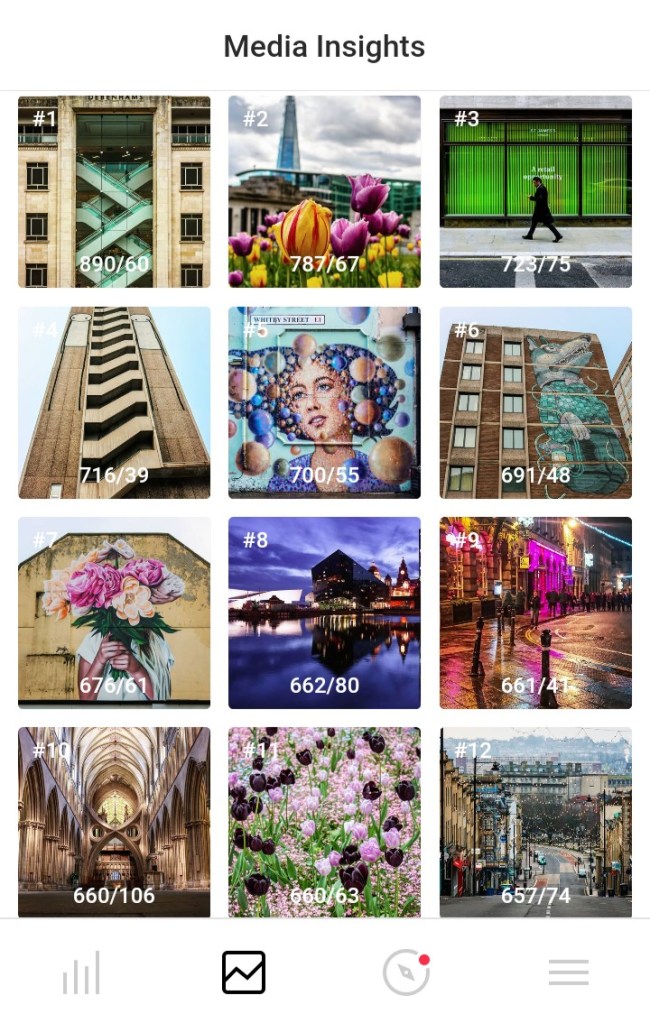
Lastly, I do make use of an app to track who follows and unfollows me as there is an annoying tendency on Instagram for people to follow and unfollow as a way to rapidly increase their following. I use the Instagram business account analytics feature to keep an eye on my engagement and to establish what content is working best. These are essential tools to assist with getting the right content to your audience.

Screenshot of my media insights tool showing likes showing the top posts and the number of likes and comments. These are useful analytics to work with. Instagram: @juanita_mckenzie_

The Digital – New Possibilities

Repeatedly through the course of this term and the previous one, we have at various times reflected on the impact of digital technology and social media on the photographic industry. On one hand, it has made the market very competitive and, some say, oversaturated with inferior quality images, but on the other hand, it has created a tremendous opportunity for photographers and visual artists to showcase their work and connect directly to their audiences and potential markets. Social media offers a very effective way to network online and connect with others on a global level.

Anna, our module leader, said that in her opinion Instagram is one of the most effective online platforms for photographers, providing opportunities that were not their previously. She discussed the importance and value of having an online presence and invited us to submit work to the University Instagram to be published online. This is something I will definitely consider doing in the future as I am already an active Instagram user. We also discussed the importance of having a strategy for Instagram and other social media as these are great marketing tools.

A screenshot of my Instagram feed @juanita_mckenzie_

Journal Reflection -Sustainable Prospects Week 9

Individual Tutorial

My tutorial this week was very insightful yet again and has given another layer of meaning to my project that I feel is definitely worth exploring. in fact, it is starting to change the project slightly and this is an interesting development. Laura likes to find out more and is very good at asking the right questions that lead to deeper exploration of my motivation for my project.

We discussed the narrative around ‘walking’ and the book I have been reading by Erling Kagge, called Walking. I am starting to see that there is tremendous significance to the act of walking and the metaphorical association with a journey or quest. In many ways this is me mapping my location with my feet and this relates to the concept of psychogeography as discussed by Merlin Coverley in his book by the same name. I have observed that walking is a way that I discover the true nature of a place, mapping it in my psyche in the tradition of the ‘urban wanderer’ referred to by Coverley. This is a thread that weaves through this project and my photographic practice as a whole.

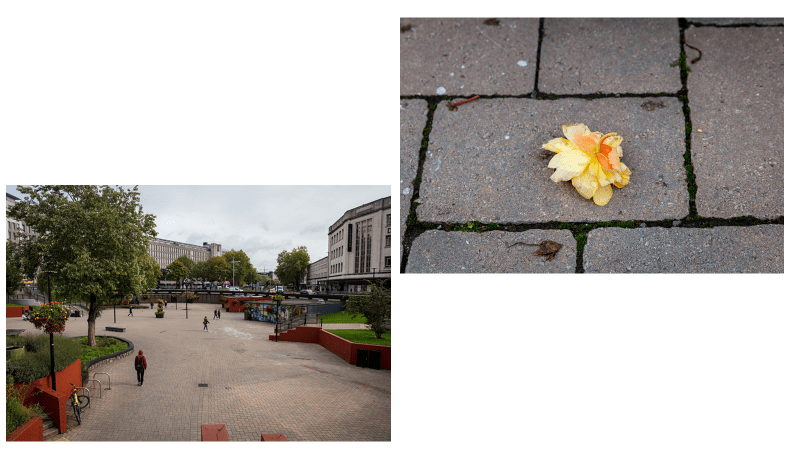
I discussed with Laura how lost I felt after Ursa the Bear had been removed from the Bearpit and discussed how some of the photographs I included in my presentation today reflected this sense of loss and emptiness. It had led me off on a tangent focusing on autumn in the city as a poignant reminder of the transient and fleeting nature of all things. Although Laura liked the autumn images, saying they make her want to touch them but she did not feel they were part of the same project as my Bearpit work.  She described them as being beautiful surfaces and beautiful things, but said that if I wanted to include them in this project then I would need to be creative about how I paired the images with others in order to capture attention.

In looking through my photographs from the Bearpit, Laura said that she felt like I was hovering in a safe space with this project and she wanted to see my going deeper with it. She has suggested that my project is becoming about looking for the bear and, in so doing, looking for my own sense of place. Laura has suggested that Looking for Ursa is potentially the name of this project and could be the central concept to it. She is definitely challenging me to connect to the emotional and psychological aspects of this project and my relationship with it.

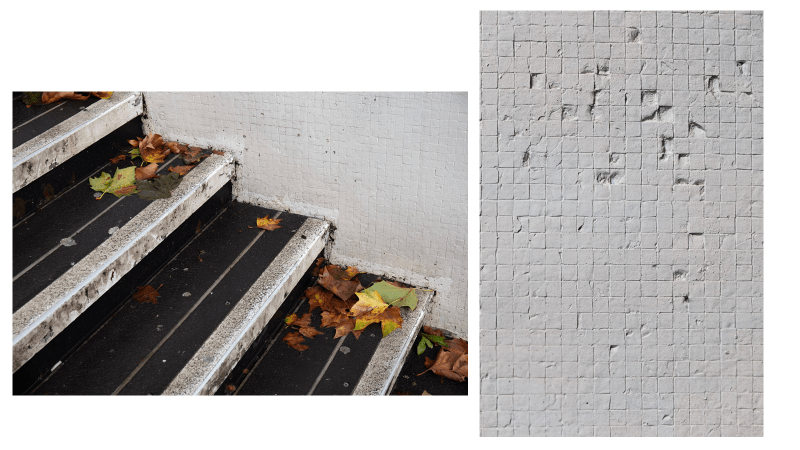
Laura particularly loved the image of the stairs and the wall sequenced together – she says these are very decisive in their framing.  They are almost black and white in their stark contrasts, and the flatness is appealing, they could be taken anywhere – in other words we don’t know where they are from or why they are there – making it intriguing.  She said that as the viewer she is almost unsure if they are outdoors or indoors shots and there is a feeling of the outdoors being indoors or vice versa. This is why the sequencing of work is important, as it creates an experience for the viewer.

Most importantly, Laura wants me to really go looking for Ursa, and an idea was to go about finding her origins and history, looking at archival material.  The project is about finding her, anything I can find out about Ursa is important to the project and would be interesting to the work. It may turn out to be less about actually find Ursa but perhaps about what I find out, or find along the way.  

References: Coverley, M. (2018). Psychogeography. Chicago: Oldcastle Books.