Live Brief – Project Review

Live Brief – Week 10

Now that we have reached the end of the live brief project and delivered the final pitch, it is important to have a debriefing and review the project. As we are all approaching the deadlines for assignments this term and trying to keep up with the workload, as well as jobs and other life demands, it seemed that there was not time that we could arrange where everyone could be present to do a debriefing discussion. I took it upon myself to start a document and share this with the rest of the team so they could add to it in their own time. It seemed the best solution to allow collaboration for a team working remotely. These are some of the main points extracted from this:

What did we do well?

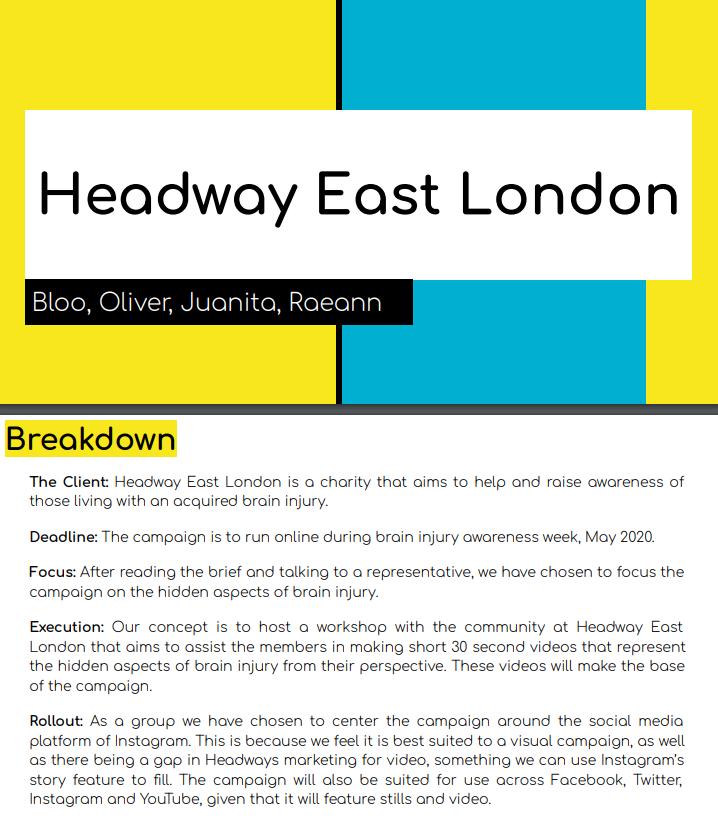
  • We understood the brief quickly and did very thorough research which allowed us to meet the brief accurately, identifying the most appropriate social media channel and understanding the organisation’s ethos and way of working collaboratively. These formed key parts of our campaign.
  • Communication was excellent with use of Whatsapp, conference calls, Google Drive. Weekly meetings were well attended and documented in the event somebody couldn’t attend.  
  • We always worked respectfully and heard each others viewpoints even if we didn’t always agree.  We were always able to give and receive feedback within the group and could adjust accordingly. We received tutor feedback very well and used it to develop the project further. We changed course quite dramatically in response to the feedback in our second review and this was a positive move.
  • We worked extremely well as a team.  Great teamwork with people putting in as much time and effort as possible, and voluntarily covering when others couldn’t.  
  • We were willing to take a creative risk and this was well-received.

What could we have done better?

  • If we had identified earlier that we were doing far too many different work streams, we would have been able to work with more focus and more efficiently.  We could possibly have come up with more of our own creative content if we had gone with a narrower focus. 
  • It would have been great if more of our own content had been included in final pitch (however, I know for all of us this was based on time constraints and the demands of work and studies).
  • It would have been more professional if we had agreed on a budget and minimum rates prior to the pitch.  

What are the lessons learned that we could apply to future projects?

  • After the initial creative brainstorming, it is important to narrow the vision down so that the project becomes very focused, efficient and streamlined. Agree on a set of clear parameters so everyone can participate creatively on equal terms to produce consistent results.
  • More frequent reviews, both of project milestones and the creative output from the team, are important to ensure the project is staying within scope, timeline and according to brief, as well as working effectively.  Question the plan if things don’t appear to fit and be confident in raising any issues or concerns. Being able to adapt and adjust accordingly is essential.
  • Make sure that every possible detail has been taken care of before the final pitch.  A rehearsal of the pitch may be a good way to identify any missing information, areas that need more work or questions that may arise.  

Looking back, this has been a very intense 9 weeks working hard on our studies and also on the live brief. Despite the challenges of working long distance and never meeting face to face, we managed to collaborate and create together. It has been a tremendous experience to be able to work on the live brief and gain valuable knowledge through this process. I think we did a great job to deliver our final pitch to deadline and it was a real pleasure to work on this project with Bloo, Raeann and Oliver, who were always positive, always willing to pitch in and do the work and considerate of each other every step of the way. We made a great team!

Journal Reflection -Sustainable Prospects Week 9

Individual Tutorial

My tutorial this week was very insightful yet again and has given another layer of meaning to my project that I feel is definitely worth exploring. in fact, it is starting to change the project slightly and this is an interesting development. Laura likes to find out more and is very good at asking the right questions that lead to deeper exploration of my motivation for my project.

We discussed the narrative around ‘walking’ and the book I have been reading by Erling Kagge, called Walking. I am starting to see that there is tremendous significance to the act of walking and the metaphorical association with a journey or quest. In many ways this is me mapping my location with my feet and this relates to the concept of psychogeography as discussed by Merlin Coverley in his book by the same name. I have observed that walking is a way that I discover the true nature of a place, mapping it in my psyche in the tradition of the ‘urban wanderer’ referred to by Coverley. This is a thread that weaves through this project and my photographic practice as a whole.

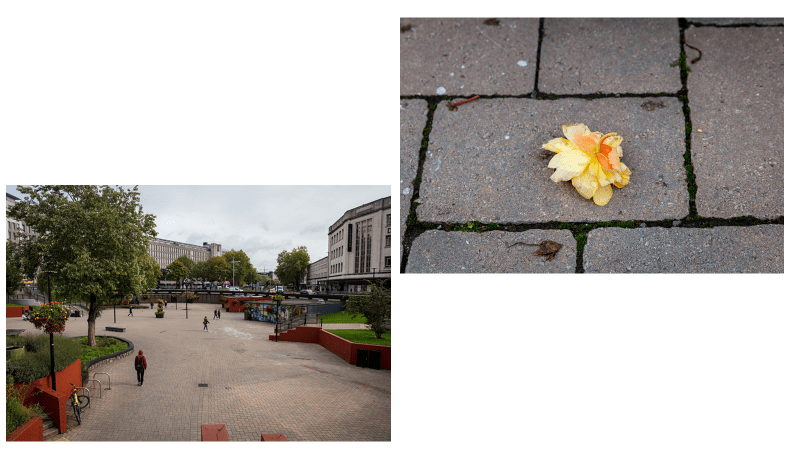
I discussed with Laura how lost I felt after Ursa the Bear had been removed from the Bearpit and discussed how some of the photographs I included in my presentation today reflected this sense of loss and emptiness. It had led me off on a tangent focusing on autumn in the city as a poignant reminder of the transient and fleeting nature of all things. Although Laura liked the autumn images, saying they make her want to touch them but she did not feel they were part of the same project as my Bearpit work.  She described them as being beautiful surfaces and beautiful things, but said that if I wanted to include them in this project then I would need to be creative about how I paired the images with others in order to capture attention.

In looking through my photographs from the Bearpit, Laura said that she felt like I was hovering in a safe space with this project and she wanted to see my going deeper with it. She has suggested that my project is becoming about looking for the bear and, in so doing, looking for my own sense of place. Laura has suggested that Looking for Ursa is potentially the name of this project and could be the central concept to it. She is definitely challenging me to connect to the emotional and psychological aspects of this project and my relationship with it.

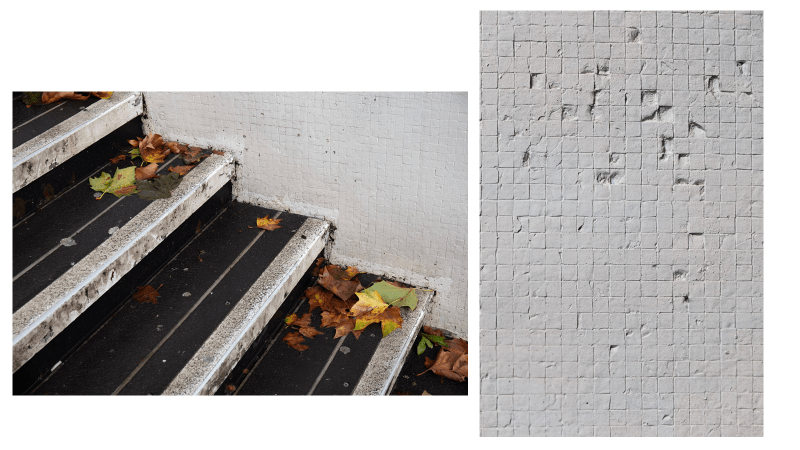
Laura particularly loved the image of the stairs and the wall sequenced together – she says these are very decisive in their framing.  They are almost black and white in their stark contrasts, and the flatness is appealing, they could be taken anywhere – in other words we don’t know where they are from or why they are there – making it intriguing.  She said that as the viewer she is almost unsure if they are outdoors or indoors shots and there is a feeling of the outdoors being indoors or vice versa. This is why the sequencing of work is important, as it creates an experience for the viewer.

Most importantly, Laura wants me to really go looking for Ursa, and an idea was to go about finding her origins and history, looking at archival material.  The project is about finding her, anything I can find out about Ursa is important to the project and would be interesting to the work. It may turn out to be less about actually find Ursa but perhaps about what I find out, or find along the way.  

References: Coverley, M. (2018). Psychogeography. Chicago: Oldcastle Books.

Live Brief – Pitch

After working together as a group for 9 weeks, the day has finally arrived for us to do the live pitch for Headway East London. Due to the time allocated for the pitch, only two of us could be present, as one of our members could not get time off work and the other could not attend because of the time zone difference.

We had agreed that Bloo would present the pitch as she was also the person who had so beautifully compiled and designed the visual document for the pitch. My role was to be in the background and provide support if necessary. This meant I was able to observe the reactions of our tutors and those of the team from Headway East London.

They appeared to be really engaged with our presentation and were particularly positive about our choice to focus on Instagram as the main social media channel for the campaign, and appeared to enjoy the presentation of the video clip. They were particularly excited about our workshop concept and said that this way of working collaboratively was precisely their way of working with their members.

We had loosely agreed on a budget but had not included this in our campaign pitch. This may have been fortunate as we were caught out by the fact that the other group who had pitched had offered to do this campaign pro bono. We both managed to field this question well and successfully navigate this unexpected development.

Afterwards, I managed to watch the recordings not just of the other group who pitched for Headway East London, but for all the groups who had pitched to other organisations too. I found it very valuable to see how these groups had worked together and how they had interpreted their briefs. Overall, I think we did extremely well as a group as we understood the client and their brief. We have worked exceptionally well together throughout the 9 weeks despite challenges and we can be pleased with what we have achieved.

Journal Reflection -Sustainable Prospects Week 8

It has been a busy week with preparation for the pitch that is coming up and also with me attending the Laia Abril talk, the Sugar Paper Theories Exhibition and talk with the artist Jack Latham, and also a visit to the Martin Parr Foundation. These were all very valuable in learning about how to research projects and how to work with subjects for documentary projects in ways that are ethical and collaborative.

I was very interested in how these artists approached the photographic narrative and art of story-telling, something which I would love to develop further and would be eager to learn more about in the course of my MA Photography. The other aspect of these talks that was of big interest to me was the way in which they approached the creation of a photobook and made it unique with clever design, layout and inserts. These are all techniques designed to create visual interest and subtly guide the viewer to reach their own conclusions about the topic. Very insightful talks and it was great to be able to attend.

Events & Exhibitions

The Miniclick Photo Talks – Laia Abril

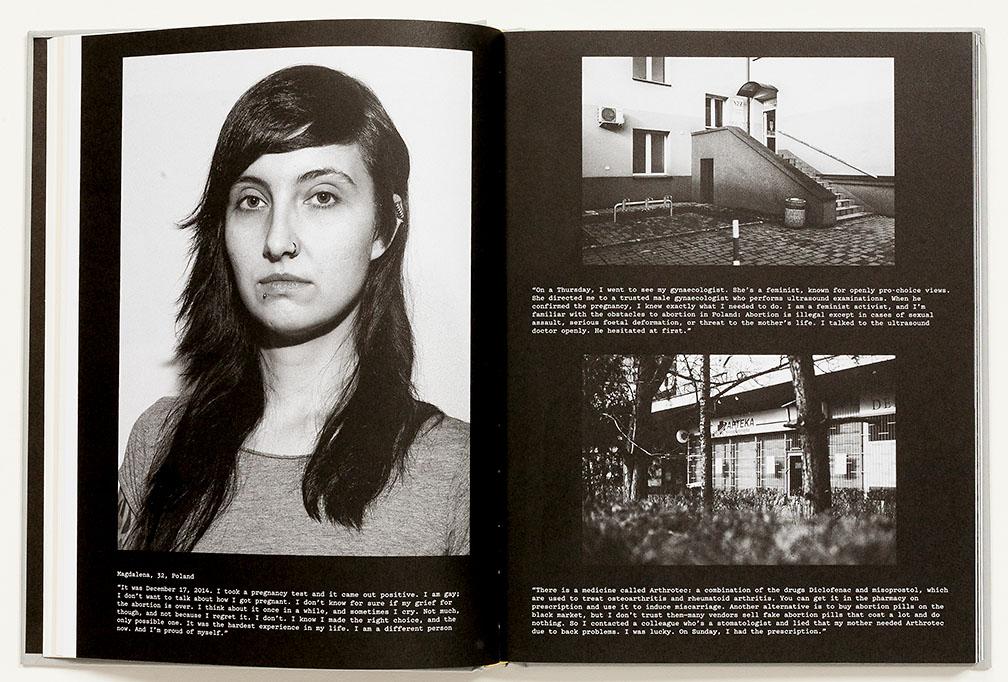
This was a fascinating talk that I attended with a fellow student on the MA Course. It was a Miniclick Photo Talk with Laia Abril, a photographer and multi-disciplinary artist who works across a number of different mediums and platforms. Her work relates to femininity but addresses the uneasy stories and realities around subjects such as gender equality. She has produced a number of books around these subjects, including A History of Misogyny: Chapter One: On Abortion (2018), which looks at abortion controls and how this appears across many different cultures, as well as showing the repercussions of these controls. Abril is currently working on A History Of Misogyny, Chapter 2: On Rape Culture.

This is not my usual choice of photography or artist, however I was quickly captivated by Abril’s own review of her work, which showed her to be a deeply insightful, sensitive and courageous human being. She spoke of how she considered her subjects and the potential danger they could be placed in through working with her. She was always aware of this every step of the way and was very protective of the woman who agreed to be her subjects. She also admitted that the danger and threat was also a potential for her as the photographer who could easily become a target around such emotional issues and readily acknowledged that she sometimes feels scared. I was very impressed with her strong sense of ethics and courage.

Abril approached these books by visualising complex situations and emotions, things that cannot be photographed. She then attempts to articulate and represent these visually. She supports her work by doing an immense amount of research and this stems from her journalism background. She said that reading and text research was central to her projects and that this is valuable when as a photographer you are located geographically far away from your subjects. Abril said that her process was one of accumulating information and then finding her position in it.

Her goal, she says, is usually a book and her aim is to make sure the viewer enjoys it from start to finish, so this can be difficult when presenting uncomfortable issues such as abortion. This has meant she has had to become very creative in how she designs a book or presents an exhibition. Abril focuses on how she groups images together, integrates text into the artwork, uses clever inserts and includes interesting representational images. She makes use of small, simple images because she believes it is more powerful for people to make the connections themselves.

Abril is always incredibly sensitive towards the women who are her subjects and says that it is through building a connection that they will talk to her, when they feel comfortable and safe. She cautions that it is important to be aware of how a subject experiences working with a photographer as we do not know the impact we have on them emotionally and psychologically. As photographers we must always consider how we portray our subjects, but also how we interact with them and what the impact on them will be.

Although, this is not my particular style of photography, I learned a tremendous amount from this discussion and would be apply to apply this in the future if I begin to work with subjects as part of social documentary projects.

On Abortion, 2018 ©Laia Abril