Prior to the start of this module, we were invited to participate in a voluntary challenge inspired by the work of Ed Ruscha. The aim of the task was to produce a series of images as a small book, inspired by one of Ed Ruscha’s.
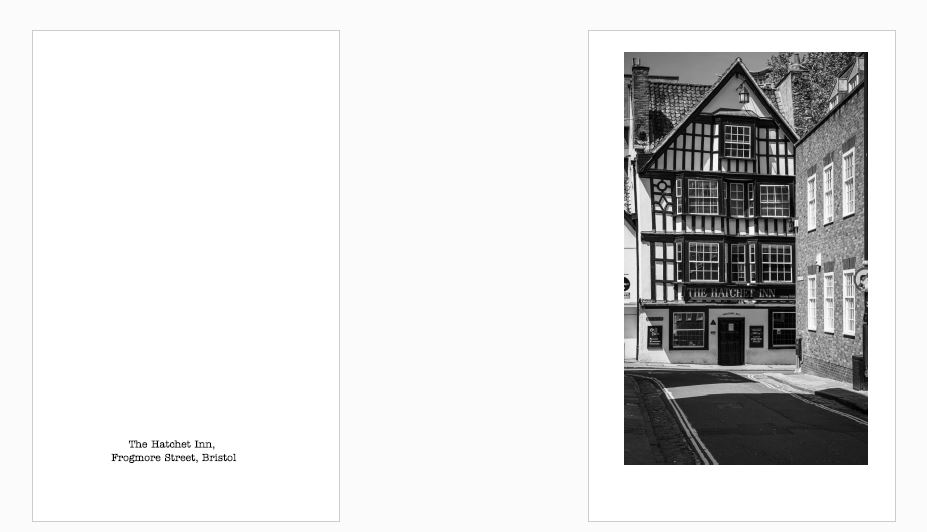
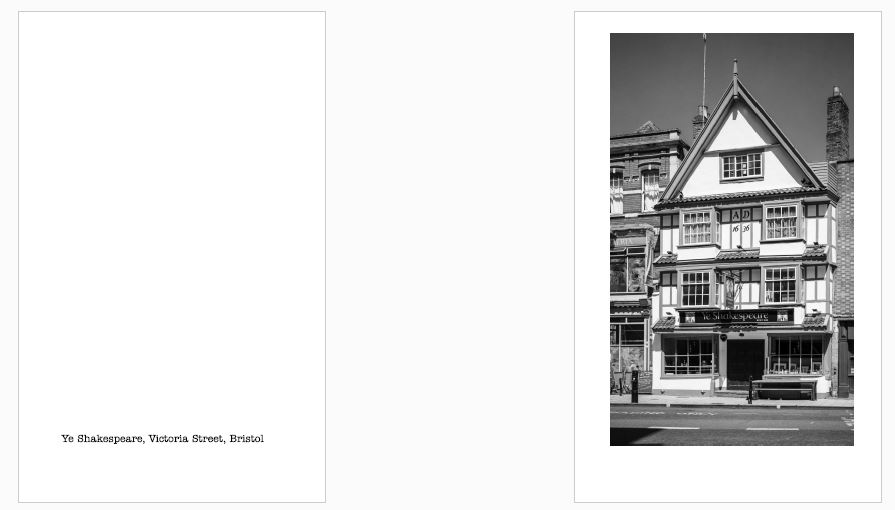
In responding to this challenge, I chose to work with an interpretation of Ruscha’s book: Some Los Angeles Apartments, 1965. I decided to choose a similar subject but one which would be related to a current theme: the impact of Covid-19 reflected in the local pubs that were closed as a result of lockdown measures. I planned a route to walk and took all the photographs on the same day of a selection of closed up pub buildings.
I chose to produce my images in black and white and to format their layout in a very similar style to that used by Ruscha in this particular book. Staying with this style, I used very little description and simply provided a caption in a plain font that stated the pub name and location. I titled the book in the same style font and layout as Ruscha’s and titled my book project: Some Bristol Pubs in Lockdown
I have been fascinated with the work of Ed Ruscha for some time and was also fortunate to view his exhibition at the Tate Modern earlier this year (see previous post), so this challenge was one I really looked forward to doing as I have found a lot of inspiration in his work. In approaching the challenge I opted to print a book that would look very similar and would draw upon Ruscha’s use of typography, layout and simple captions. I usually work in full colour but opted to work with black and white images not only to stretch my creative abilities but to create something similar in feel to those created by Ruscha. Below are some samples from the book that I printed.
One of the biggest challenges facing any visual artist and photographer is that everything has already been done before and we need to find ways to make our work unique and stand out from within the millions of images that we are bombarded with each and every day. Exploring strategies of looking refers to the returning to or revisiting moments and their place in time. This is a valuable method and approach to photography as looking at previously made images and ideas is a way to learn from them and to incorporate these strategies into my own approach and methods.
My practice has always been rooted in the urban landscape with a focus on architecture, non-spaces, structures of power, identity of places, and cycles of decay. My interest in the urban landscape arose from the New Topographics movement and photographers such as Edward Ruscha, Lewis Baltz and Joel Steinfeld. Their images of man-made urban structures and photographic stills capture the details within the emptiness of the urban environment while simultaneously implying a human presence.
This is something I’ve incorporated into my own work and I’ve begun to look at the urban landscape very differently, capturing small details that are only revealed upon closer inspection of the image. These subtle clues provide a sense of the environment, the way people interact with these places and how I am responding to the spaces as a photographer. The influence of the New Topographics Movement is very evident as I convey a sense of loneliness and isolation within my images, the absence of others being countered by the small details that remind of the human presence.
This is a popular methodology and many landscape photographers have drawn upon the work of the New Topographics, focusing on finding beauty in the banale and building on the foundation created by this movement. Those artists who locate their practice in contemporary expressions of the New Topographics tend to combine the influences of a number of artists associated with this movement and style, coming up with a unique synergy of their own. This is indeed what I attempt to achieve in my own practice.
My research project based on The Bearpit and Stokes Croft was extremely challenging in these past months due to illness and then followed by the circumstances of Covid-19 Lockdown. The work in progress portfolio can be viewed here.
The photographic gaze explores the ethics of ‘looking’ in the context of the photographic image. Photography is often described as being voyeuristic, something we usually associated with images of a sexual nature. However, this is not always the case as it denotes any form of furtive surveillance or distant viewing of the subject. Many photographers approach their subject from the perspective of a spectator which can result in objectification of the subject through distance and disconnection from the subject.
The gaze in photography is entirely subjective and is often shaped culturally and can also be influenced by cultural and gender stereotyping. This is particularly true of the way in which nudity is portrayed in photography as well as the focus on the female form. As photographers and consumers of the photographic image, we must confront these questions: when does photography become voyeuristic and when does the image become offensive? At what point does representation become fetishisation? When does the gaze shift to being something else?
Wendy McMurdo’s work touches on identity through the camera as mirror, particularly in the digital age where the image is so much a part of shaping identity through its relationship with social media. McMurdo’s work looks at how the photographic image reflects back to the subject, causing the subject to encounter a different view of self, at times an unsettling and uneasy experience of confrontation.
This is something I can relate to as I prefer to be on the other side of the lens as the photographer rather than the subject of the image. I struggle to confront my own image and find it challenging to cast my gaze upon myself – perhaps this is a call for me to explore self-portraiture and the conflict of the different aspects of the gaze as both the photographer, subject and viewer of the photographic image.
As a landscape photographer, the question arises as to how the gaze falls upon the landscape and what characteristics are attributed to it. There has long been an artistic tradition of feminising the landscape and this is often seen in the Utopian visions of the Romantic writers and artists, such as William Blake. In contrast, the industrial and city landscapes are viewed as dystopian and potentially portrayed as masculine landscapes.
Within my own photographic practice my gaze falls upon the urban landscape and the structures that shape our relationship with it. The absence of human interest within my landscapes is an illusion as closer inspection will always reveal small details that remain and indicate somebody has been there before. This is reminiscent of Ruscha’s images of Los Angeles swimming pools where the ripples in the water are all that signify human interaction with the urban landscape. This could be viewed as a distant gaze, yet it is an intentional and focused gaze that looks closely at details to reveal relationship with the urban landscape.
What better way to explore the manner in which we consume and relate to the photographic image than to turn towards advertising. This is particularly interesting for me as I admire the work of many of the great American photographers who photographed many of the iconic signs, billboards and brand icons, for example Ed Ruscha, Stephen Shore, Walker Evans, John Vachon and Dorothea Lange.
An important thing to consider when looking at any image, is how we read, recognise and understand the image, as well as how we relate to it and how we derive meaning from it? Images have many layers of meaning, including the surface or indexical, the iconic and the symbolic meaning.
The French theorist, Roland Barthes viewed the image as a message and believed that the transfer of meaning was only possible if compatible or plausible means, or systems of signs and symbols, were shared by both the encoder and the decoder.
This is a concept well known and well used in marketing and advertising where symbolic and implied meaning is one of the core components of a successful campaign. These deliberately constructed images are easily recognisable and easily understood as they play to our dominant cultural values and ideologies.
Furthermore, Barthes discusses how images layers of meaning with his ideas of the denotational message of the signifier and the connotational, or implied message, in what is signified. Katherine Frith (2005) also identifies different layers of meaning when viewing adverts, namely the surface meaning, intended meaning and cultural meaning.
Turning towards adverts I recalled cigarette adverts from the 1980’s. These were something I frequently saw on billboards, in magazines, on television, at sporting events and in cinemas. Below is a print advert and the cinema advert for Peter Stuyvesant.
Peter Stuyvesant advert from the 1980’s
Both the print and cinema adverts are consistent in using the brand colours of red, white and blue and portray scenes of travelling and luxury. The aeroplane features strongly and there are event two airline names appearing on the print advert. There are scenes of skiing, yachts, roller coasters and icons of the jet-setter lifestyle, all of which match the brand slogan, ‘The International Passport to Smoking Pleasure’.
In analysing my response to these adverts, the dominant reading in is that this is the luxury, jet setting lifestyle of the cool people and they they smoke this particular brand of cigarettes as part of their exclusive lifestyle. The negotiated reading is that this is a lifestyle I could aspire to because they all look so fit and healthy, and they are definitely having a lot of fun. Finally, the oppositional reading is that I know that all cigarettes come with health warnings that do not portray the same message as the advert does. I can’t help but think about how my responses to these adverts must have been quite different in the 80’s as the health messages were not so prevalent.
This leads me to believe that not only does meaning come from the interpretation of the various layers of an image but also the context of the image and the message it is intended to convey. I can also conclude that meaning derived from an image could also change over time depending on the position of the viewer.
In my own photographic practice this means that I should be very clear about my intention before starting out on a project or when creating an image. I should know what I hope to achieve and how I will set out to achieve it using the tools available to me. I will also need to consider how the message will be understood and interpreted by the viewer of the image, and also whether there are any symbols or cultural icons that could be used to convey a specific meaning to the audience.
References:
Barthes, Roland (1977). Image Music Text. London: Fontana.
Frith, Katherine. (2005). The Construction of Beauty: A Cross-Cultural Analysis of Women’s Magazine Advertising. Journal of Communication. 55. 56-70. 10.1093/joc/55.1.56.



 Journey Through the Lens