An Unruly Discipline

Photography as a discipline has changed rather rapidly throughout it’s history and even more so since the advent of digital technology. It has been influenced by a number of different disciplines, such as art, film, and literature. It has also had a strong relationship with technology and, since the early inception of the Camera Obscura to the DSLR and smart phone technologies of today, it has been influenced by the available technologies. As there are so many different photographic tools available, there is a tremendous variance in method, technique, processing and product within the discipline of photography.

Photography has also been used in a number of different ways, making it difficult to define it as a discipline. It has been used by the arts, news, military, science, forensics, research and documentary fields, all with very different purposes and processes. Photography has also been used to create technologies like x-rays and infra-red, that have been used in the fields of medicine or military technology. More recently infra-red has been used artistically by photographers to create stunning, almost otherworldly images that are the result of a the crossover between science and art.

Edward Thompson.The City. Studies in pollution #1, North Circular (2014)
© Edward Thompson

Photography also cannot be separated from the arts, such as fine art, stills, cinema and architecture. Not only has it drawn inspiration from these arts, but it has also influenced them, illustrating the interrelationship between these fields. Anthropology, archaeology and the social sciences have also worked with photography resulting in a relationship between photography and cultural, historical and geographical influences.

As a field photography is an unruly discipline as it refuses to be limited or confined by the boundaries and prescriptions of a single discipline. It is by its very nature an interdisciplinary field that is constantly evolving and dynamically responding to the changing world we live in.

References: https://www.designboom.com https://edwardthompson.co.uk
Thinking Away From Photography

The coursework this week set a task of finding a piece of work that was not a photograph but which linked in some way to our own practice or research interests. I actually found this to be quite a difficult task, not because of thinking away from photography, but rather because of the amount it revealed.  I realised that there are a number of influences in my photography and in my life, some of which go quite far back.  These influences range across music, films, art, documentaries and many different genres but through exploring these in the context of this discussion, I realised there is a common thread. 

From Blake to Banksy….poetry to graffiti….what is the connection?  For me it began a long time ago with William Blake’s ‘Songs of Innocence and Experience’, a collection of poems that show two very different states of the human experience and reflect upon the inequality inherent in the industrial society of that time.  Banksy on the other hand, is one of the most controversial and well known street artists of our times. His work is often political and satirical, critical of authority, inequality and the human suffering that results. This is the theme that I have found in common across the many different artists or genres that influence my own practice or research interests.

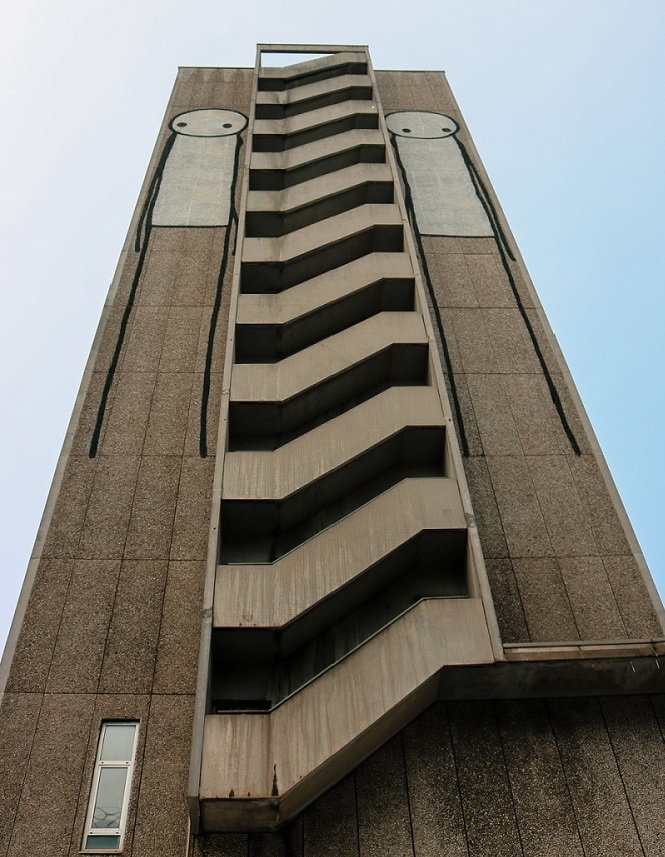
Looking at my current work, street art is one of my research projects and one of my favourite street artists is British street artist, Stik. His work has definitely inspired me to photograph the streets, the street art that appears there, the people that live in these areas, the urban environment and the relationship people have with it, as well as to capture the character of places before they are gone.  In a way I feel that photography is a means of documenting the rapid changes happening in our cities and communities, but also preserving something of them before they are gone. 

Large scale mural by Stik - Nelson Street, Bristol  ©Juanita McKenzie
Large scale mural by Stik – Nelson Street, Bristol
©Juanita McKenzie

Stik uses simple stick figures to convey meaning through simplicity – the subtle bend in an arm, or position of the dot for an eye, can convey so much expression and emotion.  He makes use of colour, line and environment to create artworks that represent the community and reflect the vulnerability of the human being while also giving hope.  His artwork has not only inspired me but has also been a source of tremendous comfort and joy to me at various times in the past few years. (This is discussed in my oral presentation which can be found here).

I feel a connection to Stik’s artwork because in my own practice, I also try to capture similar themes in my photography – the vulnerability of people in the harsh environment of the city, the inequality and contrasts that are so much a part of urban life (really a microcosm of the global inequality), but also the tremendous courage, community and spirit that arises from this. 

I hope to capture the vulnerability but also the fragile beauty in the cities, the dialogue between the opposites, the dance between old and new, the tension and friction, and the constant process of metamorphosis. 

The clip below is by Stik and discusses some aspects of his work and community: 

Visit Stik’s website for further information about his work: http://stik.org/

Oral Presentation – Positions and Practice

This oral presentation is for the MA Photography module of Positions and Practice. In the presentation I discuss my photograhic work to date, exploring my early influences, my current practice and thoughts on future projects. As this presentation forms part of my coursework within an accredited educational programme, I refer to the work of other photographers and have referenced accordingly.

Journal Reflection – Positions and Practice,Week 1

The first week of the MA Photography has been simultaneously challenging and stimulating.  The enormity of the amount of work that the MA entails has become real now and it has been challenging trying to balance the demands of full-time work, life and studies during this first week.  It has taken a little bit of time to understand the online learning environment but the available tutorials and introductory webinar have been excellent.

The opening lectures around the theme of the Global Image really got me thinking about what needs, questions and perspectives I bring to my own photography and also when viewing the work of others.  I had never really given this much thought previously so this was insightful and I realised that whether conscious of it or not, we do bring to our work a set of perspectives that shape what we choose to photograph and the context in which we do so.  This catalysed some deep internal searching that wasn’t necessarily easy but which was revealing and has brought new depth to my understanding of my photography. 

I can definitely see in my own work that I have a need to explore and discover the urban environment because it is relatively new to me and perhaps this is how I try to gain an understanding of it and find my own place within it.  I have questions about the inequality so prevalent in the world at this time and the way in which I see this occurring within the city I live in and other cities that I visit. These questions arise because on a daily basis I encounter how there are different realities and different experiences of these cities depending on the level of affluence and security of the individual. 

I question our very humanity in an urban setting that can be an extremely hostile environment and also one of isolation.  My perspective is that of social commentary in which I identify more with those communities which are being fractured and displaced, pushed to the outskirts of the cities as rapid commercial development and gentrification become the norm.  At the same time, I look for beauty in the ordinary, in the small details, in the often overlooked and forgotten things, or those we take for granted within our urban environments.  I can see that it is necessary for me to find these things as a way to balance the darker realities of urban life and inequality in Britain today. 

I learned this week that photography is both window to the world and mirror to the inner aspects of the photographer and I understood how this impacts on our position and practice as photographers, on the viewpoints we present to the world and the context in which we do so.  This is a theme I will continue to explore within my own photographic practice and when analysing the work of others.  I understood the global impact that photography has as a medium and how the photographic image is imbued with a catalytic power which makes it even more important to understand my own position and practice as a photographer.  The tremendous self-questioning this week was challenging and at times brought up emotions and deep feelings but this is exactly what will add greater depth and meaning to the way I approach my work. 

Big City, Small Human
©Juanita McKenzie

Windows and Perspectives

One of the first tasks on this course was to take a picture from a window and share this in a discussion forum with our peers as a way of introduction.  We were asked to think about what this image might say about us in terms of our situations, our photography or our interests in general. On the surface this sounds like a simple task but I found it actually opened up a lot of ideas, thoughts, and questions about the nature of windows themselves, but also the relationship to photography as a ‘window on the world’. 

Are windows a way to see out of something or into something? Are they a way that we frame something?  Do they limit the boundaries of what we see or do they expand them?  Are they mechanisms to be open or closed, creating barriers or openings?  How does this link up to photography?  I realised that all of these questions relate to our perceptions of ourselves and the world we live in and that the answers will depend on our perspectives, both conscious and unconscious, at a particular point in time. 

The changeable nature of these perspectives is also a factor and is influenced by the way we view ourselves in relation to the world, the context in which we are situated at any given time, our sense of personal boundaries, including what we choose to share with the world and that which we choose to hide.  The analogy of the window was very effective in highlighting the way in which photography reflects not only the subject but also the photographer. 

The question was raised whether photography is a window to the outer world and environment, or a mirror to the inner world of the photographer.  Looking at my own picture and those posted by my peers, I definitely came to the conclusion that photography is both window and mirror simultaneously in a dynamic shifting of balance between the two depending on the perspective and context at that time. 

It was a great discussion point and very insightful in what it revealed about us all.  In my own photograph, I had made a conscious decision to lean out of the window and photograph to a particular side.  I did this because it was my preferred view, however, what was revealed in the discussion was that I was unconsciously choosing that view because the colours, tones and textures of the buildings reminded me of my home country.  One of my favourite comments from a peer was by Andre: “I love your perspective, or should I say introspective.”  I think that really sums up what this exercise revealed to me about myself, my peers and how this relates to our photographic practice.

Lastly, this exercise has led me to looking at windows very differently and seeing the opportunities that they create for photography.  I am looking now at what windows communicate about the buildings themselves and also the inhabitants of these environments.  I am considering how windows communicate their actual purpose and context, as well as their relationship with the outer world and the inner inhabitants of these spaces.  Simultaneously, I am now aware of these aspects in relation to my own photography and the way it acts as both window and mirror. 

Windows and Perspectives
©Juanita McKenzie