It has been a busy week with preparation for the pitch that is coming up and also with me attending the Laia Abril talk, the Sugar Paper Theories Exhibition and talk with the artist Jack Latham, and also a visit to the Martin Parr Foundation. These were all very valuable in learning about how to research projects and how to work with subjects for documentary projects in ways that are ethical and collaborative.
I was very interested in how these artists approached the photographic narrative and art of story-telling, something which I would love to develop further and would be eager to learn more about in the course of my MA Photography. The other aspect of these talks that was of big interest to me was the way in which they approached the creation of a photobook and made it unique with clever design, layout and inserts. These are all techniques designed to create visual interest and subtly guide the viewer to reach their own conclusions about the topic. Very insightful talks and it was great to be able to attend.
Sugar Paper Theories is a photobook created in 2016 by photographer, Jack Latham. This body of work had previously only been exhibited at the Reykjavik Museum of Photography and the exhibition being held at The Royal Photographic Society shows extra work created especially for this exhibition. Further information about the exhibition can be found here.
The photobook and exhibition is about the most controversial and infamous Icelandic murder investigation, the Guðmundur and Geirfinnur case, or the Reykjavik Confessions. Latham’s project brought together new images with the original images, as well as using archival images and he interviewed as many of the key people involved as was possible. Latham visited the original sites from the investigation and took new images that played upon the concept of truth and reality.
The visit to the exhibition was arranged as a voluntary face to face event for the MA students and we were able to see the exhibition as well as attend a panel discussion afterwards with Jack Latham, Gisli H. Gudjonsson, Professor in Forensic Psychology, and Erla Bolladottir, one of the six convicted in this case. It was an extremely interesting discussion about the case, the concept of ‘memory distrust syndrome’ and the concepts of truth, fact, and reality.
Latham did a lot of research for this project and sourced material from local newspapers and court cases and incorporated this archival material into his project in way that plays with the concept of the photographic narrative and causes the viewer to question that the differences are betwen what is factual and what is true.
Latham worked collaboratively with Erla Bolladottir and others involved in this case, saying that when photography is used to tell as story, then the photographer should become part of the story too which shifts the photographer from being an observer to being part of something. He emphasised that photographers who do this type of photography take on an obligation to represent the people accurately and tell their story authentically.
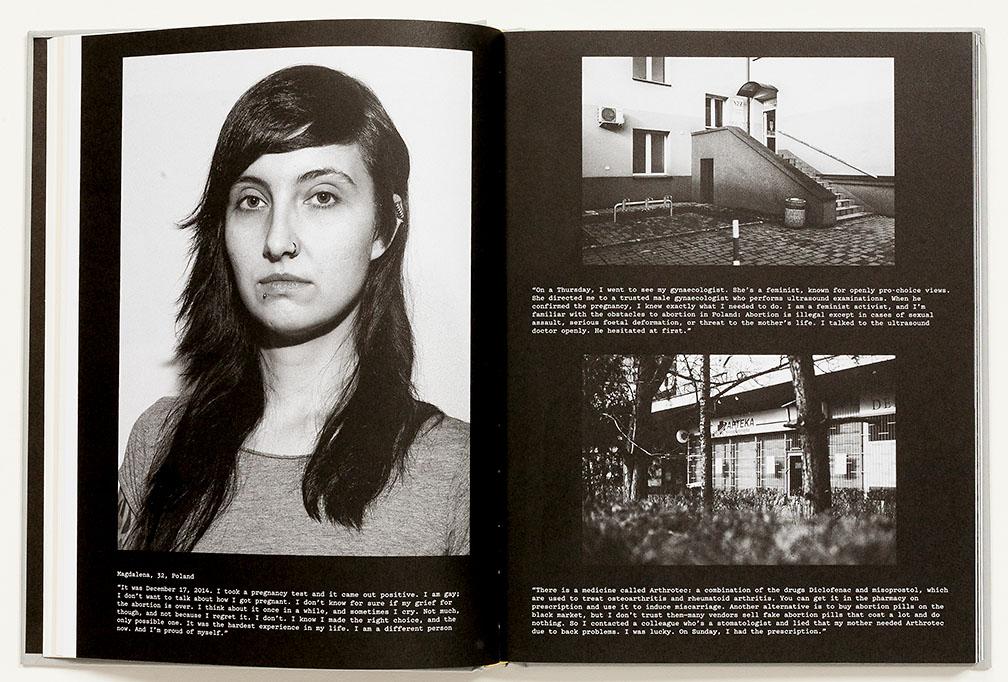
This was a fascinating talk that I attended with a fellow student on the MA Course. It was a Miniclick Photo Talk with Laia Abril, a photographer and multi-disciplinary artist who works across a number of different mediums and platforms. Her work relates to femininity but addresses the uneasy stories and realities around subjects such as gender equality. She has produced a number of books around these subjects, including A History of Misogyny: Chapter One: On Abortion (2018), which looks at abortion controls and how this appears across many different cultures, as well as showing the repercussions of these controls. Abril is currently working on A History Of Misogyny, Chapter 2: On Rape Culture.
This is not my usual choice of photography or artist, however I was quickly captivated by Abril’s own review of her work, which showed her to be a deeply insightful, sensitive and courageous human being. She spoke of how she considered her subjects and the potential danger they could be placed in through working with her. She was always aware of this every step of the way and was very protective of the woman who agreed to be her subjects. She also admitted that the danger and threat was also a potential for her as the photographer who could easily become a target around such emotional issues and readily acknowledged that she sometimes feels scared. I was very impressed with her strong sense of ethics and courage.
Abril approached these books by visualising complex situations and emotions, things that cannot be photographed. She then attempts to articulate and represent these visually. She supports her work by doing an immense amount of research and this stems from her journalism background. She said that reading and text research was central to her projects and that this is valuable when as a photographer you are located geographically far away from your subjects. Abril said that her process was one of accumulating information and then finding her position in it.
Her goal, she says, is usually a book and her aim is to make sure the viewer enjoys it from start to finish, so this can be difficult when presenting uncomfortable issues such as abortion. This has meant she has had to become very creative in how she designs a book or presents an exhibition. Abril focuses on how she groups images together, integrates text into the artwork, uses clever inserts and includes interesting representational images. She makes use of small, simple images because she believes it is more powerful for people to make the connections themselves.
Abril is always incredibly sensitive towards the women who are her subjects and says that it is through building a connection that they will talk to her, when they feel comfortable and safe. She cautions that it is important to be aware of how a subject experiences working with a photographer as we do not know the impact we have on them emotionally and psychologically. As photographers we must always consider how we portray our subjects, but also how we interact with them and what the impact on them will be.
Although, this is not my particular style of photography, I learned a tremendous amount from this discussion and would be apply to apply this in the future if I begin to work with subjects as part of social documentary projects.
This week we discussed the Fine Art market and how it has only been relatively recently that photography came to be seen as art. Unfortunately, it still sells at only a fraction of the price of other art, such as paintings. Although I don’t necessarily agree with this difference in pricing, it is likely because photographs can be reprinted and large editions of a print can be sold.
Fine art is a relatively small market as it is, and there are not many galleries that show photography. If they do, galleries will choose to represent only a small number of artists, making it a very limited market to break into. Nonetheless, there is a potential market out there, it is just about reaching it and getting the initial recognition.
We discussed that there are two types of fine art market:
Primary market – artwork is sold through a gallery or sold for the first time by the photographer.
Secondary market – the artwork is sold again or sold through an auction.
Our module leader, Anna, emphasised that networking is very significant in breaking into the market as it is often through introductions that work becomes visible. She suggested that in order to get our work and portfolios seen it would be a good idea to enter prestigious competitions, get portfolio reviews done, speak to producers and photo-editors at fairs, and try to get work into good magazines and group fairs.
As a group we arranged a very quick meeting to review the feedback we had received from our tutors, Anna and Jesse. Based on their feedback, we decided to adjust our campaign by incorporating the video and photographic stills. At the very last minute, we also came up with a way to integrate into our campaign the concept of having a ‘workshop’ and decided we could illustrate this effectively in our pitch by including a ‘sample Instagram page’ illustrating the workshop concept.
We agreed that we want to emphasise to Headway East London that the idea of having a workshop would be so that they have full control of creating the content of the campaign alongside us providing the technical and design skills required to create our videos and images. We want the members to at the centre of the campaign, co-creating it with us, as this would instil a sense of community, collaboration, accomplishment, authenticity, and inclusion.
I am particularly excited about this because the creative collaboration is exactly what makes our campaign ethical. In the discussion I identified certain key points that I will put together in a short blurb to be used within our pitch. We have agreed that we will work with the video that we have already from Oliver, use the final storyboard created by Bloo, and add any other creative content that we can and which is relevant prior to the pitch. Bloo is putting the final presentation together and we will have our final draft ready a week prior to pitch date.
I have noticed that there seems to be a little bit of strain within the group now as we approach the final weeks of this project. We are still working collaboratively but at various times we have each been pulled away from the project due to other demands. Occasionally I sense there is frustration building but our group always seems to remain positive and respectful towards each other. I think we have done exceptionally well with our communication and I am particularly proud of the way group members have stepped up to stand in when others are not available. We have done very well working together this far.



 Journey Through the Lens