In January 2020, I visited the Tate Modern to explore the Ed Ruscha collection on display in their Artist Rooms. As an avid fan of Ruscha’s work I was eager to see this display encompassing a selection of his works spanning across his entire career and including his photographic books, photographic series and some of his iconic paintings.
Text has always been an integral part of Ruscha’s work with his clever use of typography and seemingly random use of isolated words and phrases. This was the first time that I have seen his paintings, all of which incorporated interesting textures and words or phrases superimposed on landscapes or sometimes on plain backgrounds.
Ruscha’s early career was as a graphic artist and it is clear that he draws upon these techniques to create his art, cleverly working with different styles, fonts and layouts both on canvas and within is photographic books. Ruscha’s background in graphic art also influences his use of language and text as he frequently draws upon the language of advertising and adverts. This is quite obvious in works such as the one below:
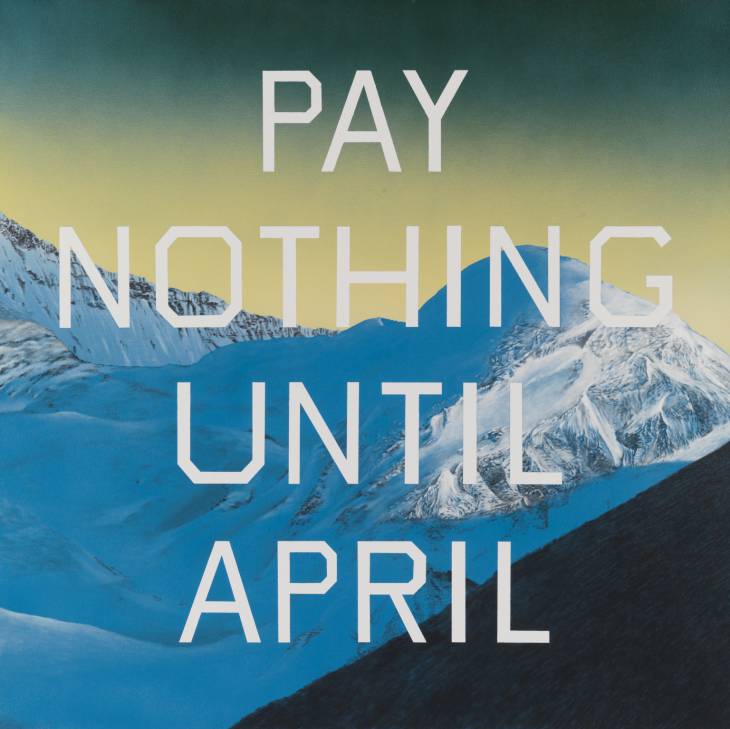
Edward Ruscha, Pay Nothing Until April 2003 . ARTIST ROOMS Tate and National Galleries of Scotland . © Ed Ruscha
The same language of advertising also appears in his photographic books with titles such as Some Los Angeles Apartments (1965) and Real Estate Opportunities (1970). Furthermore, this is a language that appears in Ruscha’s images and artwork not only as words, but also as a visual language through objects, signs and various other symbols.
Ruscha was fascinated by sign painters and he was inspired by the colourful billboard signs he saw all around him in Los Angeles. In a fascinating interview with Tate Modern’s Director, Frances Morris, he also refers to speeches made by people such as Mohammed Ali and authors such as Gertrude Stein, people who had a colourful and descriptive way with words. Ruscha describes these as being early influences that were part of his environment and his history and which later became incorporated into his work.

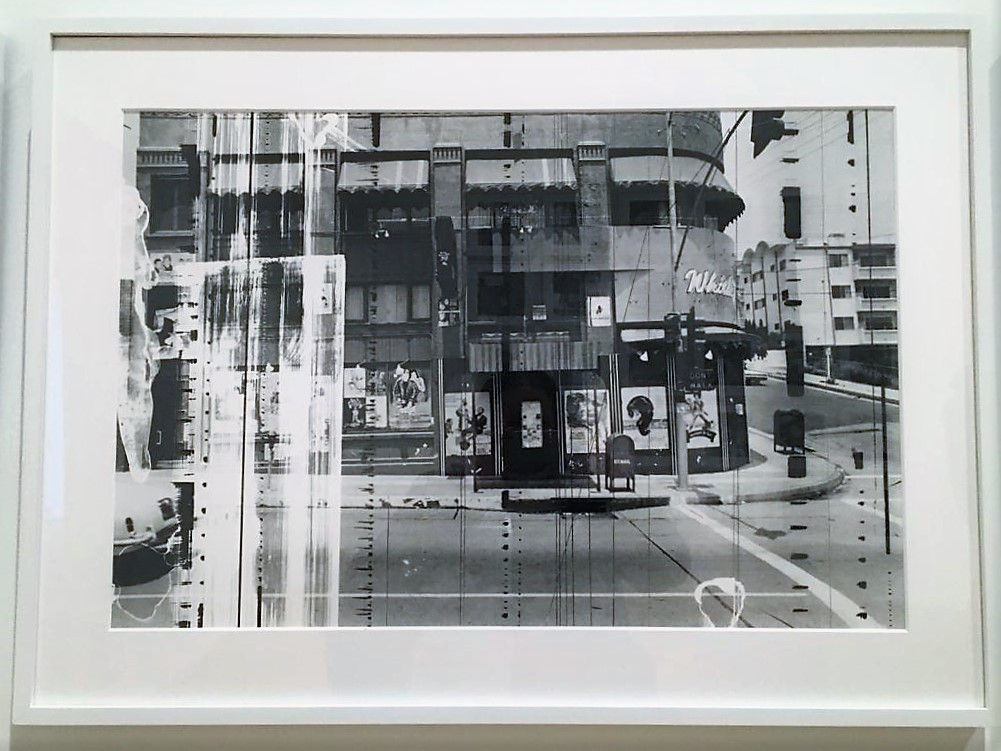
Ruscha is a talented conceptual artist and seeing his paintings gave me a greater understanding of his photographic works as it emphasised how he approaches his subject matter as a conceptual artist influenced by his earlier career as a graphic artist in the advertising industry. He incorporates text into his paintings in ways that are often out of context or at odds with the image in order to emphasise stereotypes and cultural conditioning. In his photographic books and series, this influences his choice of subject matter, the clever use of repetition of a theme or concept, his unusual book titles, and the use of very minimal words in his books, as well as the layout of his images.

His use of everyday words and phrases combined with images of the banal have create Ruscha’s iconic conceptual artworks. The image below is inspired by British writer J.G. Ballard whom Ruscha greatly admired. The text is taken from Ballard’s 1975 novel, High-Rise, a dystopian novel that revolves around a modern residential tower block and the process of social breakdown which occurs in this setting. The text appears at odds with the tranquil landscape it is superimposed upon, creating a contrast between two very different landscapes and states of being. Interestingly, J G Ballard, once said of Ed Ruscha: “The coolest gaze in American art.” (Ed Ruscha: ‘There’s room for saying things in bright shiny colours’, 2020)

Ruscha finds inspiration in his everyday environment and in the banal, transforming it into art and offering a form of commentary on American life and politics, stereotypes, consumerism and mass media imagery. He draws upon the topography, architecture, and mundane objects of his environment, in particular his home town Los Angeles and Hollywood and attempts to record what he sees. He draws consistently upon the urban landscape, as well as the typical cultural brands, icons, signs and language that form part of the ‘American Dream, for example cinema, the automobile culture, billboards.
For me there is a fascination with Ruscha’s focus on the icons of the ‘American Dream’ as there is something alluring about the concept of the American automobile culture and the classic road trip that is perhaps resonant with my own childhood experiences and landscapes growing up in South Africa. The similarity is in the wide open roads and constantly changing landscapes, the isolated petrol stations along the way, as well a the fascinating signposts, local icons and well known brands. The large American cities and icons were always present in the films of my teenage years and the Hollywood influence feels always familiar as a result. Ruscha’s interest in the urban landscape and it’s banal details, inspire much of my current photographic practice as I now find meaning in the urban landscape in which I find myself and which forms the narrative of my daily life.
References:
- Tate. 2020. ARTIST ROOMS: Ed Ruscha – Display At Tate Modern | Tate. [online] Available at: <https://www.tate.org.uk/visit/tate-modern/display/ed-ruscha> [Accessed 22 June 2020].
- Tate. 2020. Artist’s Talk: Ed Ruscha – Talk At Tate Modern | Tate. [online] Available at: <https://www.tate.org.uk/whats-on/tate-modern/talk/artists-talk-ed-ruscha> [Accessed 22 June 2020].
- the Guardian. 2020. Ed Ruscha: ‘There’s Room For Saying Things In Bright Shiny Colours’. [online] Available at: <https://www.theguardian.com/artanddesign/2010/sep/12/ed-ruscha-obama-pop-art> [Accessed 22 June 2020].
 Journey Through the Lens
One thought on “Art Display: Ed Ruscha – Artist Rooms, Tate Modern”